

Executive Summary
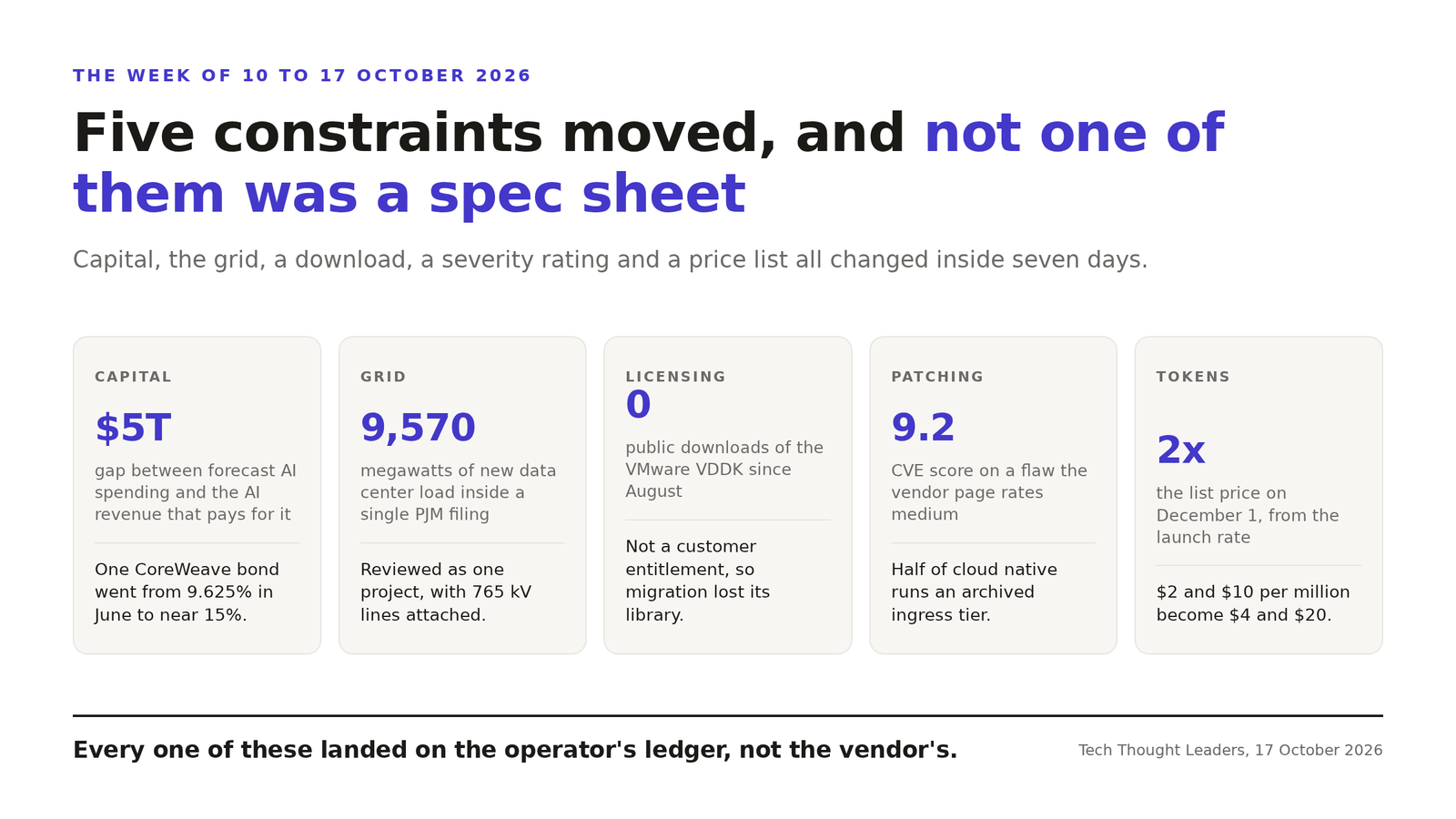
Five moves landed inside seven days and not one of them changed a specification. Financing a GPU fleet got more expensive. A ten gigawatt campus asked a grid operator for a bespoke schedule. Broadcom kept its virtual disk library away from the tools that migrate virtual machines. NGINX shipped a fix rated medium for a flaw scored 9.2. Google wrote an expiry date into a model price.
The pattern sits in who carries the downside. Every one of those moves hands residual risk to the buyer, and every one arrives with a number the buyer can budget against. The verdict is that the hard engineering now looks like the reliable part. Capital, interconnection and license terms set the schedule and the invoice, and none of them respond to better software. Operators who model the second number will spend less than operators who plan against today’s page.
For two years the argument about AI capacity was about supply. This week it was about price. Everything that moved carried a date or a dollar sign, and almost none of it landed on the vendor.
The bond market priced the buildout before the spreadsheets did
Gartner put the arithmetic together in September, and The Register carried it on Wednesday. Close to one trillion dollars of AI infrastructure spending in 2026, then another six trillion through 2030. Covering that and its financing while clearing a twelve percent return needs eight and a half trillion dollars of AI revenue. Gartner’s own revenue forecast is three and a half trillion.
The market moved first. The debt-heavy names sold off on Wednesday, with CoreWeave down about fifteen percent after a hotter inflation print. A CoreWeave bond sold in June at 9.625 percent now trades near fifteen. Gartner expects four trillion dollars of write-downs by 2032 and eighty percent of the neoclouds gone as independent companies by 2030.
Google moved the same idea to the consumption side on October 13. Gemini 4 Argon costs two dollars per million input tokens and ten per million output through November 30. On December 1 they become four and twenty, per the published rate card. Argon also bills reasoning tokens at the output rate inside agent loops. Any cost model built on the November figure expires with it.
A substation now sets the delivery date, not the purchase order
PJM filed a project agreement with federal regulators on October 13 under Docket ER27-126-000. It covers about 9,570 megawatts of new data center demand and roughly 10,170 megawatts of generation, plus a 765 kilovolt substation and three new 765 kilovolt lines.
The site is the PORTS-Pike Technology Campus on a decommissioned uranium enrichment plant. SB Energy develops it, OpenAI is the tenant under twenty-year leases, and Nvidia agreed in August to backstop up to 105 billion dollars of financing for an initial 4.25 gigawatts of IT load.
The filing matters because it moves the binding constraint. A GPU cluster can be racked in months. A 765 kilovolt line cannot. Ohio’s State Agreement Approach lets a state ask for transmission planning against a policy goal instead of a first-come queue. The queue did not vanish. It became one negotiated proceeding, and most operators will never get one.
Two vendors moved the work onto your side of the table
Broadcom removed the public VMware Virtual Disk Development Kit downloads in late August. That library is how Nutanix Move read source disks out of vSphere, so teams beginning a migration hit a dead link mid-wave. Broadcom told The Register the kit stays available to select partners for backup and recovery, and that it is not a customer entitlement.
Nutanix Move 6.3.3, released October 12, drops the dependency with DirectPath. It attaches snapshots of the source disks and copies the data across, so there is no library to fetch. The catch is where it runs. DirectPath deploys the appliance inside the source VMware environment, and 6.3.3 installs as a fresh appliance only. An appliance partway through migrations should finish where it sits.
NGINX 1.31.7 and 1.30.6 shipped on October 14, and the loudest fix, CVE-2026-15176, scores 9.2 under CVSS 4.0 against a vendor advisory page that rates it medium. The trigger is a configuration shape, an alias block paired with rewrite, and the realistic outcome is a worker restart. In a shared ingress tier one crash loop in front of every service is an outage.
Reach is the real problem. Ingress NGINX was archived in March 2026 and takes no patches for flaws reported after its end of life, while roughly half of cloud native environments still rely on it. Upstream shipped a fixed build. Whether it reaches your edge depends on who assembles the image.
Three questions are worth putting to your own stack. What is the second number in each contract, the December rate rather than the launch rate. Who builds the proxy that terminates your traffic. And how many megawatts can you energize before the queue clears. The week answered none of them, and made each one billable.
Related reading. Broadcom built HyperArmor because patching the hypervisor was too slow. Kubernetes 1.34 goes dark on October 27. And QumulusAI is billing seven megawatts of Blackwell capacity ten weeks after signing.
Get the next one before it is old news
Independent analysis of cloud-native infrastructure, Kubernetes and data center economics. No vendor spin.