

Executive Summary
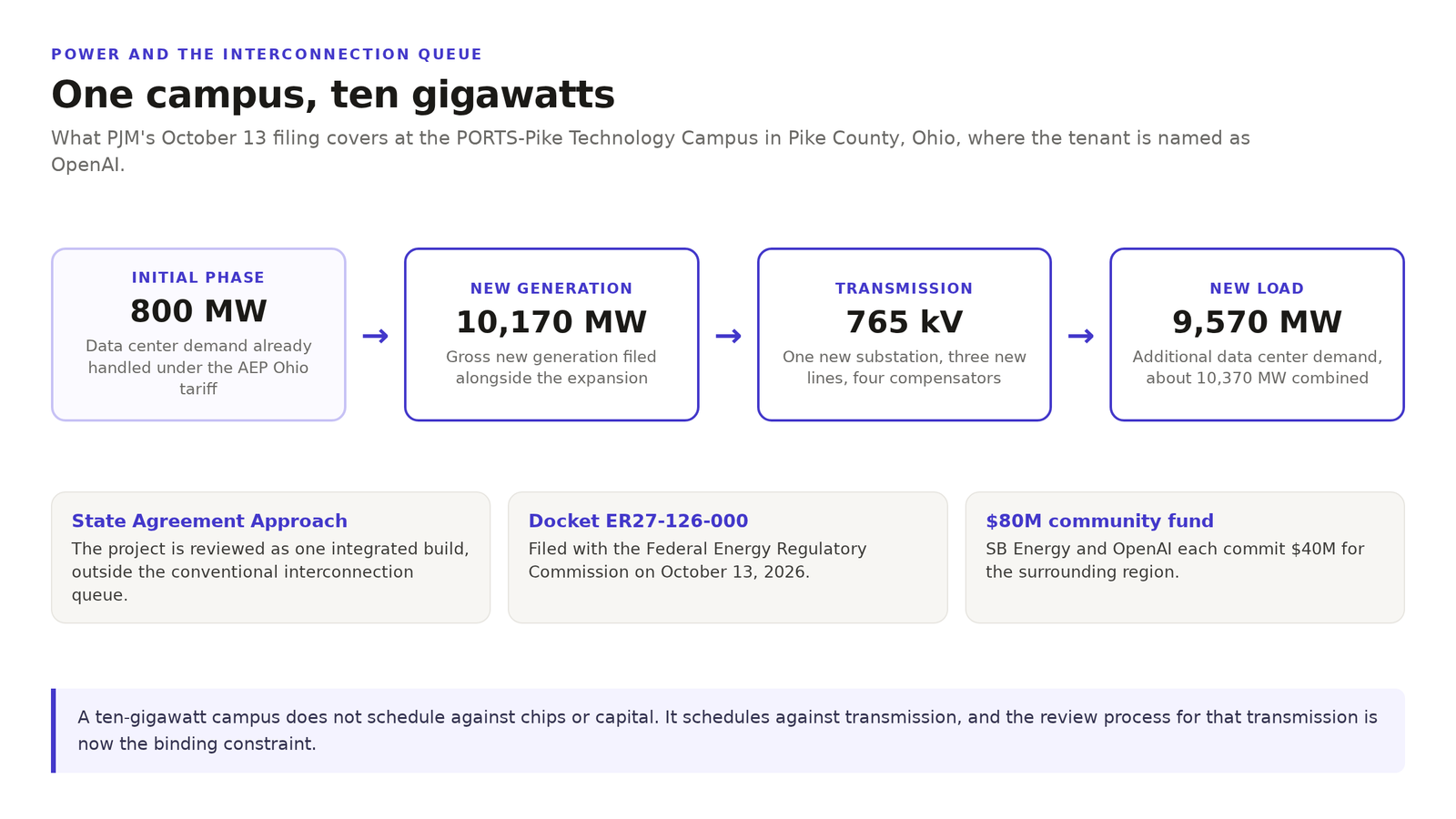
The largest AI campus in Ohio will be reviewed as a single project rather than through the queue that every other large load joins. PJM filed the agreement with federal regulators on October 13, covering roughly 9,570 megawatts of new data center demand, about 10,170 megawatts of new generation, and a 765-kilovolt transmission build at the former Portsmouth Gaseous Diffusion Plant in Pike County. SB Energy, a SoftBank affiliate, is the developer. OpenAI is named as the tenant.
The filing matters because it moves the binding constraint. For a campus this size, the schedule is set by transmission and interconnection, not by chips or capital. PJM runs the review under Ohio’s State Agreement Approach, which lets a state request transmission planning for a policy goal instead of sending each piece through the conventional queue. The week’s AI selloff was about money. This filing is about physics, and physics is the harder gate.
The hardest variable in an AI buildout is not the accelerator order. It is how many megawatts you can energize, and how soon. PJM’s filing makes the data center interconnection problem concrete at a scale the grid has rarely seen.
One filing covers ten gigawatts of load and generation together
PJM Interconnection filed the agreement with the Federal Energy Regulatory Commission on October 13, under Docket ER27-126-000, as reported this week. Instead of routing new generation through its conventional interconnection queue, the filing sets up a project-specific review that treats the data center expansion, the generation that feeds it, and the transmission that connects them as one integrated project.
The numbers are large. The filing covers roughly 9,570 megawatts of additional data center demand and about 10,170 megawatts of gross new generation, beyond an initial 800-megawatt phase already handled under AEP Ohio’s data center tariff. Combined, the two phases represent about 10,370 megawatts of demand. The transmission schedule lists a new 765-kilovolt substation, three new 765-kilovolt lines, and four static synchronous compensators to hold voltage steady.
The queue, not the accelerator order, sets the schedule
A GPU cluster can be ordered and racked in months. A 765-kilovolt line cannot. The steel, the transformers, and the studies that clear them all run on their own clock, and a new large load normally waits behind every other project in the interconnection queue. That queue has been the bottleneck on new AI capacity for two years, and it is why operators that already hold interconnection rights have become valuable partners.
Ohio’s State Agreement Approach is the escape hatch. It lets a state ask the regional grid operator to plan transmission for a public policy objective, so the campus can be studied as one build alongside the generation and lines that serve it. It does not remove the work. It moves the work, from a first-come queue to a single negotiated proceeding.
The project behind the filing is the PORTS-Pike Technology Campus, on a decommissioned uranium enrichment site. SB Energy, a SoftBank affiliate, is the developer. In August, NVIDIA agreed to back up to 105 billion dollars of financing for the campus, covering an initial 4.25 gigawatts of IT load with an option on about 3.75 more, with OpenAI as the tenant under 20-year leases. SB Energy and SoftBank committed to build at least 10 gigawatts of generation and to invest at least 4.2 billion dollars in regional grid infrastructure.
Three questions the filing forces on any large campus
Ask how many megawatts you can energize, and when, before you commit to a multi-year accelerator order. Ask whether your power sits behind an interconnection that already exists or behind a queue that has not cleared. Ask who pays for the transmission, because the cost of connecting a large load to the grid is shifting toward the load itself. The campus in Ohio answers the schedule question with a negotiated agreement. Most operators will not get one.
Related reading. For how the AI rack itself is being localized in India, see our look at Adani and Jabil building the rack. For the memory side of the same buildout, see HBM Cannot Hold the Context Window.
Get the next one before it is old news
Independent analysis of cloud-native infrastructure, Kubernetes and data center economics. No vendor spin.