


Executive Summary
QumulusAI signed a $71.9 million Blackwell agreement in August 2026 and was billing on every GPU ten weeks later. That speed is the story. In a market where AI capacity is usually sold long before it is energized, a neocloud turning a contract into invoices in ten weeks says more about demand than any forecast.
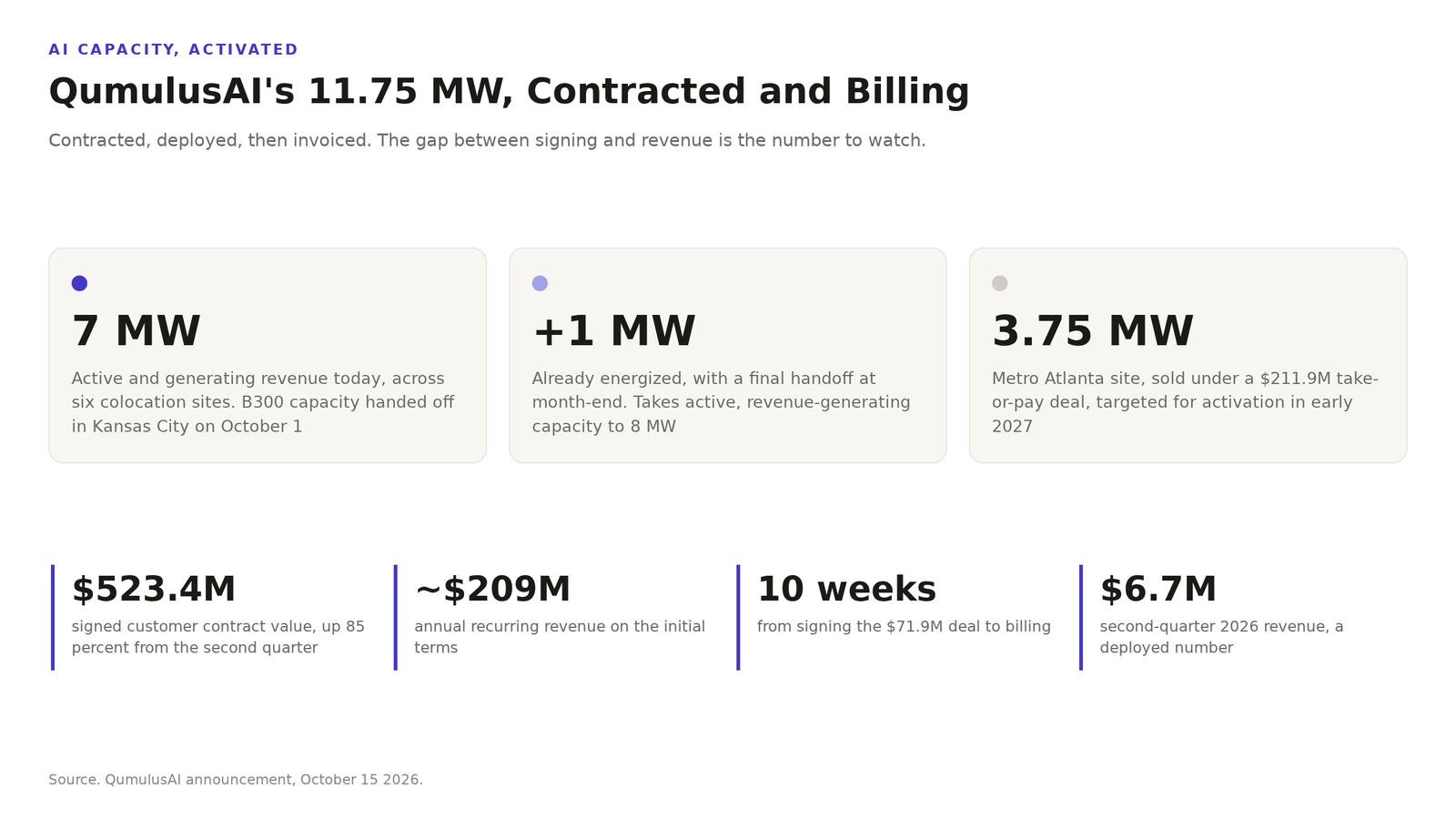
The company has 11.75 megawatts of contracted capacity across six colocation sites. Seven megawatts are active and generating revenue today. One more is energized and handing off at month-end, and 3.75 megawatts in metro Atlanta are sold under a $211.9 million take-or-pay deal for early 2027. Signed customer contracts have reached $523.4 million, up 85 percent from the second quarter. The AI buildout is now metered in megawatts, and the operators who turn power into billing fastest write the terms.
Second-quarter revenue of $6.7 million looked small next to half a billion dollars in signed contracts. The gap is not a problem. It is the shape of the AI capacity business.
QumulusAI is an AI neocloud provider built for GPU compute, and it sells capacity under long contracts before the hardware is fully live. The company announced on October 15 that it had completed the final B300 handoff under a $71.9 million, three-year agreement, putting every GPU in that deal into production and billing ten weeks after signing.
The mechanics matter more than the headline. Of its 11.75 megawatts of contracted capacity, 7 megawatts are active and generating revenue today. A further megawatt is already energized and scheduled for final handoff at the end of October, which takes active capacity to 8 megawatts. The remaining 3.75 megawatts sit at a metro Atlanta site, sold last month under a $211.9 million take-or-pay agreement and targeted for early 2027.
The number that matters is megawatts billing, not megawatts announced
QumulusAI closed the second quarter with $6.7 million in revenue. Its CEO, Michael Maniscalco, framed that number plainly. “Our second-quarter revenue reflected what we had deployed, not what we had sold,” he said. Revenue follows handoff, and handoffs follow power.
Signed customer contract value has reached $523.4 million, up 85 percent from the $282.5 million reported with the second quarter. Combined, the agreements work out to about $209 million in annual recurring revenue on their initial terms. That is the number an operator gets judged on, and it measures capacity in service rather than capacity on a slide.
Revenue follows handoff, and handoff is a power problem
The one-megawatt gap between energized and handed off is the whole business in miniature. Power arrives before the customer does, and the invoice starts when the rack is ready. QumulusAI spread its footprint across six colocation sites, which spreads the procurement risk of power and cooling across more than one landlord.
It also ran the capacity demand-led and inference-first, placing it near customer demand instead of building one giant campus. The Atlanta capacity was sold before it was energized, which is the clearest signal of how tight the market is. The same customer behind the $71.9 million deal signed a second agreement for Atlanta worth $211.9 million, bringing its own commitments to $283.8 million.
What a signed megawatt tells you about the AI buildout
The hyperscalers sign gigawatts. The neoclouds sign megawatts and then have to deliver them. That gap is where the honest reporting lives. A ten-week path from contract to billing is fast for this industry, and it only holds if the power is already there and the sites can ship hardware.
The pattern is consistent across the market. Capacity gets pre-sold, revenue trails deployment, and the balance sheet runs ahead of the grid. Watch the spread between signed megawatts and billing megawatts at every one of these operators. QumulusAI reports 11.75 signed and 7 billing. That ratio is the health metric to track.
Three questions for anyone weighing capacity contracts. How much of what you signed is actually energized? What is the operator’s record on the gap between signing and billing? And does the contract carry a take-or-pay floor, or does the price float with the market?
Related reading. The AI buildout just met its cost of capital, and the PJM interconnection queue is now a ten-gigawatt conversation. Both frames matter here, and we covered them in the cost of capital piece and the PJM analysis.
Sources. Figures come from the QumulusAI announcement on October 15. Product details for the NVIDIA DGX B300 come from NVIDIA, and company background comes from QumulusAI.
Get the next one before it is old news
Independent analysis of cloud-native infrastructure, Kubernetes and data center economics. No vendor spin.
[…] The gap between signed megawatts and billing megawatts is the metric to watch. Read the full analysis here. […]
[…] because patching the hypervisor was too slow. Kubernetes 1.34 goes dark on October 27. And QumulusAI is billing seven megawatts of Blackwell capacity ten weeks after […]