
Executive Summary
Nvidia is buying its way into the inference silicon it competes with. The Information reported on October 8 that Nvidia plans to invest in d-Matrix, a startup whose accelerators are built to run trained models faster and cheaper than a general-purpose GPU. Neither company has confirmed the investment or its terms.
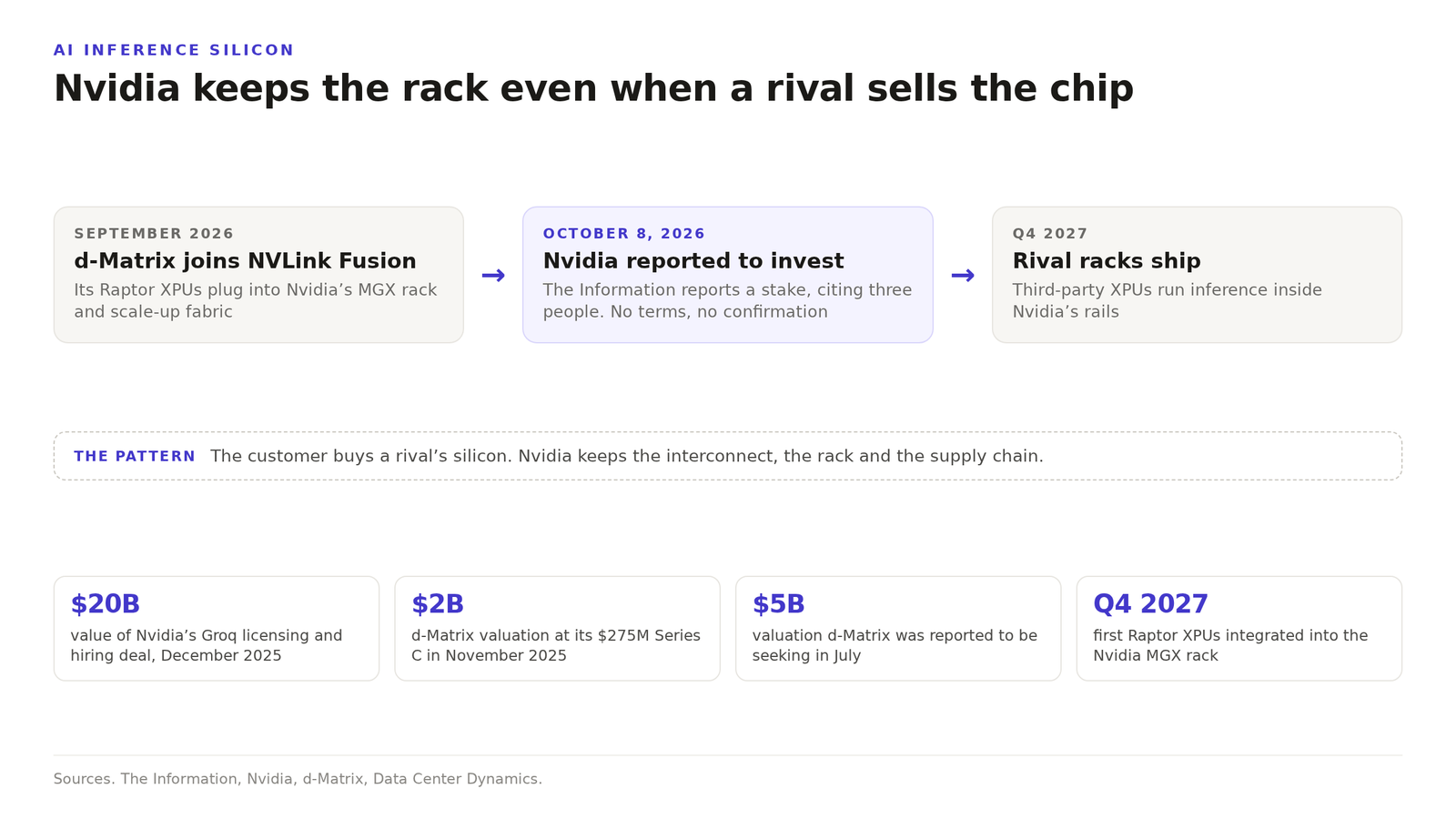
The reported stake follows a September deal that put d-Matrix’s Raptor XPUs inside Nvidia’s MGX rack over the NVLink Fusion interconnect. That last part is the story. Instead of beating a specialized inference challenger, Nvidia makes it a tenant of its rack, its switches and its supply chain. Amazon is doing the same with Trainium4. The customer gets more accelerator choice, and Nvidia keeps the rails the choice runs on.
The most valuable chipmaker on the planet is reported to be buying a slice of a company selling chips built to replace its own. d-Matrix does not build training GPUs. It builds inference accelerators, the silicon that answers a model’s requests after training. Its Corsair platform uses a memory-centric design, and the following chip, Raptor, is built to slot into somebody else’s rack.
That somebody is Nvidia. In September, d-Matrix said its Raptor XPUs will support NVLink Fusion, the interconnect that links a non-Nvidia accelerator to Nvidia’s scale-up fabric, and plug into the MGX rack design used across its AI systems. The first integrated systems are expected in the fourth quarter of 2027, per the company release.
The chip is a rival. The rack is not.
The Nvidia d-Matrix investment report adds equity to a relationship that was already public. That is the part worth watching. The accelerator competes with Nvidia. The rack it sits in does not.
Nvidia has run a version of this move. In December 2025 it agreed to license technology from Groq, an inference-chip startup, and hire its engineers in a transaction reported at $20 billion, rather than buying the company. The rival silicon kept shipping. It simply shipped with Nvidia inside the room.
A minority stake in d-Matrix is the lighter form of the same play. Nvidia spends less, owns less and gets the same thing, a place at the table when the next class of inference silicon gets defined. d-Matrix was valued at $2 billion in November 2025 and was reported in July to be seeking a $5 billion valuation. Distribution is the hardest problem for any Nvidia challenger. Nvidia is selling it.
What it changes for the operator
For a team buying inference capacity, the equity is not the headline. The rack is. Disaggregated serving already splits one request across different silicon, prefill on one pool and decode on another. d-Matrix sells into that split, and its pitch is the memory side of it. The company claims Raptor delivers up to 10 times the performance, three times lower cost and three to five times better energy efficiency than GPU-based systems. Those are vendor figures, not independent results.
Inference is where the money moves first. Training is a smaller, lumpier market, and Nvidia already owns most of it. Serving runs continuously, on the widest margin, and it is memory-bound. Decode re-reads the model weights for every token, so bandwidth, not arithmetic, sets the ceiling. That is the opening d-Matrix and a dozen funded challengers are built against, and the reason an incumbent would rather own the rack than win the chip outright.
The operator question is narrower. If a rival accelerator runs inside only one vendor’s rack architecture, what did you actually diversify? You gained a chip and kept the interconnect, the networking and the supply chain.
Three questions to run against your own fleet. Would you buy an accelerator that runs inside only one vendor’s rack? What happens to your serving cost if that vendor owns part of the chip supplier? And how much of your inference bill is tied to the fabric rather than the silicon?
Related reading. We covered how Arista put open Ethernet inside the rack where Nvidia’s lock-in lives, and why Nvidia stopped selling GPUs and started selling the rack.
Get the next one before it is old news
Independent analysis of cloud-native infrastructure, Kubernetes and data center economics. No vendor spin.