


Executive Summary
Broadcom shipped VMware HyperArmor on October 13 to protect the ESX hypervisor inside VMware Cloud Foundation. It works three ways. Host-layer virtual patching blocks a malicious action before a flaw can run, with no reboot and no software upgrade. Positive security guardrails set a baseline and block any script or executable the host has not run before. And a time-based one-time password is added to the SSH login, so a stolen root password is not enough. Support starts at ESX 8.x.
The verdict sits in the vendor’s own framing. Broadcom says attacks now arrive at machine speed and that reactive detection and patching are no longer enough. That is an admission that the maintenance window, not the fix, was the weak point. Virtual patching narrows the exposure but does not remove the flaw, and the official patch remains the remedy. For operators, HyperArmor buys time to patch on a schedule instead of under pressure.
Broadcom introduced VMware HyperArmor on October 13, a host-level shield for the ESX hypervisor inside VMware Cloud Foundation. It is aimed at the gap between a flaw going public and every host getting patched, and it lets a host defend itself without the reboot that gap used to require.
The pressure behind the release is the part worth reading closely. Prashanth Shenoy, a Broadcom vice president, told The Register that VMware moved to a monthly update rhythm partly because of flaws its own AI tooling surfaces, and that customers were struggling with the pace well before that. His description of the problem was blunt. “You don’t have enough time to triage a single alert, and you can’t apply patches at machine speed.”
The shield blocks the exploit before the patch exists
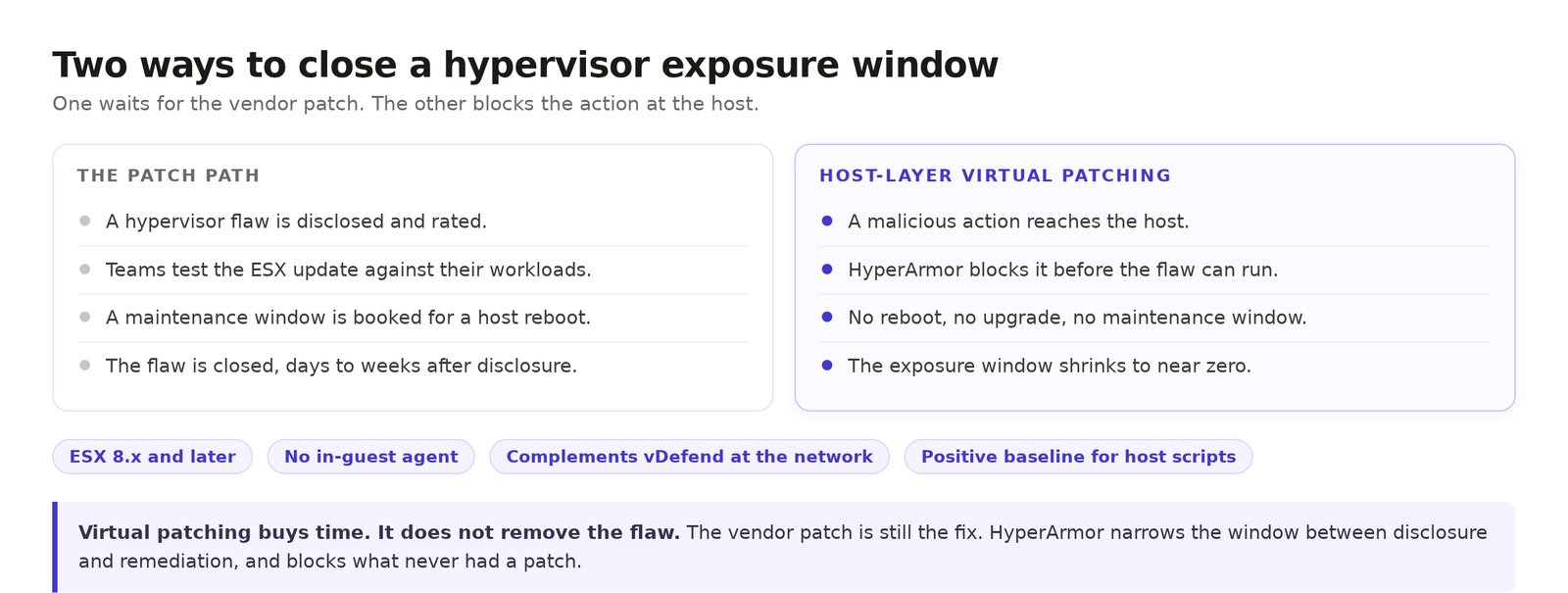
HyperArmor adds host-layer virtual patching to the ESX component of VMware Cloud Foundation. The mechanism is direct. Instead of letting a known-bad action reach a known flaw, the host detects and blocks the malicious action as it happens. Broadcom says the mitigation needs no host reboot and no software upgrade.
That matters because a hypervisor sits under everything else on a host. Rebooting it means stalling every workload above it. When the mitigation is a policy that runs in place, security teams can react to a disclosure in hours rather than waiting for the next maintenance window.
It mirrors what Broadcom already sells at the network layer. VMware vDefend does virtual patching for VCF traffic, and the company positions HyperArmor as the same idea pushed down to the hypervisor itself. Broadcom lists the patches it ships on its security advisories page, and CISA tracks the flaws already under exploitation.
Guardrails and a second factor close the credential path
The second half of the product is a positive security baseline. An ESX host runs a small, fixed set of processes, so HyperArmor inventories the scripts already on the host and allows them. Anything else is blocked unless an administrator approves it. Broadcom says there are no agents inside guest virtual machines.
This flips the detection model. Most endpoint tools try to recognise what is bad, which fails against anything new. HyperArmor tries to recognise what is good and blocks the rest. That is a stronger default for a host whose job never changes, and it means a stolen credential is not automatically a breach, because a valid login still cannot run a binary the host has never seen.
The third feature targets the stolen-credential path directly. HyperArmor adds multi-factor authentication inside the ESX SSH login, so a session needs the standard password and a time-based one-time password tied to a separate identity. A leaked root password alone no longer reaches the command line.
A time-buyer is not a replacement for the fix
Broadcom calls the feature a complement, and the wording is careful. Virtual patching does not remove the underlying flaw. It blocks the action that would exploit it, which narrows the window but leaves the vulnerable code in place. The official patch is still the fix, and Broadcom frames HyperArmor as what lets IT apply that patch on its own schedule instead of a scramble.
That framing is the story. Broadcom runs one of the largest hypervisor installed bases in the world, and its chief product officer for the division, Paul Turner, says attacks have grown in volume, velocity and variety. When the vendor of the hypervisor says patching cannot keep up, the honest reading is that the maintenance window was always the weak point, not the patch itself.
Eric Chen, a Broadcom distinguished engineer, put the same limit in plainer words. “We always still want you to patch; that is the right thing to do, but this basically buys you time.” HyperArmor is a discrete add-on to Cloud Foundation, and Broadcom’s Symantec and Carbon Black teams built it rather than the virtualization group.
Three questions for any team running ESX. Does your change process treat patching as the only defense? Can you list what is allowed to run on a host today? And if a hypervisor flaw landed tomorrow, could you mitigate it without a reboot?
Related reading. Broadcom and Intel say money, not chips, is the AI bottleneck now. A Dell storage release shipped a fix that still carried a flaw. And the GhostAction worm showed why rotating one secret is not enough.
Get the next one before it is old news
Independent analysis of cloud-native infrastructure, Kubernetes and data center economics. No vendor spin.
[…] Read the full analysis. Broadcom Built HyperArmor Because Patching the Hypervisor Is Too Slow […]