

Executive Summary
Amazon is negotiating to buy Decart for a reported $7 billion. The asset is the Decart Optimization Stack, software that lets a model run on Nvidia GPUs, Google TPUs or AWS Trainium without a rewrite. That is a sales tool for Amazon’s own silicon, and the reported price is what Amazon thinks the tool is worth.
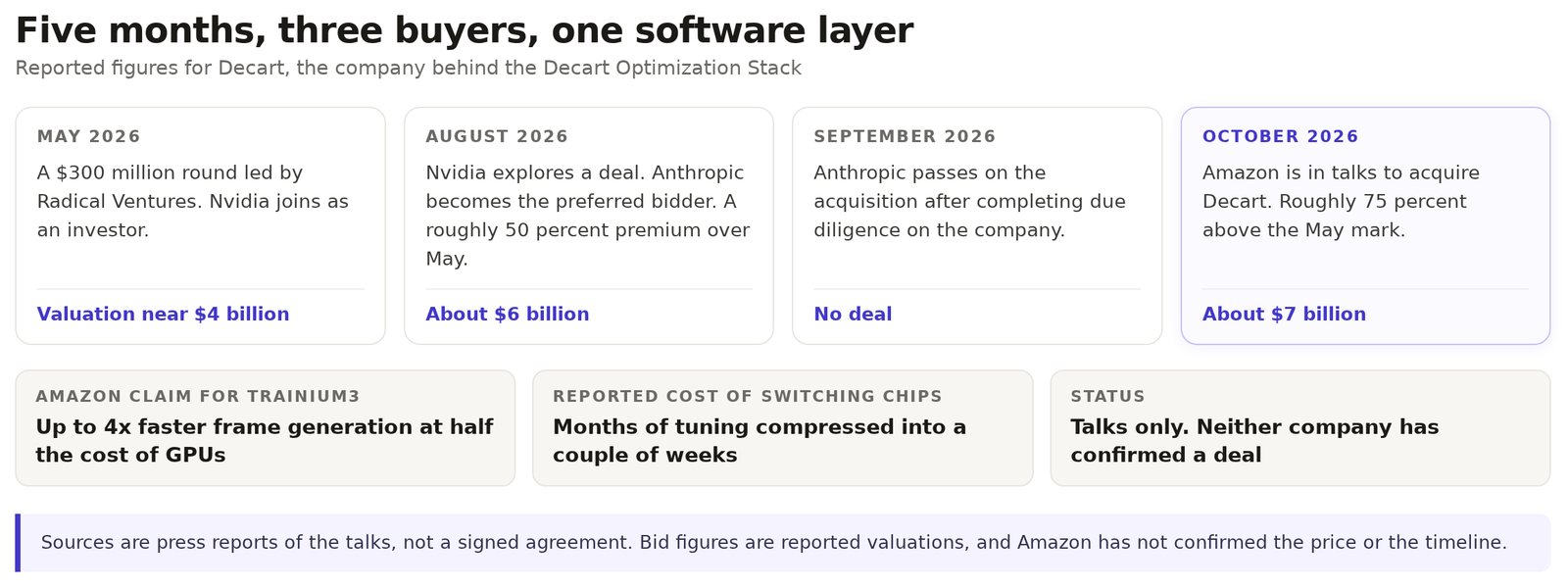
Three buyers examined the same software inside five months. Nvidia invested in May at a valuation near $4 billion. Anthropic negotiated at roughly $6 billion in August and walked away in September. Amazon’s reported number sits about 75 percent above the May mark. None of them is paying for the video models. They are paying for the cost of leaving Nvidia.
The interesting number in Amazon’s reported approach to Decart is not the $7 billion. It is that three buyers examined one piece of software in five months and two of them walked away. The pattern says the value sits in AI chip portability, and in the price of leaving Nvidia behind.
The product is a shorter migration, not a faster chip
A model built for Nvidia’s software stack does not run on Trainium or a TPU as written. Kernels get rewritten, memory layouts change, and the tuning that produced the original throughput does not carry over. Decart’s own product targets that gap, and the reported effect is a migration that used to take months of engineering compressed into a couple of weeks.
Amazon already knows the company. AWS gave Decart early access to Trainium3 in 2025, and Amazon became a strategic customer in May under a commercial agreement and a joint go to market plan. Amazon’s own numbers for the chip claim up to 4x faster frame generation at half the cost of GPUs, and it says some customers cut AI costs by up to 50 percent. Those are vendor claims rather than independent measurements, and the audience that matters is the one holding Nvidia commitments it cannot easily leave.
Three bids, three reasons to own the same layer
Nvidia invested in May and kept a position. Anthropic bid in August, became the preferred buyer, then passed in September after completing due diligence. Amazon’s reported price is the higher of the two. Read together, a chip vendor, a model lab and a cloud operator all priced the same asset, which is the software that shortens a migration.
The part Amazon cannot buy outright is neutrality. If the tool that moves workloads between Nvidia, Google and Amazon silicon is owned by one of those three, the other two have a reason to distrust it, and GeekWire raised that as the open question on the deal. That is the real risk in the acquisition, not the price.
What changes if migration stops being the lock-in
Switching cost is where the power sits in an infrastructure contract. If moving a workload from one accelerator to another takes weeks instead of months, the renewal conversation changes, because the alternative is no longer a rewrite project. It also changes who absorbs a shortage. A capacity crunch is survivable when the escape hatch exists, and the vendor selling scarcity knows it.
Amazon has been here before. It bought Annapurna Labs in 2015 for a reported $350 million, and that team went on to build Graviton, Trainium and Inferentia. Decart is a different kind of purchase. It is not a chip, it is the on-ramp to a chip.
Two threads of our own coverage point the same way. Nvidia has been buying the inference companies it could not beat, and the constraint on the buildout moved from silicon to the balance sheet. Software that makes hardware interchangeable sits between those two trends.
Three questions for your own plan. How many months of engineering would it take to run your largest inference workload on a second vendor’s silicon? Who in the organization knows that number, and is it in the negotiation pack? If the hyperscaler across the table owned the tooling that made the switch cheap, would you trust the tooling or keep paying the premium?
Get the next one before it is old news
Independent analysis of cloud-native infrastructure, Kubernetes and data center economics. No vendor spin.