


Executive Summary
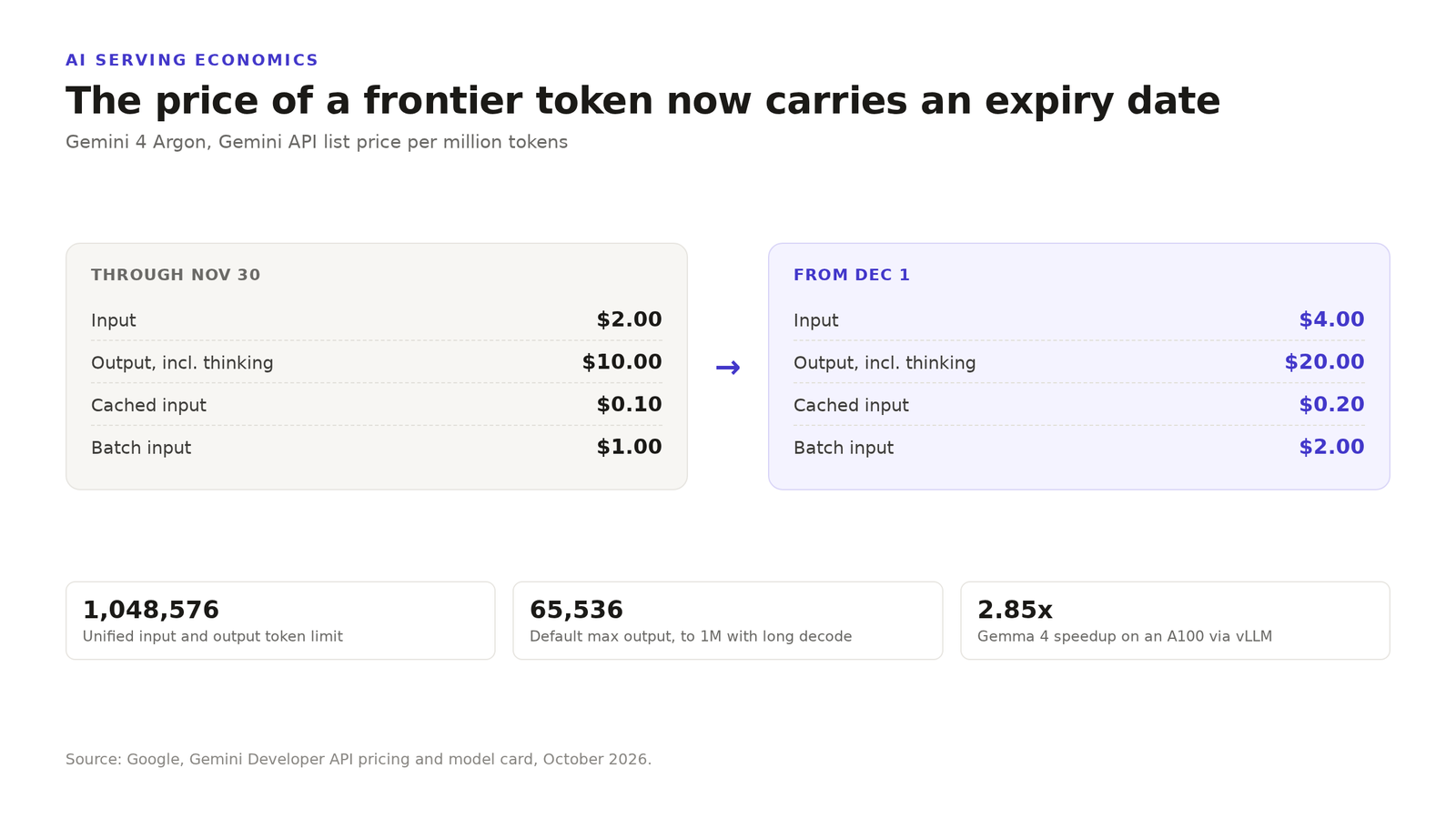
Google released its flagship reasoning model to paying customers on October 13, and it put an end date inside the price. Gemini 4 Argon costs $2 per million input tokens and $10 per million output tokens on the Gemini API through November 30. On December 1 the same model costs $4 and $20. Cached input runs $0.10 per million and also doubles on that date.
The verdict is that the launch rate is a window and not the price. Argon also shares one million-token budget between input and output, and it bills reasoning tokens at the output rate inside agent loops. For a team building on it, November is the promotion and December is the budget. Plan the fleet on the second number.
Google opened Gemini 4 Argon to developers and enterprises on October 13, after a limited run with vetted security teams. It is the company’s flagship reasoning model, built for software engineering, scientific problem solving and long autonomous agent work. Early coverage framed it around coding, math and robotics.
Two published numbers define it. Argon carries a unified context window of 1,048,576 tokens, and input and output draw on that single budget. The default output cap is 65,536 tokens, and a long decode path extends the answer to the full million when a task needs it. That is a large pool for one request and a tight one for an agent that opens with a long system prompt and then keeps talking.
The cheap rate is a deadline, and the deadline is the signal
On the Gemini API pricing page, every Argon rate is listed twice. Standard input is $2.00 per million tokens through November 30 and $4.00 from December 1. Output, which includes thinking tokens, is $10.00 and then $20.00. Cached input is $0.10 and then $0.20. Batch rates follow the same step, from $1.00 and $5.00 to $2.00 and $10.00.
Google calls it an introductory period and has not said why it ends. Read it either way and the operator’s fact is unchanged. The rate on the page today is scheduled to double on a date you can put in a calendar, and any cost model built on the November rates expires with them.
One shared token budget changes how you plan an agent
The model card confirms that the context window is a single input and output limit rather than two separate pools. Long prompts consume room the answer would otherwise use, so the prompt and the reply compete for the same million tokens. A long decode path is the documented way to reclaim the full window for output.
Google’s billing notes make the second detail plain. Managed agents and the Antigravity agent are charged at standard list rates for all model inference, including the intermediate input and reasoning tokens generated during agentic loops. A reasoning model that thinks in the open bills that thinking as output. For a workflow that fans out into many steps, the tokens you never see are the ones that move the invoice.
That is why cache pricing matters more than the headline rate. A repeated system prompt can be served from cache at $0.10 per million instead of $2.00, and because explicit caching is not supported, the discount depends on implicit hits. The lever you control is prompt reuse.
The serving stack is the other half of the price
Google published a serving result alongside the launch. Its team used Argon to reach a 2.85x end-to-end speedup on the open Gemma 4 model through vLLM on an A100, from about 37,900 to more than 108,000 tokens per second with token parity, and contributed the changes upstream. The work covers attention tuning and speculative decoding.
That is the part infrastructure teams should read twice. The rate on a pricing page is a function of the serving stack under it, and the cheapest way to cut cost per token is to make the same hardware produce more of them. Following the upstream patches is how you learn which of your own serving choices are now the slow ones.
Three questions are worth putting to your own stack this quarter. What does your busiest agent cost per task at the December rate rather than the November one. What share of your input arrives from cache. And what would you change if the model you standardized on repriced before you finished tuning your prompts.
Related reading. For the hardware side of the same cost equation, see how Microsoft scored Maia 300 in tokens per megawatt rather than peak compute, and how vLLM reached 7.8x more per-GPU throughput on a Rubin rack.
Get the next one before it is old news
Independent analysis of cloud-native infrastructure, Kubernetes and data center economics. No vendor spin.
[…] Read the full analysis, Gemini 4 Argon Is Half Price Until December 1. […]