

Executive Summary
NVIDIA introduced DSX POD on 21 October, a reference design that puts a complete Vera Rubin AI factory inside modular containers, built and cabled and validated by partners before shipment. The company claims deployment at a prepared site in as little as 14 days, down from six months, with partner deliveries starting in early 2027. The wider DSX platform carries the efficiency numbers, near-zero cooling water and up to 30 percent less power for the same output, plus a grid trial with Emerald AI, EPRI, Nebius and the UK National Grid that cut cluster power draw by up to 40 percent on simulated grid events.
The finding is that the two clocks in an AI build have separated. Integration runs in weeks. Foundations, heat rejection and utility interconnection run in years, and none of that work moved into the container. The verdict is that DSX POD is a real gain in the portion of the build NVIDIA controls and no gain at all in the portion that decides when capacity earns money. Read the 14 days as a container metric, not a capacity metric.
NVIDIA put the data center in a shipping container this week. The container arrives in two weeks. The electricity still takes years, and the distance between those two clocks is the whole story.
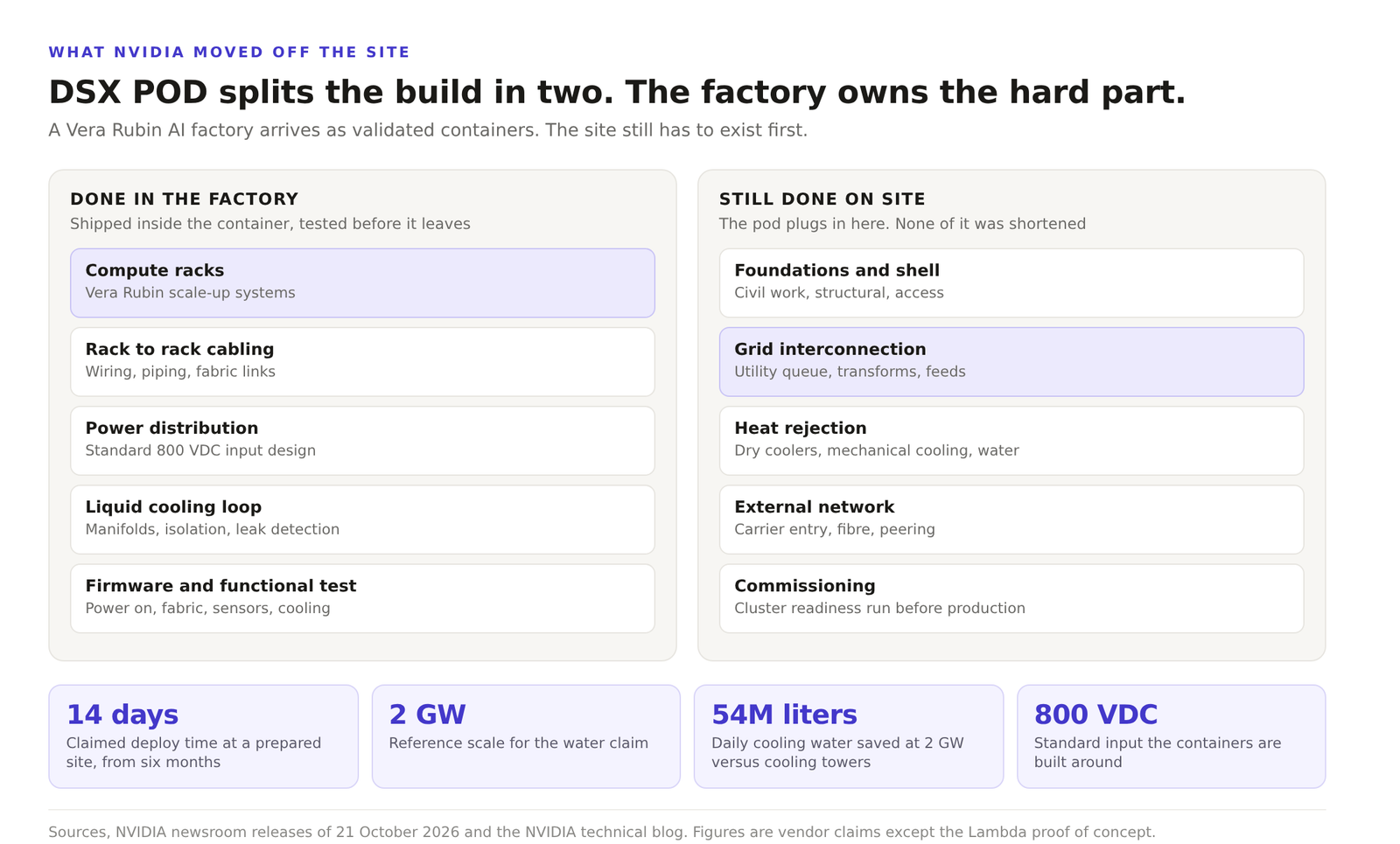
NVIDIA DSX POD is a reference design for a complete Vera Rubin AI factory, assembled by partners inside modular containers and validated before delivery. The units connect to a prepared site’s power, cooling, networking and support infrastructure. NVIDIA puts the change at six months to as little as 14 days, and seventeen partners are lined up to deliver worldwide in early 2027.
What moved is the tedious part. Rack to rack cabling, wiring, piping, power distribution, validation and leak testing now happen in a factory. The design also fixes the electrical input at 800 VDC, which matters more than it sounds. A standard input voltage at the container boundary is what lets one partner build the same box for any site.
The 14 days measure the inside of the fence
Site preparation now runs in parallel with manufacturing, which is where the schedule gain comes from. Foundations, shell, dry coolers, carrier entry and grid interconnection are all still on site and all still on their own timelines. The pod arrives at a building that has to exist first.
That is not a small caveat. Microsoft walked away from 23,000 GPUs at its Loughton campus because the grid connection was not going to land until the 2030s. A 14 day install does not compress a queue, and the queue decides whether a cluster runs this decade.
The efficiency claims are about throughput, not the power bill
The efficiency announcement is the more interesting reading. DSX reference designs pair closed loop liquid cooling with outdoor dry coolers, so heat leaves the loop into air instead of evaporating water. At 2 GW the company claims 54 million liters a day saved against cooling towers, equal to the daily water use of 180,000 households, and up to 100 percent reduction in cooling water. DSX MaxLPS adds dynamic power allocation for up to 30 percent less power at the same token output.
Hold that 30 percent next to the proof of concept NVIDIA named. Lambda ran HGX B200 systems with MaxLPS and reported 24 percent more cluster token throughput and 19 percent more GPU capacity inside a fixed power budget. Those are throughput per megawatt numbers, not reductions in consumption. Both can be true. They are not the same claim, and procurement teams carry whichever one their slide deck grabbed first. Lambda is a partner here, so treat the figure as vendor sourced.
The grid feature is the one that rewrites a contract
DSX Flex is the piece with consequences past the rack. In an early trial, Emerald AI, EPRI, Nebius, the UK National Grid and NVIDIA cut power draw by up to 40 percent on a Blackwell Ultra cluster in response to simulated grid events while critical workloads kept running. If a campus can behave like that on demand, it stops being a load to be served and becomes an asset a utility can dispatch. That changes what an operator can ask for in an interconnection agreement.
The software is following. Three DSX OS components are in developer preview, including a rack management service that handles power, inventory, firmware and switches, and a cluster readiness engine that validates a GPU cluster before production work lands. Rack level power and firmware control is what makes a container manageable as a unit instead of a pile of parts.
Three questions worth asking your own build. Does the schedule you were handed measure the container or the connection? Which efficiency number is in your business case, the throughput gain or the power saving? And if the facility had to shed 40 percent of its draw on a grid signal next quarter, which workloads would still be running?
Related reading. The trade coverage carries the vendor numbers. On our side, the spare capacity inside a Meta rack and the fair queue that shipped in llm-d cover the same utilization problem from the scheduling side.
Get the next one before it is old news
Independent analysis of cloud-native infrastructure, Kubernetes and data center economics. No vendor spin.
[…] power side of the same problem is the queue a factory has to clear before it can be built, and the packaging bottleneck has its own American counterweight in GlobalFoundries. Neither […]
[…] reading. Our piece on why a 14 day AI factory build still waits on the power queue covers the scheduling half of this constraint. Our look at Google buying a gigawatt it has to […]
[…] reading. Our piece on NVIDIA’s containerized AI factory covers the other half of the same problem, the part where the hall has to exist before the silicon […]