

Executive Summary
Spain revised the draft decree that governs data center power in late October, two months after publishing it. The mandate now applies to new facilities above 10 megawatts instead of 1 megawatt. The window for matching each new megawatt with renewable capacity doubled from 18 months to 36 months before operation, the cap on solar is gone, and operators get a transition period of up to five years. The 80 percent renewable requirement, measured every hour, did not change.
The revision settles a question the draft left open, which is who the rule is actually for. Raising the threshold tenfold takes most colocation and edge builds out of scope and leaves the large campus, the only customer the grid was worried about. The verdict is that Madrid kept the clause with teeth and widened the door around it while more than 10 gigawatts of connection requests wait outside. The hourly test, not the annual target, is what will cost an operator money.
Spain eased its data center power rules this week. The clause that decides whether a large campus gets built did not move.
Compliance is still measured every hour against new renewable generation, and the 80 percent figure is still the bar. What changed is who has to clear it and how long they get to arrange the supply behind it.
Under 10 megawatts, the rule barely reaches you
The August draft applied to projects of 1 megawatt and up. That would have caught a mid-size colocation hall and a serious edge site. The revised threshold of more than 10 megawatts leaves both out and keeps the campaign builds in. Spain has more than 10 gigawatts of data center projects seeking grid connections, according to Data Center Dynamics, and a threshold that only the largest projects must clear changes which of those projects can still pencil.
The Spain data center power rules now reach a far smaller set of buildings than the August draft proposed. Read the move as arithmetic rather than retreat. A rule that covers everything above 1 megawatt sweeps in facilities that could never contract their own generation. A rule that covers the biggest buildings targets exactly the load the grid operator has to plan for.
Doubling the matching window changes what you can buy
The original design required every new megawatt of load to be matched by renewable capacity installed within 18 months before the facility started operating. The revision extends that to 36 months and removes the limit on solar.
Eighteen months is a procurement clock that favors generation already under construction. Thirty-six months reaches a solar farm that holds a permit and no panels yet. For an operator, that is room to sign a power purchase agreement with a developer instead of buying clean attributes on the spot market, and it decouples the renewable build from the data center build. The two no longer have to be financed on the same schedule.
The hourly test is where the money is
The 80 percent figure was never the hard part. A procurement team can contract 80 percent of annual volume with solar and call it done. Hourly compliance is a different problem, because solar does not generate at night and a data center does.
Under the draft, shortfalls brought rising surcharges on grid charges, and in the limit a facility could lose grid access. The five year transition softens the ramp, not the shape of the requirement. Firm clean supply, storage, or a contract with a generator that can shape its output are the routes, and each is priced per hour rather than per year.
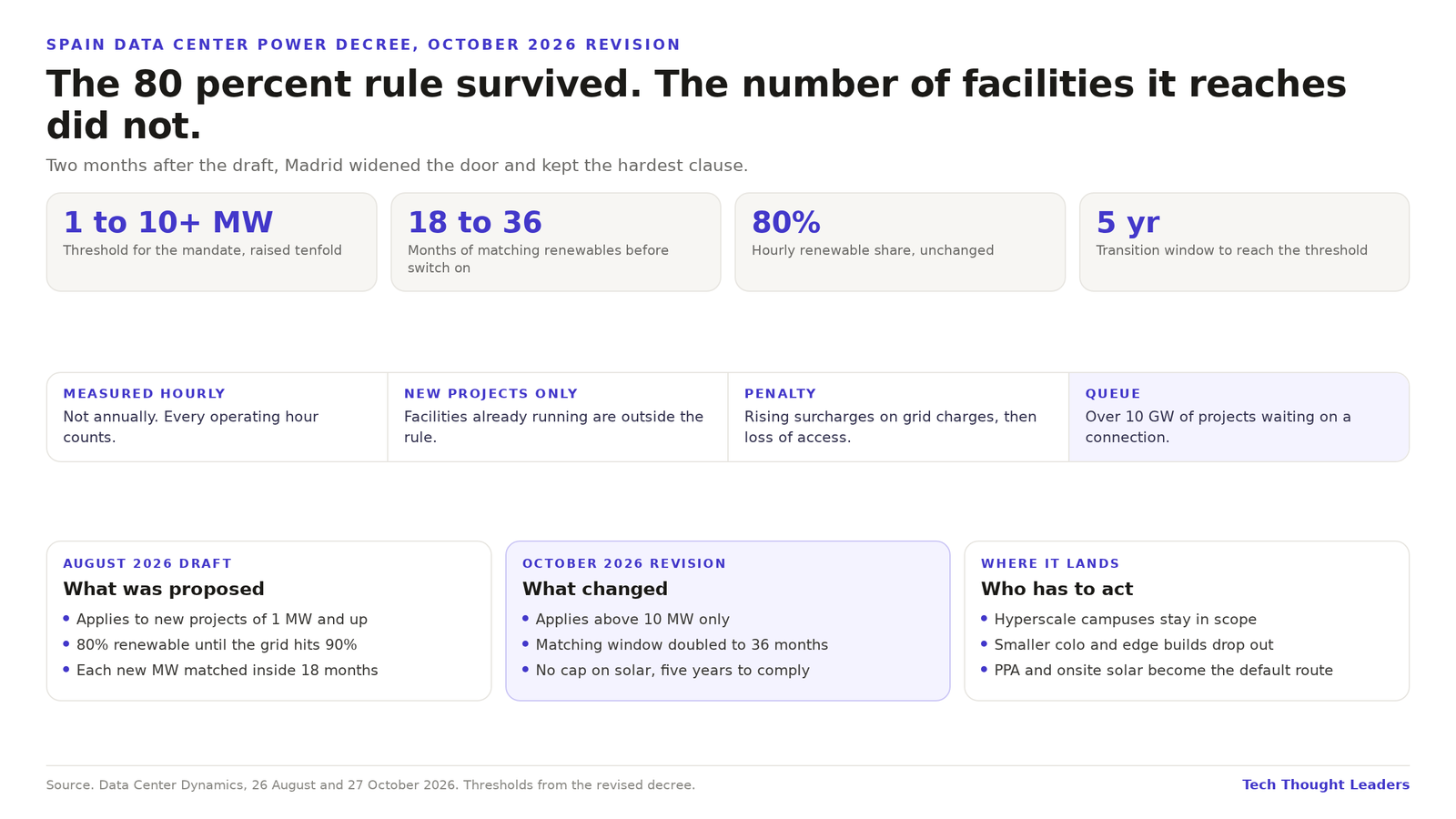
The rules apply to new projects rather than facilities already operating, and the original draft set grace periods of six months, or three for projects awaiting a grid tender. Anyone planning a Spanish campus this decade should read the final text in the official gazette rather than the coverage of it, because the transition conditions are where the exceptions live.
Three questions to run against your own pipeline. Which planned sites now fall under 10 megawatts and exit the regime entirely? If you need hourly matching, what firm clean capacity can you contract inside 36 months, and at what price per hour? And what does a missed hour cost you, in surcharges and in the right to stay connected?
The comparison that matters is not Spain against Ireland or the Netherlands. It is the rule against the interconnection queue. Grid operators in Spain are being asked to fund a decade of capacity for load that may never be built, and every threshold in a decree like this one is a guess about which projects are real.
Related reading. We covered the American version of the same fight in A Rural City Found the Real Cost of a Data Center Moratorium, and the gas build behind firm capacity in A 5 Gigawatt AI Campus Bought 6.47 Gigawatts of Gas.
Get the next one before it is old news
Independent analysis of cloud-native infrastructure, Kubernetes and data center economics. No vendor spin.