

Executive Summary
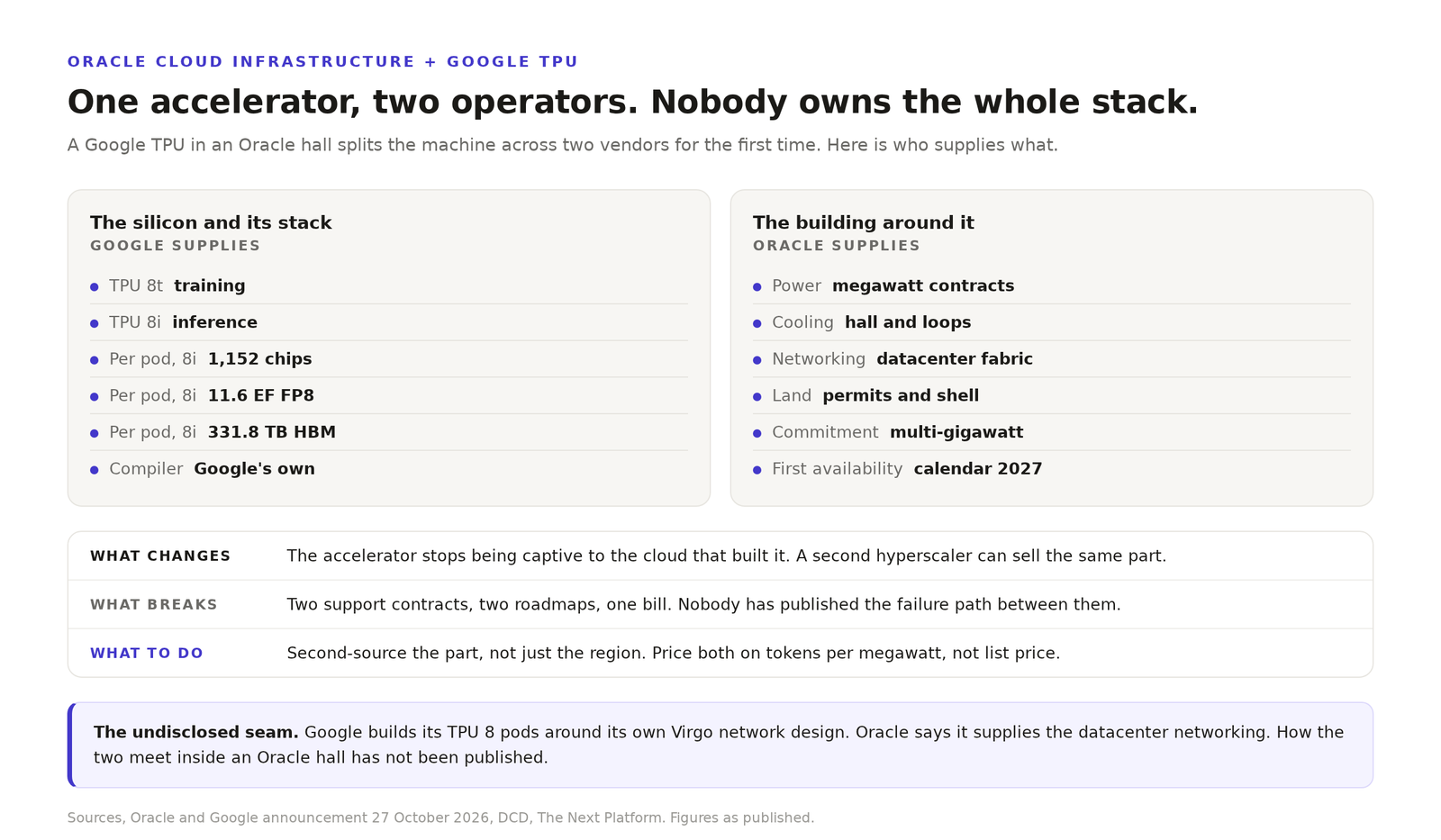
Oracle will run Google Tensor Processing Units inside its own data centers from calendar 2027, the first time the chip has been offered on a hyperscale cloud that Google does not own. Google supplies the silicon and the software. Oracle supplies the power, the cooling and the datacenter networking. Neither company published the size of the first deployment.
The finding is that the accelerator has separated from the cloud that built it, so procurement can now treat a TPU as a part with a second supplier. Oracle’s Karan Batta calls the arrangement a multi-year, multi-gigawatt commitment and says a new TPU will arrive on the day Google launches it, a cadence nobody can test until 2027. The verdict is that this lands as a sourcing question before it becomes a technology one. Price two clouds for the same chip, and read the support boundary closely, because the seam between Google’s network design and Oracle’s fabric is the part nobody has described.
Google’s TPU has never left home. Every one of them has run in a Google building, on Google’s fabric, sold under Google’s name.
From 2027 that stops. Oracle Cloud Infrastructure will deploy the chips and rent them out, which makes this the first Google TPU to run on a hyperscale cloud that Google does not own. The two companies confirmed it on 27 October.
Google sells the part, Oracle sells the building
A TPU pod is not a card you slide into a server. It is a rack-scale system with its own interconnect and its own compiler, and it works because the building around it was designed for it. When one company owns all of that, the boundary is invisible. When two own it, the boundary becomes a contract.
Oracle’s release is unusually plain about the split. OCI provides the power, the cooling and the datacenter networking. Google provides the accelerators, described as custom silicon co-designed with open software to cover training, large-scale inference and agentic reasoning.
The hardware is the eighth TPU generation. TPU 8i, the inference part, scales to 1,152 chips in a single pod and carries 331.8 terabytes of HBM per pod alongside 11.6 exaflops of FP8 compute. TPU 8t, the training part, puts roughly three times the compute per pod of the previous generation and pairs 400Gbps of scale-out networking with 19.2Tbps of scale-up bandwidth.
A multi-gigawatt promise with no megawatt number
Oracle declined to say how large the first deployment is. Karan Batta, senior vice president for OCI, told Data Center Dynamics it is a multi-year, multi-gigawatt partnership that will look and feel the same as it does from Google’s own cloud. He was equally clear that this is not a pilot.
Gigawatts are the right unit for a power contract and the wrong unit for a purchase order. A gigawatt of TPU capacity implies a hall, a substation and an interconnection slot, and Oracle has already accumulated demand that would justify the spend. OCI posted $7.4 billion of revenue in the first quarter of its 2027 fiscal year, up 121 percent, and remaining performance obligations reached $664 billion after a rise of $209 billion.
Google is not making Oracle its exclusive landlord either. It is also working with Blackstone on a TPU platform in the United States, and whichever of the two comes online first gets the milestone. That race explains why the timing is firm and the scale is not.
Second sourcing the part is the point
For a decade the accelerator and the cloud were one purchase. You picked a vendor because it had the parts, and you took the fabric, the pricing and the roadmap that came with them. A TPU that runs in two clouds breaks that, and it prices it.
The comparison an operator can now run is tokens per megawatt in two places, on the same chip, with the same compiler underneath. That is a real number, and it is the one that decides where inference sits in 2028.
What the announcement does not answer is who owns the failure. If a pod underperforms, the cause could sit in Google’s compiler or in Oracle’s fabric, and the customer holds two support contracts and one bill. Ask which of the two takes the call, and what the credit looks like when neither does.
Three questions before TPU capacity goes into a 2027 plan. Does your architecture assume one supplier provides silicon, network and support, and can you split that contract? Which benchmark decides the winner, your workload or theirs? And if the day-one promise holds, what stops reserved capacity from being repriced at every TPU launch?
Related reading. Our piece on NVIDIA’s containerized AI factory covers the other half of the same problem, the part where the hall has to exist before the silicon lands in it.
Get the next one before it is old news
Independent analysis of cloud-native infrastructure, Kubernetes and data center economics. No vendor spin.