

Executive Summary
The Meta Prometheus supercluster is gigawatt scale, runs hundreds of thousands of GPUs today, and is being built toward roughly one million. Meta published the engineering detail on 19 October. Pre-training jobs held more than 85 percent goodput, reinforcement learning runs held more than 90 percent, and mean time between interruptions moved from about 47,000 GPU hours to beyond 54,000 after a firmware push.
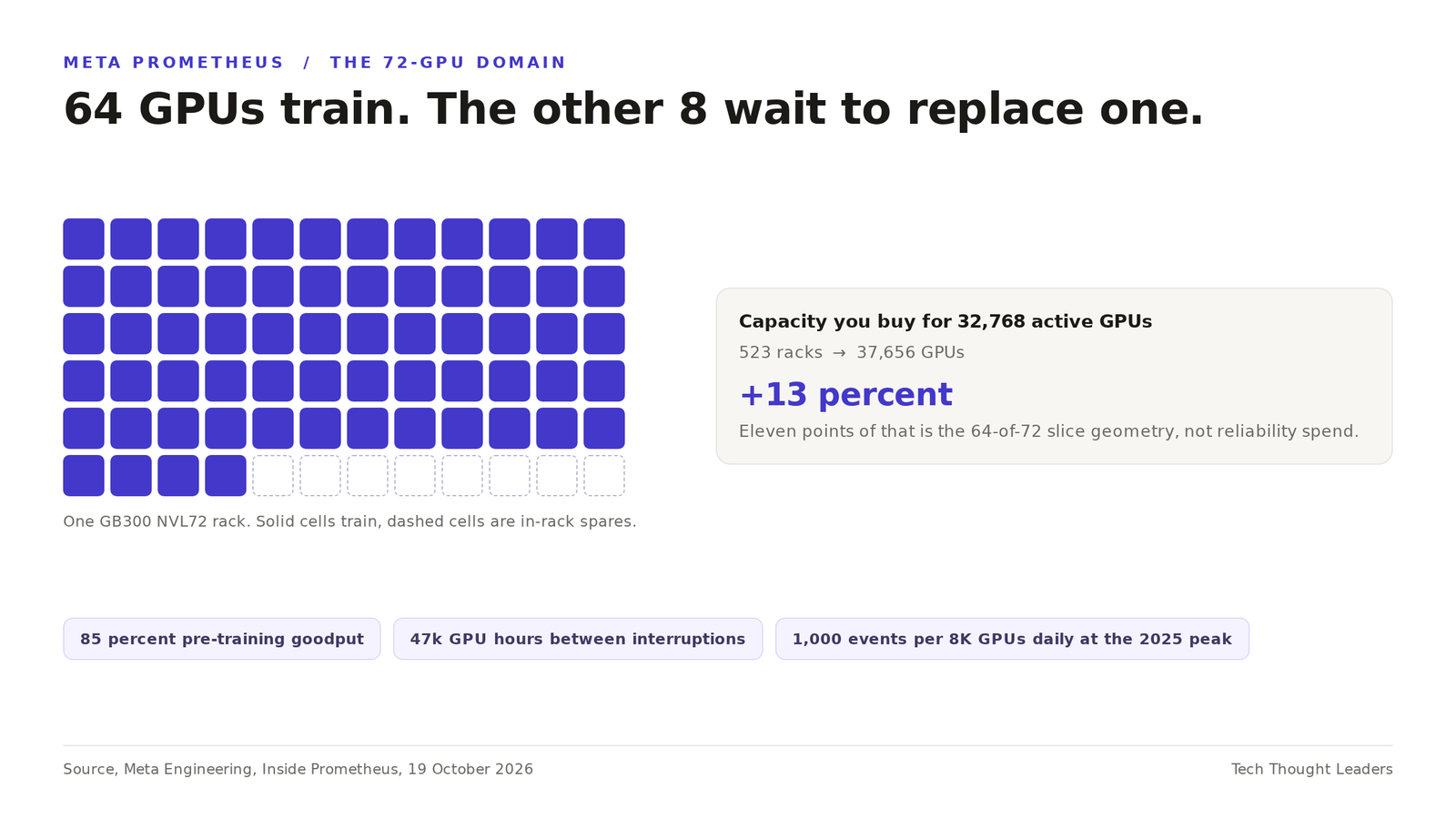
The verdict is that the GPU count is the least useful number in the post. Each 72-GPU rack runs a 64-GPU slice and parks eight accelerators as in-rack spares, which puts 13 percent more capacity on the floor than a job actually trains on. That margin is a deliberate design choice, and every team buying Blackwell racks inherits a version of it.
Meta published the numbers on 19 October. A gigawatt of buildings in New Albany, Ohio. Hundreds of thousands of GPUs today, roughly a million at full scale. The number that should change a capacity plan is smaller. 64 of every 72.
Each NVL72 domain puts 72 GPUs on one NVLink fabric and treats them as a single accelerator. Training parallelism maps onto power of two group sizes, so a job wants 64 of those GPUs, not 72. Meta runs the slice and keeps the remaining eight in the same rack as hot spares. When a GPU dies, a spare takes the slot and the job resumes from checkpoint without waiting on a repair.
The trade has a price tag, and Meta states it. A 32,768 GPU training run needs 523 NVL72 racks, which is 37,656 GPUs, about 13 percent above the active footprint. Eleven of those points come straight out of the 64 of 72 geometry. The rest is roughly 2 percent of racks held in reserve for whole rack failures.
The fault domain grew nine times and so did the spare budget
Eight H100s used to share a scale-up domain. Seventy two Blackwell GPUs share one now, a ninefold jump in what a single fault can take down. The bandwidth that makes the bigger domain worth building is the same thing that makes one bad link expensive. Meta screens more than 600,000 NVLink connections per deployment before production traffic arrives.
Goodput moved 99 percent and that is the result worth copying
In mid 2025 the first phase ran near 1,000 interruptions per 8,000 GPUs every day. Meta reports a 99 percent reduction since, through work that reads like a maintenance calendar. Firmware bundles to more than 100,000 GPUs in hours. P90 single pod upgrades down from over seven hours to two. HBM firmware settings, memory scrubbing, and a rewritten error correction path for LPDDR.
The target is two interruptions per 8,000 GPUs per day, which lands near 100,000 GPU hours between events. An interruption counts anything that forces a recovery cycle, storage stalls and thermal limits included. That definition matters more than the percentage, because it puts the network and the storage path inside the same budget as the silicon.
What an ordinary buyer can take from it
You can’t buy the 64 of 72 geometry. You can ask the same questions of whatever you rent. Power swings of 30 to 40 percent across a cluster, and tens of megawatts in seconds when a large job starts or stops, are normal at this density. Meta answers with cluster level power capping, rack battery modules, capacitor trays and site storage, and it pays the utility for the capacity. A buyer who plans for nameplate power gets throttled or refused.
Related reading. We looked at why a 2029 capacity plan is about three times too big and at why Microsoft walked away from 23,000 GPUs over grid timing. Rack level provisioning is the same argument at a smaller scale. Meta contributes the open rack designs behind this build through the Open Compute Project.
Three questions before you sign a capacity contract. How many GPUs per rack are spares, and who pays when one fails mid job? What is your mean time between interruptions, measured rather than assumed? And what happens to a 30 percent power transient when the contract bills nameplate capacity?
Get the next one before it is old news
Independent analysis of cloud-native infrastructure, Kubernetes and data center economics. No vendor spin.
[…] as the hardware. We have written about the buffers that buy time when a component degrades, from spare GPUs inside the rack to the purchasing math that changes when you buy a system instead of a server. A yield platform […]