


Executive Summary
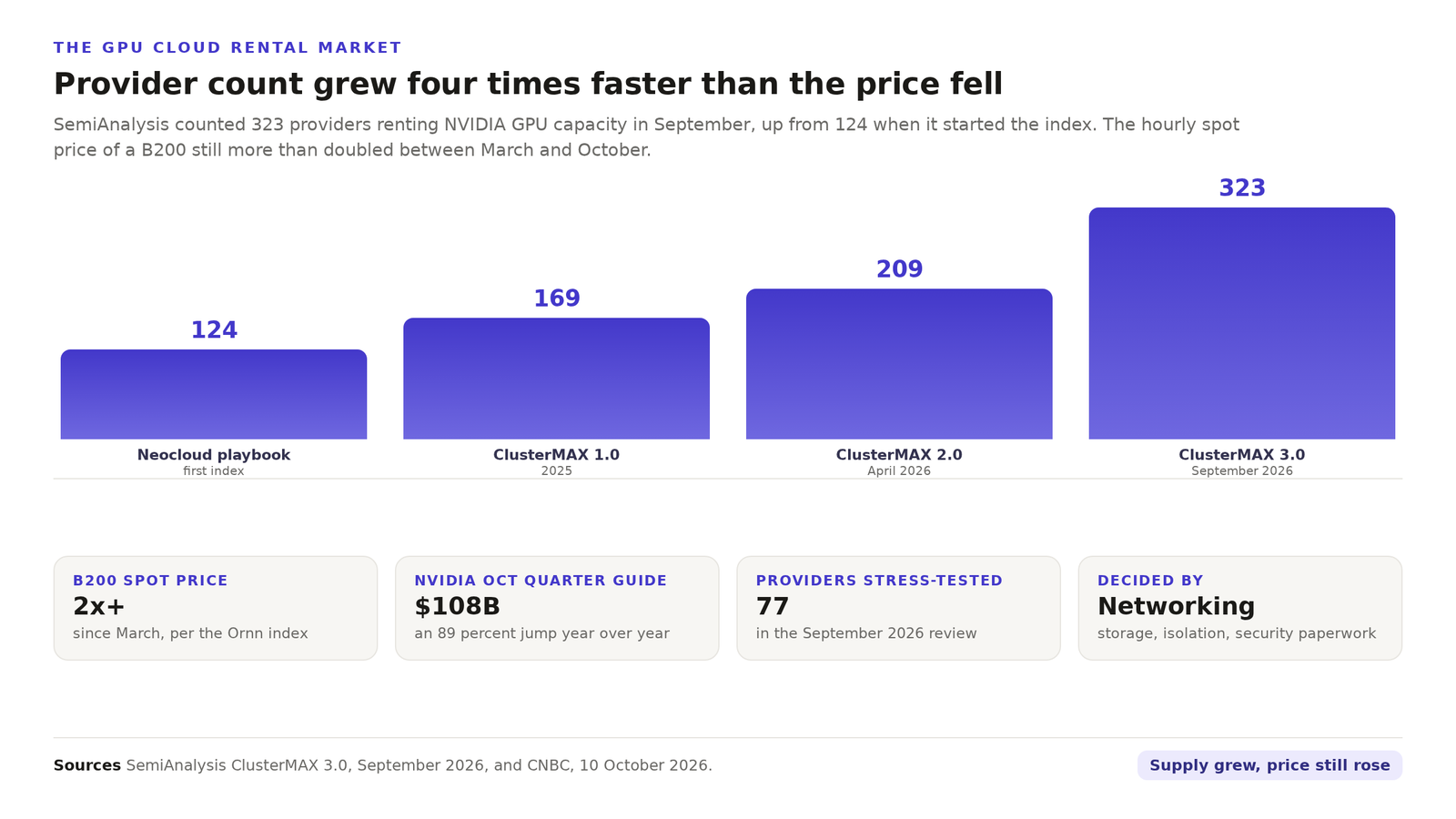
SemiAnalysis counted 323 companies renting Nvidia GPU capacity in September, up from 124 in the first version of its index. It tested roughly 77 of them in depth. Supply expanded faster than any prior build-out, and the hourly spot price of a B200 still more than doubled between March and October.
The gap between those two facts is the story. Demand is not clearing, so a price war has not arrived, and the providers winning deals are separating on the unglamorous parts of the stack. Networking, storage, tenant isolation, security paperwork and honest billing decide who holds up through the next down leg, not the headline rate per GPU-hour. The practical consequence is that a GPU cloud is now a supply chain dependency you audit before you sign, the way you would audit a database vendor or a network provider. The market spent two years rewarding the fastest builders. It is starting to reward the ones that can prove a reliability and a security story.
If the big three clouds were enough, nobody would rent from a company you have never heard of. The count of those companies keeps climbing. The GPU cloud market has hundreds of suppliers now, and the rules for picking one have quietly changed.
The provider count grew four times while the price went up
Start with the demand side. Nvidia guides $108 billion of revenue for its October quarter, an 89 percent jump year over year, and its market value sits near $6 trillion. Five customers each accounted for at least 10 percent of its accounts receivable in the July quarter, up from three in January.
The supply side fragmented to match. SemiAnalysis counted 323 providers in its September review, up from 209 in April, 169 in the previous edition and 124 when the index started. The researcher reviewed 77 of them in depth.
Fragmentation has not produced cheap capacity. The hourly spot price of a B200 more than doubled between March and October, according to the Ornn index. Amazon’s chief executive told analysts in July that the company would not serve all the demand it expects this year, and that the same would hold in 2027. Startup Modal now buys from 25 providers at once, because a few hundred GPUs from any single one is not enough. When hyperscalers cannot absorb the backlog, smaller suppliers get to charge for the gap.
The parts that decide a deal are not the parts on the pricing page
SemiAnalysis scores providers on ten criteria, spanning security, orchestration, storage, networking, reliability, monitoring, pricing, partnerships and availability. The published methodology is blunt about where the differences show up. Load times separate the field more than raw throughput does. Some providers pull a small model from shared storage in 10 to 40 seconds. Others take more than two minutes.
The lowest tier fails on things a buyer can audit in an afternoon. Older accelerator generations, missing SOC 2 or ISO 27001 attestation, PCIe access control left enabled, GPUDirect RDMA turned off, or a bill that charges for GPU hours during cluster creation and hardware downtime. Nebius moved into the top tier in the September review, and CoreWeave remains the reference point for enterprise-ready capacity.
That matters because a GPU cloud is now a supply chain dependency. If a provider’s networking is misconfigured, your training job stalls and you find out weeks later. If it lacks a security attestation, your own customers inherit the problem. The underlying hardware is nearly identical across the field. The operator experience is not.
What to ask before you sign
Three questions test a provider faster than any benchmark. Ask what happens to your job when one node fails mid-run, and whether you keep paying while the cluster is rebuilt. Ask for the security attestation and the network topology in writing, not a slide. Ask whether the rate is fixed for the term, because a spot price that doubled in seven months can double again.
The uncomfortable read is that capacity is still not clearing. Oracle now lets customers bring their own GPUs, which signals how hard even a large provider will work to fill a rack. Until supply catches demand, the seller keeps the upper hand, and the safe move is to lock terms and audit the dull details early.
Related reading. The week’s roundup tracks how every constraint in AI infrastructure now arrives as a budget line. And the biggest data center subsidy may not be the one the industry advertises.
Get the next one before it is old news
Independent analysis of cloud-native infrastructure, Kubernetes and data center economics. No vendor spin.