


Executive Summary
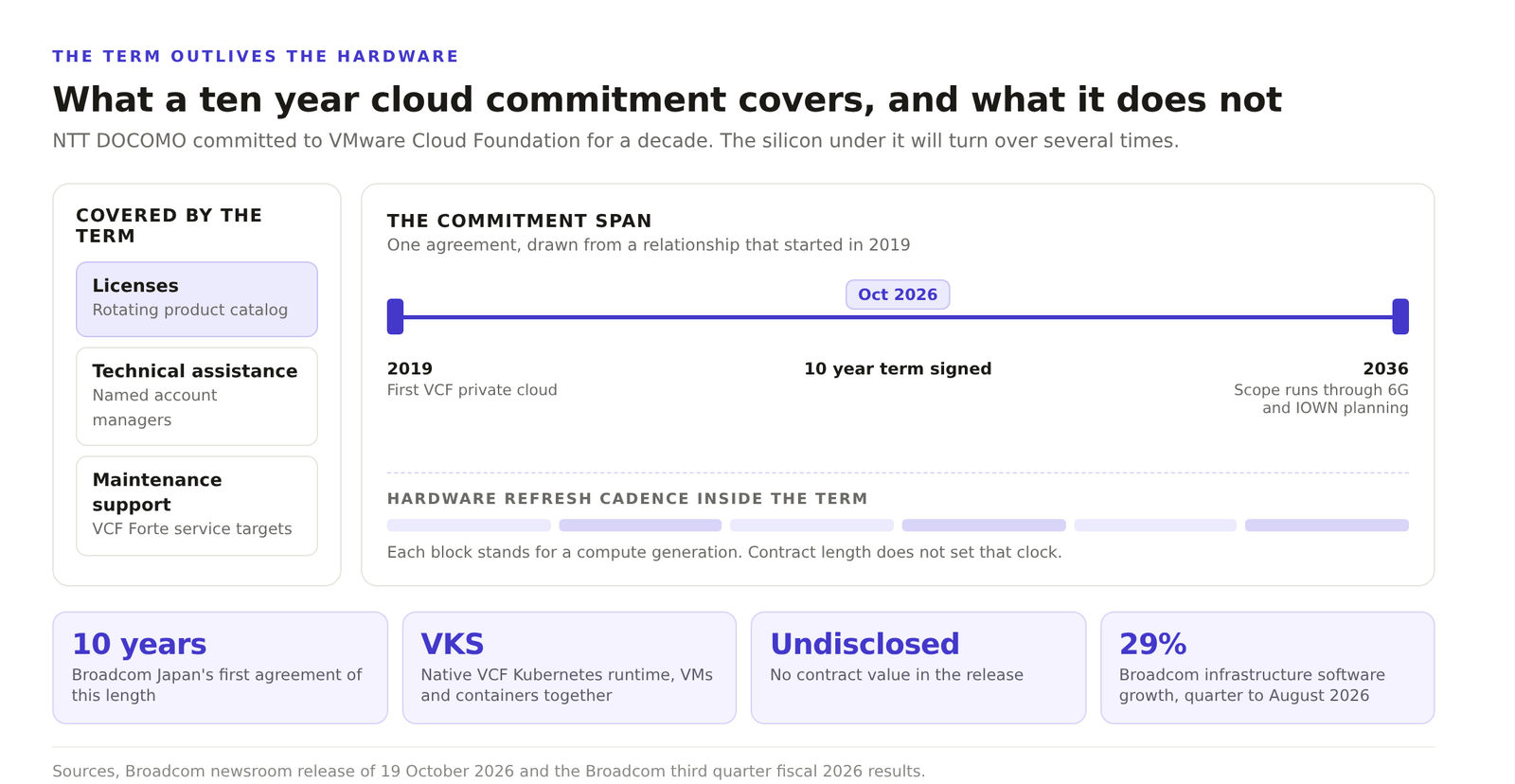
Broadcom and NTT DOCOMO signed a ten year agreement covering VMware Cloud Foundation licenses, technical assistance and maintenance, announced on 19 October. It is Broadcom Japan’s first agreement of that length, and it extends a relationship that began in 2019. The scope runs wider than a renewal. DOCOMO takes Avi Load Balancer, vDefend, VMware Tanzu Platform and VCF Forte Support, Broadcom’s highest service tier, and will run virtual machines and containers on vSphere Kubernetes Service.
The finding is that Broadcom’s renewal story has moved from price to tenure. Longer terms and higher support tiers now carry the growth, and a single carrier in Japan resets the reference point for every renewal negotiation in that region. The technical case is genuine, because a telco cannot lift and shift service infrastructure without real operational risk, and VCF plus a native Kubernetes runtime answers that directly. The verdict is that this is a credible engineering commitment inside a commercial template, and the template is the part worth reading.
Ten years is the number in the release. The price is not, because Broadcom did not publish one.
The agreement covers VMware Cloud Foundation plus Avi Load Balancer, vDefend, Tanzu Platform, named support and technical account managers, and VCF Forte Support. Forte is the top service tier, the one with the tightest service level objectives. DOCOMO has run VCF at the core of its private cloud since 2019, so this is a renewal with a decade stapled to it rather than a new logo.
Broadcom is selling the calendar now, not the SKU
The commercial shape is the story. Broadcom’s dispute with AT&T turned on contract length, with the carrier arguing its perpetual support should have renewed on its own terms and Broadcom insisting on multi-year subscriptions, as TechTarget reported. The reference account in Japan has now volunteered for ten years with the highest support tier attached. When the anchor deal in a market is a decade, every three year renewal in that market starts to look short. Call it the tenure lock, because that is what it is.
There is a real technical reason to sign, and it is not abstract. Continuity matters more than price to a carrier running billing, core network and consumer services on one estate. The release frames three priorities, upgrades without interruption, continuous security patching with anomaly detection, and faster service delivery. vSphere Kubernetes Service is what delivers the last one by putting virtual machines and containers on a common platform.
The missing contract value is the honest part
Broadcom reported 8.75 billion dollars of infrastructure software revenue in the quarter ended 2 August 2026, up 29 percent. One carrier’s private cloud, even a decade of it, will not move a number that size, and the release does not pretend otherwise. You cannot size the deal, and dividing by ten would be wrong anyway, because term length is not a revenue schedule.
A decade is an operating assumption, not a hardware bet
The part that deserves scrutiny is the mismatch in clocks. Ten years of virtualization spans roughly three GPU generations, two or three server refreshes and at least one networking transition. The virtualization layer is the one piece that can plausibly hold still that long, because its whole job is abstracting the layers that move.
Broadcom is explicit about the intent. The release names expanding AI use, AI driven threats, 6G and the IOWN optical program as the forces the platform has to absorb, and Paul Turner, chief product officer of the VCF division, called it a long term initiative for the next decade. That is a roadmap commitment from both sides. Roadmap commitments are the ones that age badly.
Three questions for your own renewal. What is your support tier buying beyond the product list? If the flagship account in your region just signed for ten years, what does that do to your next three year ask? And which layer of your estate genuinely holds still for a decade, and which one are you pretending will?
Related reading. We covered the end of license-included Azure VMware Solution and how Nutanix rewrote migration after Broadcom pulled the VDDK. Both show what leaving actually costs.
Get the next one before it is old news
Independent analysis of cloud-native infrastructure, Kubernetes and data center economics. No vendor spin.