


Executive Summary
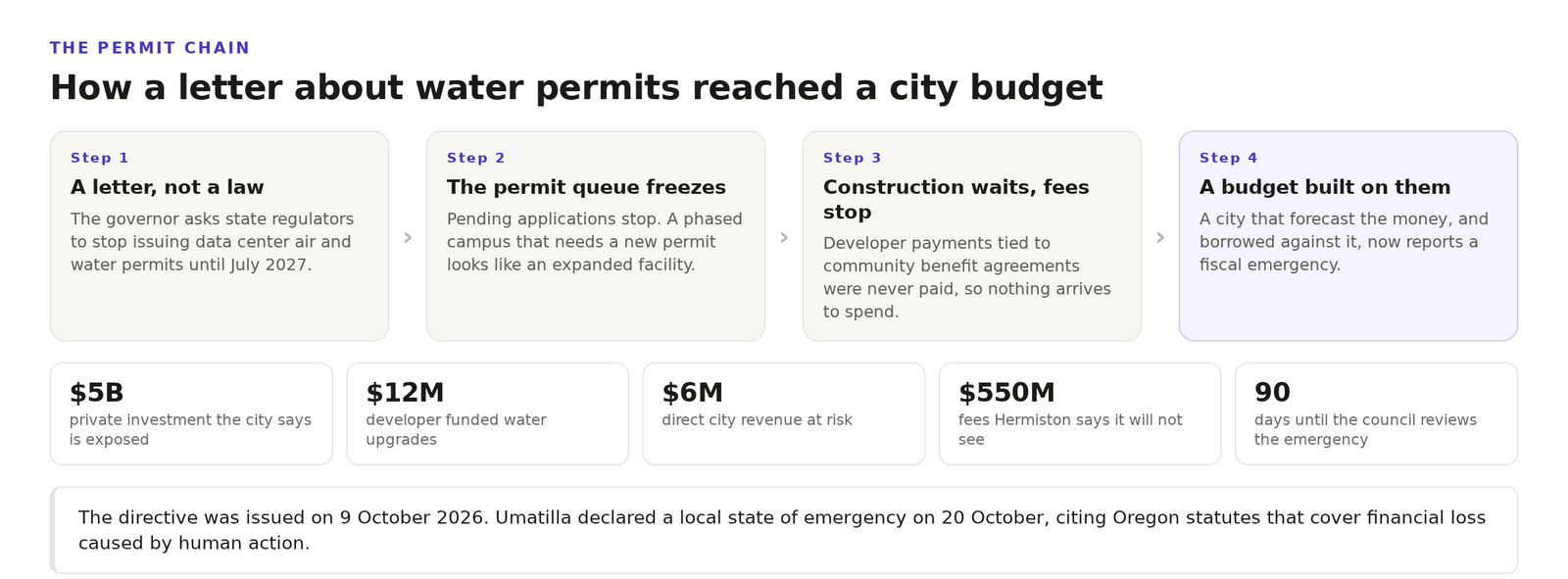
Oregon asked state environmental regulators to stop issuing air and water permits for new or expanded data centers until July 2027. The order freezes a permit queue, not a tax base. That distinction is what pushed a city of about 8,000 people to declare a local state of emergency.
The finding that matters for site selection is that the money at risk is not property tax. Oregon enterprise zones already waive most of that. The exposure is the fee stream, the developer funded infrastructure and the bond payments a small city wrote into its forecast on the promise of projects that now cannot get a permit. The verdict is that a change of law clause is worth as much as a power contract, because a state can stop a campus with a letter.
Umatilla built its next decade of city services on data center money it has not received yet. On 20 October the council voted 5 to 0 to declare a state of emergency because the permits stopped.
The permits that froze are water and air
Governor Tina Kotek sent the directive to the Oregon Department of Environmental Quality on 9 October. It asks the agency to pause processing and issuing air and water discharge permits for new or expanded data center facilities until 1 July 2027. That includes municipal wastewater treatment permits that exist to handle data center discharge. The stated purpose is to hold the line while her advisory committee finishes its work and the legislature takes up policy in January.
Legal analysis from Ballard Spahr draws the practical line. A project that already holds every permit it needs is not directly affected. A project with a pending application is frozen where it stands, even if construction is under way. A phased campus that needs a new permit for later buildings is likely to be treated as an expansion.
That last point is the quiet one. Most hyperscale sites are built in phases, and the permit for the second phase is what makes the first phase financeable. The data center moratorium Oregon never formally declared is now a line in a small city budget.
Umatilla budgeted against money it had not received
City manager Dave Stockdale put the exposure in numbers. More than 5 billion dollars of anticipated private investment, at least 1,000 construction jobs, more than 6 million dollars in direct city revenue at risk and about 12 million dollars of developer funded water infrastructure that could be cancelled. The city press release lists four operating facilities, one under construction and two planned. Sabey and Amazon Web Services are already there.
Stockdale was careful to say the budget is not broken. Reserves are at record levels and none of the anticipated money has been spent. That is what makes the declaration interesting rather than alarming. The city is not short of cash. It planned a police station bond, street work and property tax relief around payments from companies that now cannot get a permit.
Umatilla is not alone. In Hermiston, where Amazon runs two hyperscale campuses, city manager Mark Morgan put the figure at about 550 million dollars in lost future fee revenue. Both cities lean on Oregon enterprise zones, which let companies skip five to fifteen years of property tax in exchange for jobs. The fees and community benefit payments sit outside that break, and that is why a town can grow dependent on them.
Five of the six council members present voted for the declaration, and the council will review it every 90 days. The resolution also formally asks the governor to withdraw or modify the directive, and it applies Oregon emergency statutes written for financial loss caused by human action rather than by flood or fire.
Put a change of law clause next to the power contract
The operator lesson is not that Oregon is closed. It is that a permit is a political variable with a date on it. Ballard Spahr tells developers to review construction, power, financing and customer contracts for delay, force majeure and change of law provisions, which is the right order of work, because none of those clauses matter until one of them is tested.
The politics point the same way for now. Both candidates in the governor’s race support a moratorium, so an election will not settle it. The legislature meets in January with a stack of data center bills waiting, and the pause does not lift until July.
Three questions for the next site you shortlist. Does the campus hold every permit it needs for full build out, or only for phase one? Which side of the contract carries the cost of a change of law delay? And is the community contribution tied to delivery, or to a forecast?
We have covered the credit side of this constraint before. Lenders already want permitting resolved before they fund a build. Oregon just showed what happens when the permits stop and the city has already spent the promise.
Get the next one before it is old news
Independent analysis of cloud-native infrastructure, Kubernetes and data center economics. No vendor spin.
[…] reading. We covered the American version of the same fight in A Rural City Found the Real Cost of a Data Center Moratorium, and the gas build behind firm capacity in A 5 Gigawatt AI Campus Bought 6.47 Gigawatts of […]