

Executive Summary
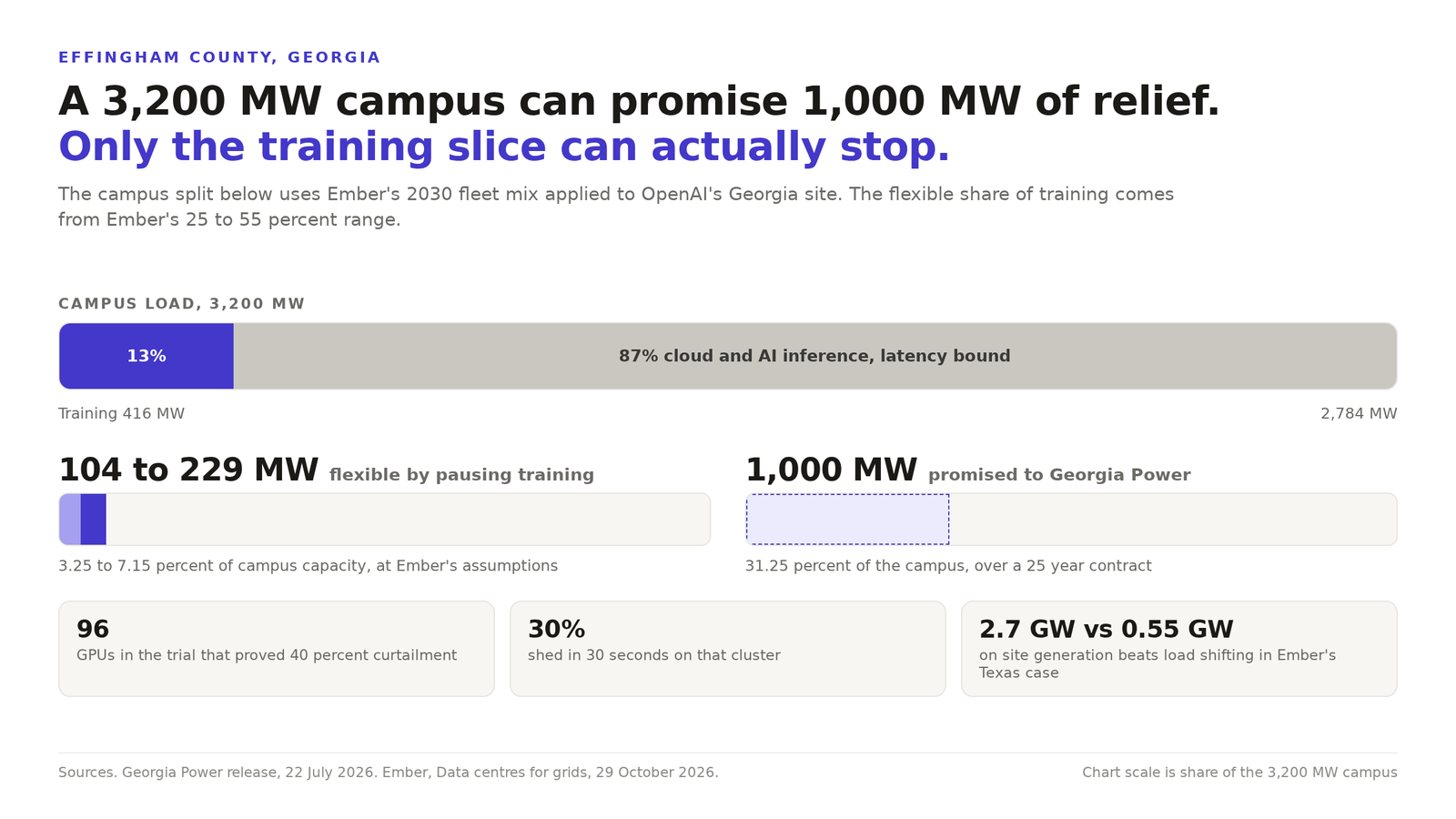
This is the first real test of whether an AI campus can behave like a grid asset, and the early arithmetic is unflattering. OpenAI has committed up to 1,000 megawatts of demand response across the campuses it develops, starting with a 3,200 megawatt site in Effingham County, Georgia. That is 31 percent of the campus. Run Ember’s workload assumptions against the same site. The capacity that can be paused without breaking a service level agreement lands between 104 and 229 megawatts, or 3 to 7 percent.
The gap does not make the commitment empty. It means most of the relief will probably arrive as generation behind the meter rather than as GPUs going quiet. That is a better outcome for the grid and a different promise than the one in the announcement. The number that settles the argument is what this publication calls the pause budget, the share of a campus that can stop mid job. Nobody has published one yet.
OpenAI launched the Grid Protectors Program on Monday. It says the campuses it develops directly will cut their power draw when the grid is strained, working with utilities on how far and how fast. The first site with a signed contract is Effingham County, Georgia, about 45 minutes outside Savannah.
That campus needs roughly 3,200 megawatts. Georgia Power agreed in July to serve it under a 25 year contract, and OpenAI will provide up to 1,000 megawatts of AI data center demand response, letting the utility cut energy delivered to the site during set periods. Georgia Power calls it among the largest single facility demand response commitments in the country. That is 31 percent of the campus.
The number that decides whether that is real is not 1,000 megawatts. It is the share of the campus that can stop mid job without breaching a service level agreement. Call it the pause budget.
Training flexes. Inference is the product you already sold.
Load management is old. Grid operators have paid big industrial customers to stand down since the 1970s, and an aluminum smelter is close to a perfect participant because nobody waits on its output. Ember’s analysis of data center flexibility, published on 29 October, explains why an AI campus is harder. It expects 87 percent of data center capacity in 2030 to run cloud services and AI inference, both latency sensitive. Training is the other 13 percent, and 25 to 55 percent of a training campus’s power demand can flex, because a training job can be paused.
Apply that to Effingham. Thirteen percent of 3,200 megawatts is 416 megawatts of training, and 25 to 55 percent of it comes to 104 to 229 megawatts of pausable load. Reaching 1,000 megawatts by pausing work alone needs training to be 57 percent of the campus, at the top of Ember’s range. At the bottom, no workload mix gets there. That arithmetic is ours, run on Ember’s assumptions. OpenAI has published no forecast for Georgia, so read it as a shape, not a disclosure.
The shape is stubborn. A campus built to serve inference has almost nothing to sell back to the grid.
Pausing a run is a checkpoint event, not a dimmer switch
The demonstration everyone cites is real and small. A cluster of 96 Blackwell Ultra GPUs at a Nebius data center in London ran with National Grid and EPRI. It held 40 percent reductions inside a minute and shed about 30 percent in 30 seconds across 200 simulated events. It sustained reduction requests for up to 10 hours.
Scale it. A training job steps in lockstep across every GPU it owns, so you cannot idle half a rack and keep the step. Curtailment means draining the step, writing optimizer state out to storage, then holding the allocation. At 3,200 megawatts that checkpoint becomes a storage and fabric event with a deadline attached. What flexes cleanly is training past a checkpoint boundary, offline evaluation and batch work. What does not is anything a customer is waiting on, which is most of that 87 percent.
The megawatts may arrive as steel and batteries
Ember’s sharper finding is that load shifting is the weaker lever. In its Texas case study, two large data centers running on site generation could take up to 2.7 gigawatts off the grid during a stress event. Shifting load delivered 0.55 gigawatts. OpenAI’s own description includes on site generation, batteries and controls to smooth demand.
A campus that fires its own turbines has kept the promise and paused nothing. For the grid that may be the better deal, since flexible demand is cheaper than new peak supply. Ember’s catch is that unregulated behind the meter generation risks locking in fossil capacity. Either way, nobody can tell yet which mechanism supplies the 1,000 megawatts, and the public power sector is asking the same question about every campus in the queue.
Three questions for your own platform team. Which workloads can stop inside a checkpoint window without breaching an SLA? Does your power contract cap the campus or cap the workload? And if your utility called tomorrow asking for 30 percent, who would you call?
Related reading. Google bought a gigawatt of power it has to switch off, and PJM wants to review a ten gigawatt AI campus as one project.
Get the next one before it is old news
Independent analysis of cloud-native infrastructure, Kubernetes and data center economics. No vendor spin.