


Executive Summary
AWS raised the metadata ceiling on the Intelligent-Tiering storage class of FSx for Lustre from 12,000 to 192,000 IOPS on 5 November. That is 16x, and it puts the cost-optimized tier on the ceiling the SSD tier has carried for years. The new limit applies to newly created file systems, in every region where the storage class exists.
Two things blunt it. The user guide still lists 6,000 and 12,000 as the valid values for that storage class, so the announcement and the reference page disagree as of this writing. And the per-operation rates have not moved, at two file operations per metadata IOP, one delete and a tenth of a directory create, a tree-heavy workload still builds 19,200 directories a second at the new ceiling. This is a real saving for readers of small files and close to a non-event for writers of directory trees.
Metadata IOPS decides how fast a training job can stage ten million image shards before the accelerators have anything to do, and until this week the cheap storage class capped it at 12,000. The expensive one had allowed 192,000 for years. AWS closed that gap on 5 November, for new file systems only.
The elastic tier was also the throttled tier
Intelligent-Tiering is the storage class AWS sells as its lowest-cost and only fully elastic Lustre option. You provision throughput independently of capacity and pay for what you store, which suits a dataset that is huge, mostly cold and occasionally read hard. It does not link to an S3 data repository, so it is not the tier you hydrate from object storage.
FSx for Lustre metadata IOPS governs that tier. It sets how many files and directories can be created, listed, read and deleted each second, and on a dataset of small objects it saturates first. Starve it and the file servers stall while the accelerators sit idle, which is the failure that sends teams back to SSD capacity they did not want to buy.
The catch is in how the ceiling is provisioned. Intelligent-Tiering supports only user-provisioned metadata, with no automatic scaling, and its valid values were 6,000 and 12,000. SSD file systems already had 192,000. This is not new physics, it is the removal of a 16x penalty for choosing the cheap tier.
The arithmetic under the number does not move
One provisioned metadata IOP is not one operation. The performance documentation gives the conversion, two file creates, opens or closes per IOPS, one file delete, a tenth of a directory create or rename, and a fifth of a directory delete.
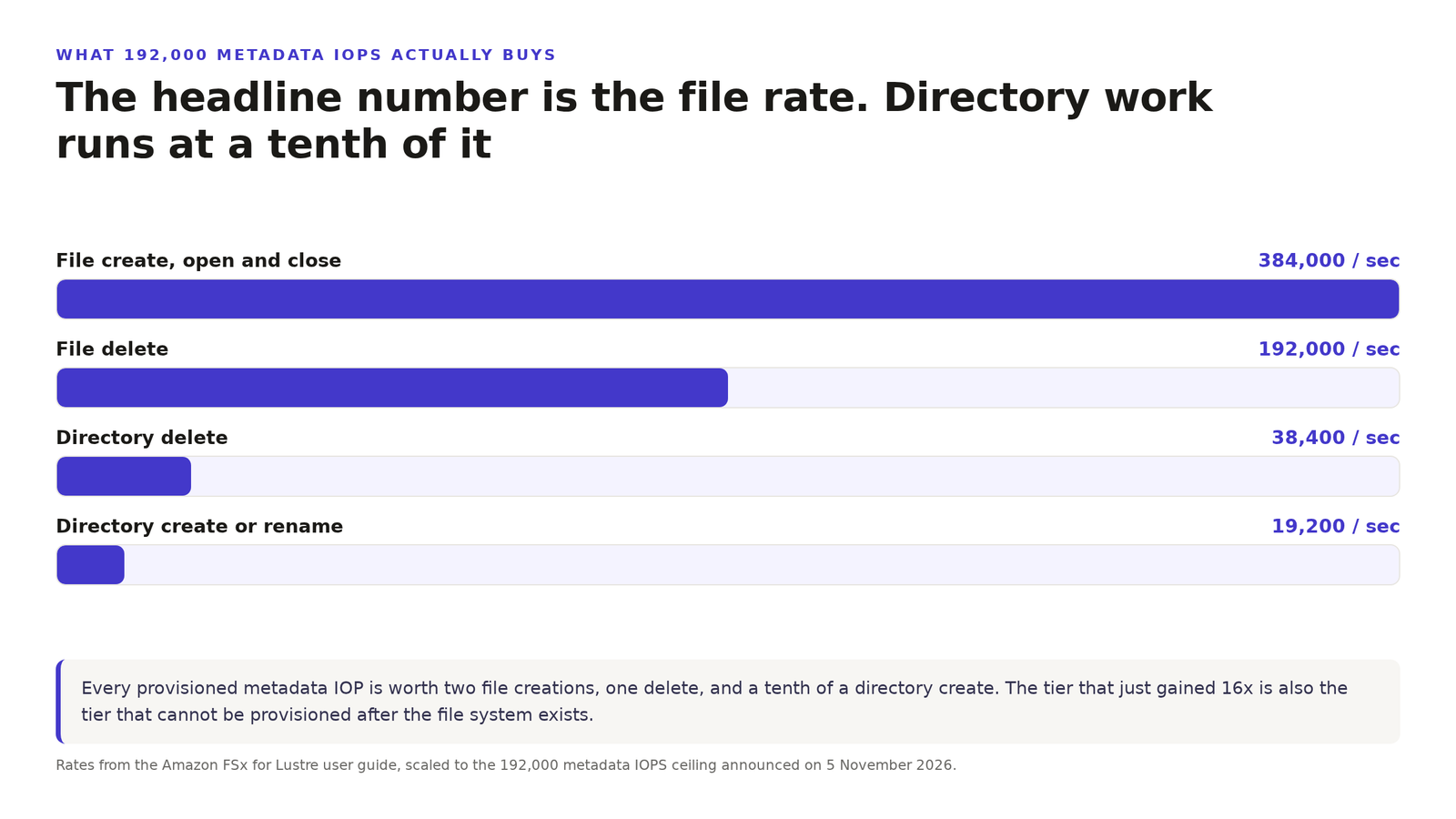
At 192,000 metadata IOPS that is 384,000 file creates a second, 192,000 deletes, 38,400 directory deletes and 19,200 directory creates. If your pipeline writes one manifest per experiment and ten thousand shards per manifest, you are on the fast side of that table. If it builds a directory per run, per worker and per shard, you can still only create 19,200 a second, and no announcement changes that ratio.
The migration is a copy, and the copy is the bill
The limit applies to new file systems. Nothing says an existing Intelligent-Tiering file system picks it up, and the user guide is specific that you cannot add or change a metadata configuration on a file system created without one, and that this needs the Persistent 2 deployment type. Metadata increases also have to be six hours apart.
There is a second trap for anyone who raises the number in place. Scaling past 12,000 adds metadata servers at one per 12,000 IOPS, and metadata written before the scale-up stays on the servers it landed on, so an old tree does not inherit the new throughput. New writes get distributed. Old paths stay put.
The user guide also still says the valid values here are 6,000 and 12,000. Either the page has not caught up with a launch three days old or the console will not offer the full range yet. Open the console, look at the Metadata IOPS field on a new file system, and see what it accepts before planning a migration around it. Watch the Metadata IOPS Utilization graph for a week first, because you pay for metadata above the default and buying a number you never touch is the easiest mistake in this entire change.
The honest summary is that AWS removed a tax, not a constraint. Teams that picked the cheap tier for a small-file dataset and then rewrote their pipeline into fewer, larger files can undo that rewrite if they will move the data. Teams on SSD storage were never blocked and gain nothing. That is worth a benchmark on a new file system and not worth an unplanned migration off an old one.
Three questions before you change anything. What is your metadata utilization at peak, and have you looked at that graph this quarter? Is your dataset one large file or ten million small ones? Would a rebuild now cost less than the throttled accelerator hours you already pay for?
Related reading. The path that feeds the GPU is the new AI bottleneck, and it is still the metadata layer. On the write side, the checkpoint interval still sets your goodput however fast the restart automation gets.
Get the next one before it is old news
Independent analysis of cloud-native infrastructure, Kubernetes and data center economics. No vendor spin.