


Executive Summary
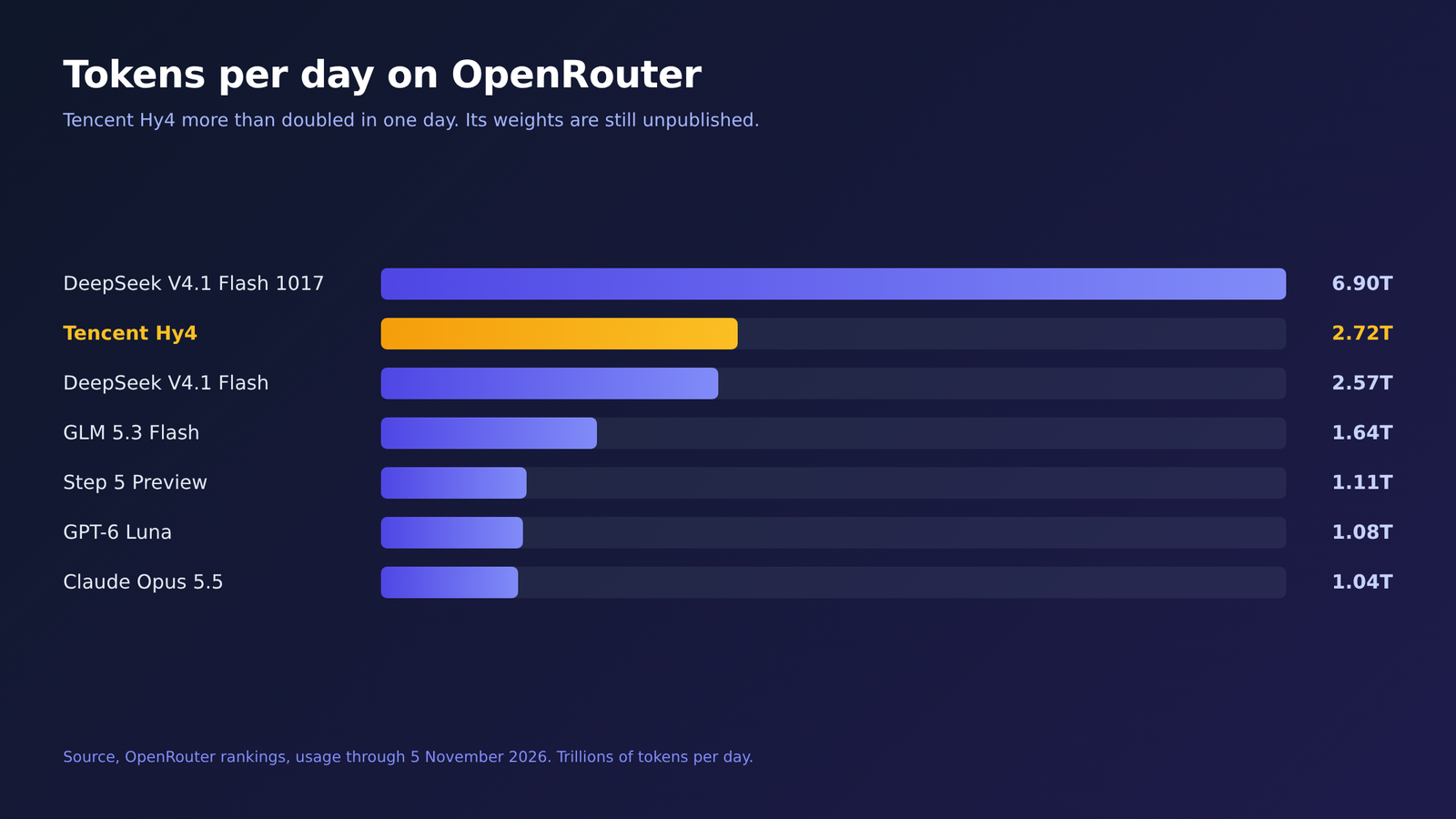
Tencent Hy4 processed 2.72 trillion tokens on OpenRouter on 5 November, second only to DeepSeek V4.1 Flash 1017 at 6.9 trillion. That is a 110 percent rise in a single day, and the model’s weights do not exist. Tencent promised checkpoints in the coming days. A check of Hugging Face and GitHub this evening finds only the August preview. The gap to DeepSeek fell from about 7.8 to one to 2.5 to one inside one day, which is our arithmetic on the published daily figures.
The direction of travel is the point. The Tencent model anyone can download fell 28 percent for the week while the closed flagship more than doubled. The same split shows up from the other side with Kimi K3.1 Pro, which took the top slot on the Hugging Face board today with 18,432 downloads and appears in neither OpenRouter top ten. Served tokens are the demand signal now, and they land on endpoints the reader does not control. Size capacity against traffic, not against the download chart.
Tencent opened the Hy4 launch page on 4 November with a claim. Hy4 “places Hy among the strongest open-source models for the first time,” it says. Two days later there is still no file to open, and the traffic has arrived anyway.
Tencent moved the traffic to the model with nothing to download
OpenRouter’s usage table through 5 November puts Hy4 at 2.72 trillion tokens for the most recent complete day, up 110 percent, behind only DeepSeek V4.1 Flash 1017 at 6.9 trillion. The same page lists Hy4 at 4.01 trillion for the week, marked as a new entry. Those two numbers describe the same two days, because the first one was 1.29 trillion on 4 November. One day at 1.29 and one at 2.72 sums to the weekly total, which is our arithmetic on the published figures.
Now look at the model Tencent actually published. Hy4 preview, the 770B Apache 2.0 release from August, sits at 6.58 trillion tokens for the week and falling, down 28 percent. It is the only Tencent flagship with a checkpoint anyone can run. The downloadable one lost ground in the same week the closed one doubled, and that is not a rounding error.
The accounting has a second hinge. Hy4 lists at 50 percent off standard pricing through 31 December, which is the detail in the launch notes we reported on 5 November. The number two slot was bought at half price and the invoice comes due in eight weeks. Read Hy4’s curve as structural demand and you are reading a promotion.
Downloads measure curiosity and endpoints move the tokens
Moonshot’s Kimi K3.1 Pro shows the same split from the other side. Our snapshot of the Hugging Face board on the morning of 5 November recorded 797 downloads at rank three. The API returns 18,432 downloads and 1,472 likes this evening, at rank one. That is a 23 fold rise inside two days, again our arithmetic on the two readings, and it is the loudest download number on the site.
Kimi K3.1 Pro appears in neither OpenRouter top ten, weekly or daily. The checkpoint is 1,561 GB of MXFP4 across 96 shards and needs a node of eight Blackwell Ultra GPUs to hold it, which we worked through on 4 November. Most of the teams downloading it tonight will not serve it at scale this month, and some never will. A download is cheap and reversible. An endpoint is a bill you pay every day.
Qwen arrives next into a split with no obvious answer
Alibaba put a teaser out today. The Qwen account posted four words, “The becoming begins,” with no model name, no date and no price, and the post has passed 608,300 views. What Alibaba has said on the record sits in its September roadmap, which lists Qwen 4 as in training and projects the line to 5 to 10 trillion parameters. Nothing downloadable exists.
Whichever lab lands next faces the same fork. Publish the checkpoint, top the download board, and carry the serving cost yourself. Or hold it, sell tokens against a promotional list, and move the volume that way while the discount holds. Tencent is running the second route in public, and it is working for now.
Three questions worth asking about your own environment. Which models are you serving this quarter, by endpoint rather than by what a team downloaded to test? If a vendor’s list price doubled overnight, would your cost model still hold? And when a lab calls a model open source with no checkpoint behind it, does your procurement language let you say no?
Get the next one before it is old news
Independent analysis of cloud-native infrastructure, Kubernetes and data center economics. No vendor spin.