

Executive Summary
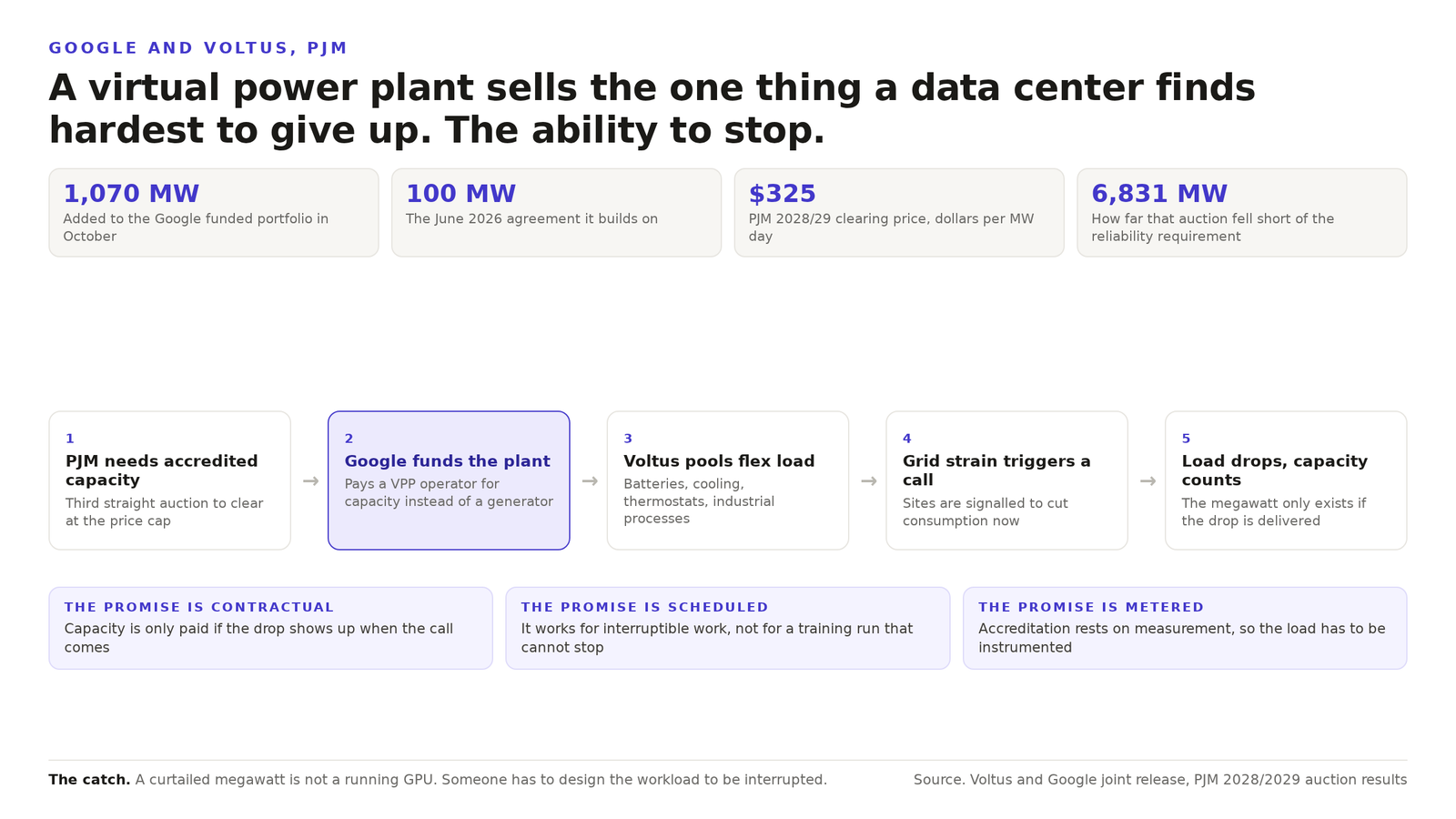
Google and Voltus announced on 22 October that they will build a one gigawatt virtual power plant in the PJM grid region, adding 1,070 MW to the 100 MW the two signed in June. Voltus pools flexible capacity from businesses and homes, Google funds it, and participating sites get paid to cut their draw when the grid is strained. The arrangement runs roughly three years.
The timing follows the market. PJM has cleared at its price cap for three auctions running and still falls short of its reliability requirement, so the cheapest new supply on the board is a promise to consume less. The verdict is that Google bought a hedge rather than a power plant, and the megawatt only exists if Google operations in PJM can drop load on command.
Google will pay for 1,070 megawatts of virtual power plant capacity in PJM, on top of the 100 megawatts it signed in June. There is no turbine behind any of it. The capacity exists only when somebody agrees to use less.
That is a different purchase from a power contract, and it puts a new requirement on the data center side of the business. In this market a megawatt is a promise to be interruptible.
The marginal supplier in PJM is now a battery and a thermostat
PJM 2028/29 Base Residual Auction secured 138,318 MW of unforced capacity and demand response across 13 states and the District of Columbia. It cleared at the FERC approved cap of $325 per megawatt day, 2.5 percent below the $333.44 cap a year earlier, and cleared supply times that price came to $16.4 billion.
The number that matters more is the shortfall. Procured resources landed 6,831 MW below the reliability requirement, and PJM described these as the first auctions in its history where the entire footprint fell short. When capacity clears at a cap for three auctions running, the price stops carrying information. The queue carries it instead, and nobody is adding supply fast enough.
A virtual power plant megawatt is a promise, not a machine
Voltus aggregates capacity from businesses and homes, including batteries, smart thermostats, industrial process adjustments and other flexible assets. When the grid is strained, Voltus signals those sites, they cut consumption, and the money returns as bill savings and direct payments. Google funding the plant is what turns scattered flexibility into a capacity product Voltus can take to a market.
The constraint sits inside the definition. Accredited capacity is capacity that performs when it is called. A site that promises a drop and does not deliver is not a power plant, it is a contract problem. So the megawatt Google is buying is a commitment to curtail, and Google operations in PJM have to be able to honor it.
Which workloads can you switch off?
That question now lands on operators who never expected to answer it. Training runs checkpoint and restart, but a restart is not free and a stalled collective wastes the accelerators that already sat waiting. Inference traffic can move between regions. Batch work can wait out a peak. The workloads that survive a curtailment signal are the ones written to be preempted.
Voltus says it connects distributed resources to all nine wholesale markets in North America and runs more than 7.5 GW of them. The Brattle Group puts the national prize at more than $100 billion over a decade from better use of the existing grid. Those numbers describe the market rather than Google, and the market is where this gets settled.
Then look at the shape of the bet. Google has bought supply on long term contracts before. This is demand, short term and callable, and it arrives years before a new generator could. We have covered why the gas peaker lost to a battery in every market modeled, and why sovereign AI capacity runs $60 million a megawatt. A curtailment contract is the cheap end of that curve, and it is the only end available this quarter.
Three questions for your own site. Which workloads can drop load inside the notice window your grid operator gives, and have you tested that? Do you meter what you would curtail, or are you estimating it? And what does a curtailment event cost in SLA credits against what the capacity is worth?
Related reading. Our look at why a 14 day AI factory build still waits on the power queue covers the other half of this constraint.
Get the next one before it is old news
Independent analysis of cloud-native infrastructure, Kubernetes and data center economics. No vendor spin.