

Executive Summary
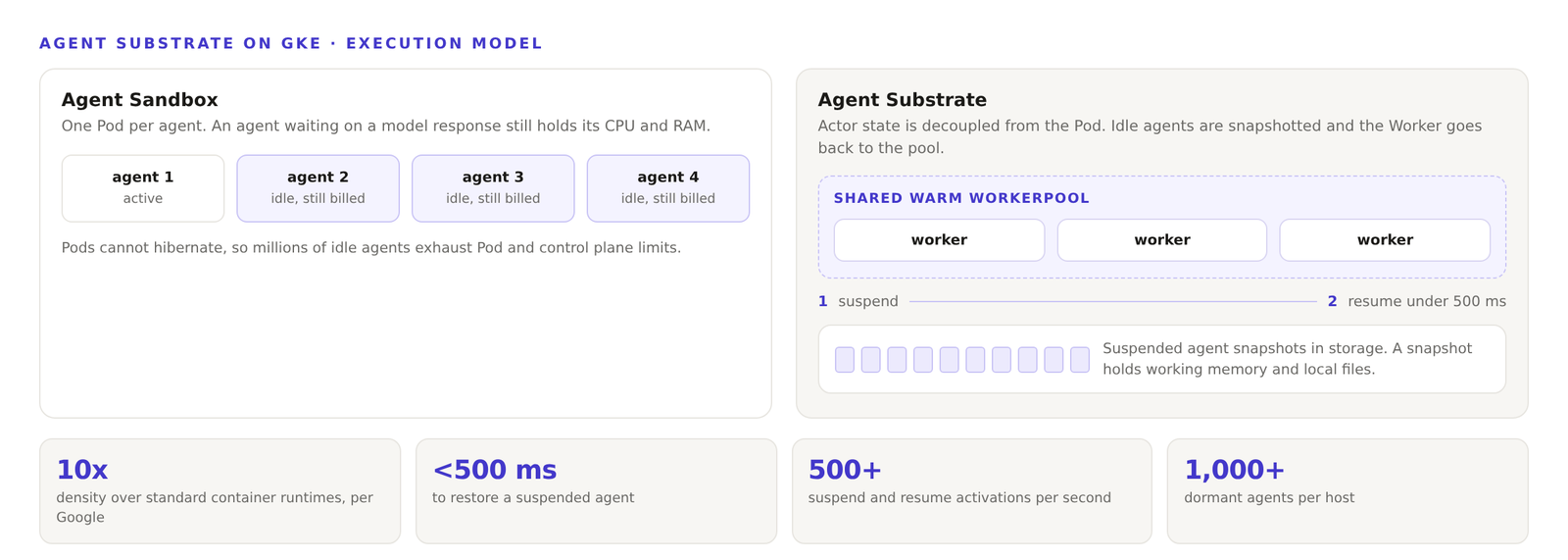
Google has made Agent Substrate available on Google Kubernetes Engine. The open-source runtime suspends idle agents to storage and restores them onto a shared pool of warm workers. Google puts the numbers at 10x the density of standard container runtimes, resumption under 500 milliseconds, and more than 500 suspend and resume activations per second.
The catch sits in the fine print. Substrate is open to all Google Cloud customers for evaluation and non-production use. Production support runs on an allowlist under a private GA program, so the teams with the densest agent fleets cannot simply adopt it. Platform teams get a credible open-source path to running untrusted agent code at scale, but not yet a supported one.
Google’s answer to the agent sprawl problem is to let the agents sleep. Agent Substrate is now available on Google Kubernetes Engine, an open-source runtime that keeps idle agents suspended and restores them in under half a second.
The design target is a fleet almost nobody runs today. Hundreds of thousands of long-lived agents that generate code, call command-line tools, drive browsers, then wait on a model response. Google says the usual Pod-per-agent model falls apart there. Kubernetes cannot hibernate a Pod, and an idle agent keeps holding its CPU and RAM. Substrate builds on Agent Sandbox, Google’s earlier sandbox runtime, and routes around that ceiling.
Substrate separates agent execution from machine management. Kubernetes still provisions the machines and owns the worker lifecycle. A second control plane owns the actors, places them onto workers in real time, and routes traffic to wherever they live.
Suspend and resume is the entire trick
An idle actor gets snapshotted, working memory and local files included, and its worker returns to a warm pool. A new request restores it onto an available worker. Google measures the restore at under 500 milliseconds and claims more than 500 activations per second, with over 1,000 dormant agents per host. Isolation comes from gVisor or Cloud Hypervisor microVMs, paired with egress proxies that inject credentials beyond the agent’s reach.
The economics come from the pause. Google says a single host can hold over a thousand dormant agents, which is where the 10x density claim comes from. Idle state is snapshotted to local disk and object storage, and the worker goes back to the pool. For a fleet that spends most of its time waiting on a model or a human, that is the difference between paying for capacity and paying for activity.
Production support is not part of the deal
Here is where the announcement gets honest with itself. The runtime is open to every Google Cloud customer for evaluation and non-production workloads. Production support is not. Google gates that behind a private GA program and a signup form. The project repository says outright that it is early and that APIs will move.
The runtime is harness agnostic and Google lists Claude Code, Codex, OpenClaw, and Hermes among supported agents, alongside the Agent Development Kit and MCP servers running as actors. Google names Nous Research as an early design partner and claims its Hermes agent ranks first worldwide by OpenRouter usage.
The portable runtime matters more than the GKE tie in
Agent Substrate on GKE is the headline, but the runtime is not tied to Google’s cloud. Google’s value add is optimized deployment tooling and ComputeClasses that stretch across spot and on-demand capacity. The bigger move is an open, framework agnostic runtime for untrusted agent code. The fight over agent infrastructure is a fight over who owns the execution layer, and Google just made its version portable.
Related reading. Microsoft open sourced the glue AI teams keep rebuilding on Kubernetes. OpenAI turned the agent harness into a managed service. And root on a single Kubernetes node is every identity on that node.
Get the next one before it is old news
Independent analysis of cloud-native infrastructure, Kubernetes and data centre economics. No vendor spin.