


Executive Summary
Tencent released Hy4 on 4 November and put it in a headline alongside the world’s leading open-source models. Its own release notes say the weights arrive in the coming days. As of 5 November there is no Hy4 repository on Hugging Face, no GitHub page for the release, and no system card to read. The only downloadable model in the family is still the August preview, and that one handles text only.
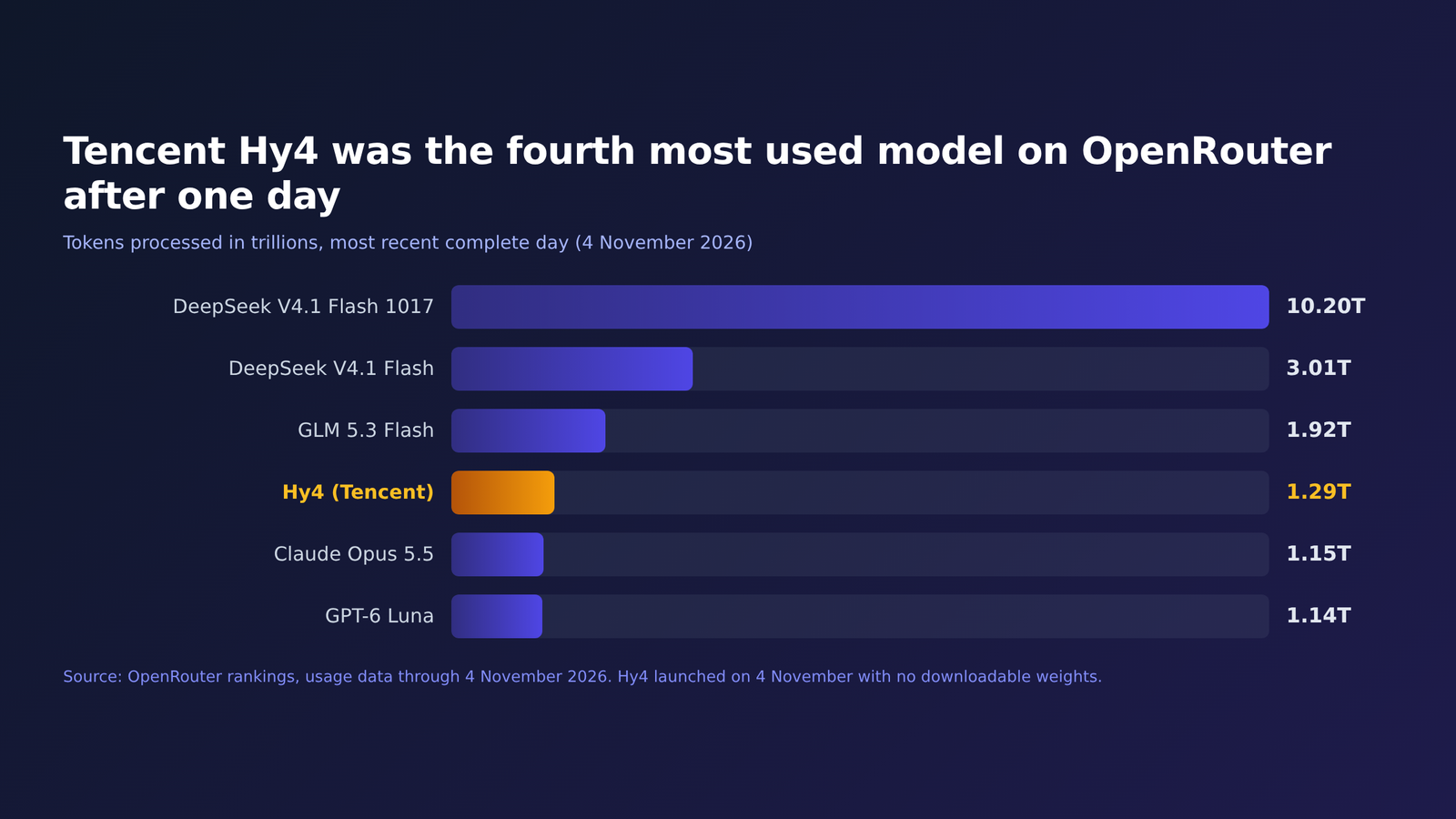
The hosted version is already the fourth most used model on OpenRouter, at 1.29 trillion tokens on its first day, ahead of Claude Opus 5.5. Budget off that listing and you budget off a discount. Tencent says the reduction ends on 31 December. Open weight used to mean a file you could hold. This release tests whether it now means a roadmap with a date nobody published.
Tencent’s newsroom post is direct about the order of events. One paragraph ranks Hy4 among the leading open-source models. The next says the company plans to release model weights and system cards in the coming days, with a focus on cybersecurity and biological safety.
The weights are a promise, and one site already printed the file
You can check this in a minute. The Hugging Face organization carries a repository for Hy4 preview and nothing for Hy4 itself. The GitHub organization has the same gap. That is not a private listing I failed to find. It is the state of the release on 5 November.
At least one site told readers otherwise. byteiota ran a piece with the line “Tencent shipped the full Hy4 today” and then “The weights are live on Hugging Face, (tencent/Hy4-preview)”. That repository is the August checkpoint. It handles text and predates the vision, computer use and chart reading Tencent is selling this week.
Both sentences are individually defensible and together they are wrong. Tencent put the word open in the title of its launch post and the qualifier in the body, which is the shape every lab uses while weights are still pending. The Tencent Hy4 open weights are a schedule, not a download.
The price on the listing is a launch discount, not a floor
OpenRouter lists tencent/hy4 at $0.417 per million input tokens and $1.251 per million output, with a 1,048,576 token context and a 65,536 token completion limit. Tencent’s own list prices are $0.834 and $2.501, with cached input at $0.042, unchanged from the preview. Read the pairs together and the listing sits at half of list, which lines up with Tencent’s statement that Tencent Cloud TokenHub runs at 50 percent off through 31 December 2026.
Anyone modeling next year on today’s number is modeling a promotion. That matters more here than usual, because the features being sold are long context and multi-step agent loops. Both burn tokens fast, and both scale their bill at list price once the discount lapses.
There is one provider behind the endpoint, Tencent Cloud. No alternate host, no price discovery, no fallback if capacity tightens.
Token rank measures prompt length, not adoption
Hy4 was the fourth most used model on OpenRouter on 4 November, at 1.29 trillion tokens, ahead of Claude Opus 5.5 at 1.15 trillion. It was new that day, so that is a debut result.
The same data puts Tencent at 1.9 percent of requests for the week, against DeepSeek at 29.8 percent and OpenAI at 18.8 percent. Both numbers are true at once because tokens divide by requests. A model with enormous average requests can top a token chart while serving very few callers. A million token window and agent loops do exactly that.
The preview finishes the picture. It still carries 8.1 trillion tokens a week at rank five, down 10 percent. The version you can download keeps doing more work than the version you cannot.
None of this makes Hy4 a weak model. Tencent ran a finance evaluation with 213 professionals across 579 tasks and scored it 3.04, against DeepSeek V4.1 Flash at 2.97 and Kimi K3.1 Pro at 2.68. Every one of those numbers is company-run and unaudited. The model is real. The download is not.
Three questions for your own estate. Does your procurement rule trigger on the announcement or on the checkpoint. Does your cost model use the promotional rate or the list rate. And which of your workloads genuinely needs a million token window, because that usage pattern is the reason this chart looks the way it does.
Related reading. Moonshot shipped Kimi K3.1 Pro weights on the date it promised, and the eight GPU floor is the real admission price. The DeepSeek share of OpenRouter traffic is the other half of this picture.
Get the next one before it is old news
Independent analysis of cloud-native infrastructure, Kubernetes and data center economics. No vendor spin.
[…] at 50 percent off standard pricing through 31 December, which is the detail in the launch notes we reported on 5 November. The number two slot was bought at half price and the invoice comes due in eight weeks. Read […]