


Executive Summary
The board turned over faster than any week in the eight days captured. On 30 October one small 3D coder sat at rank sixteen and no repository carried an image-to-3d tag at all. This morning ranks two, three and four belong to an image-to-3d generator, a 4B 3D coder and a video model. Speridlabs/idol went from first appearance at rank twenty four with 221 downloads to rank two with 17,180 inside six days.
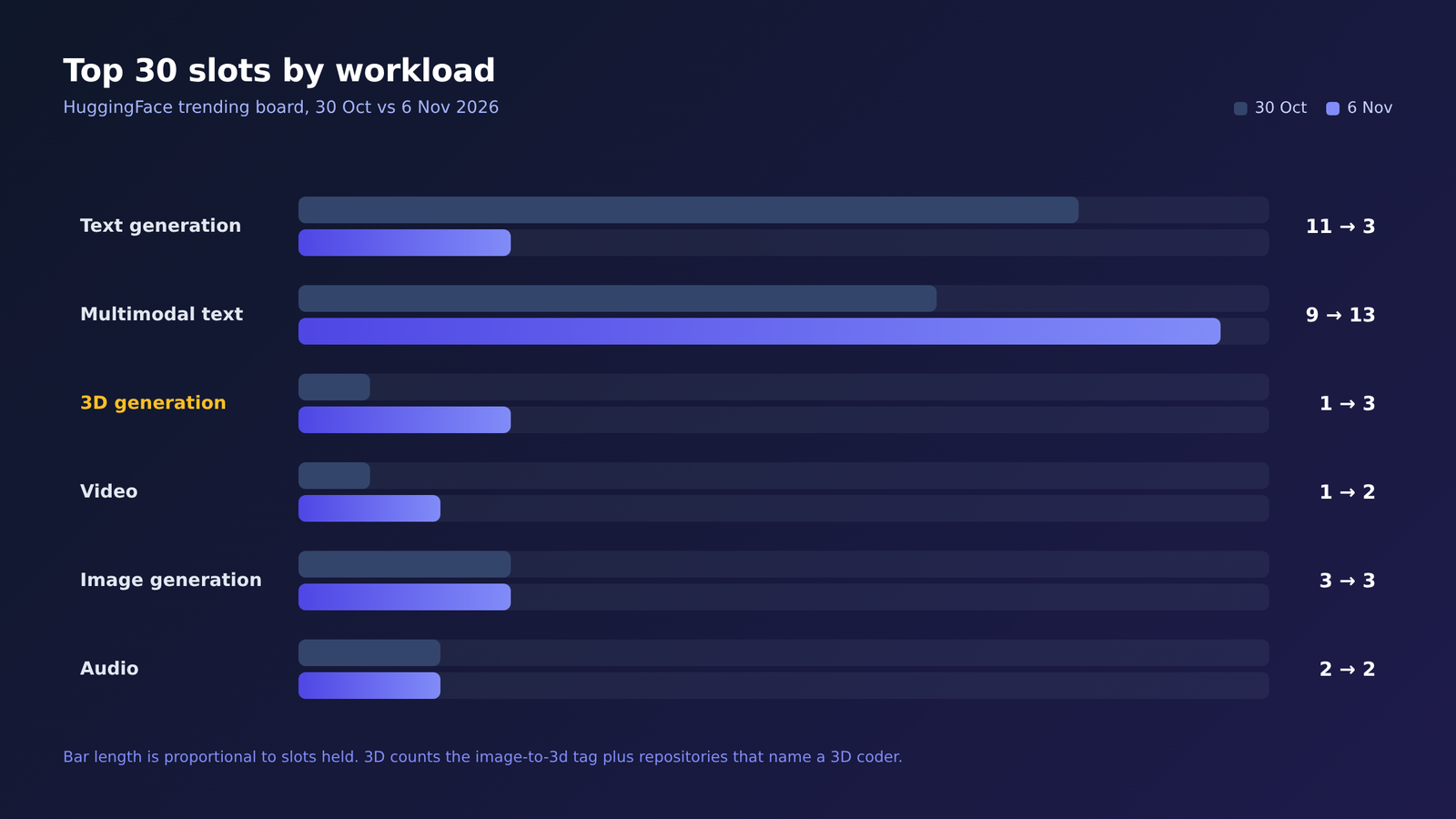
The loss is concentrated on the text side. Text-only generation held eleven of the thirty slots on 30 October and holds four today, one of which is itself a 3D asset coder. Four of the top five slots were text models a week ago and none are now. Multimodal models absorbed the difference, nine slots to thirteen. The serving consequence runs past the ranking. A 4B model at rank three runs on hardware most teams already own, and 3D output arrives as one artifact rather than a token stream, so capacity planned in tokens per second will not size it.
The HuggingFace trending board swapped its center of gravity from text to geometry inside six days. speridlabs/idol appeared nowhere in the thirty slots captured on 30 October. It entered on 31 October at rank twenty four with 221 downloads. This morning it holds rank two with 17,180.
That is a 77 fold rise. What surrounds it matters more than the rise. Rank three is ccore/Qwen3.5-4B-3D-Coder, up from sixteen, with downloads of 12,237 on 30 October against 157,157 now. Rank four is Lightricks/LTX-2.5, which turns a still image into video. Three of the top four slots now return something that isn’t a token.
A week ago no model on the board carried a 3D tag
On 30 October the capture held one 3D-adjacent repository, the ccore coder at rank sixteen, and its pipeline field was empty. The board’s own image-to-3d filter matched nothing across all thirty rows. The next morning a tagged image-to-3d model entered at rank twenty four.
Its rank then read seventeen, ten, five, five, two, two across the six captures that followed. That is not an adoption curve. It is a step.
ccore holds two slots now. A second repository, Qwen3.5-4B-GLB-3D-Coder, entered today at rank twenty five with 12,206 downloads. Both are 4B parameter models. Two slots from one lab, twenty two ranks apart.
Text-only slots fell from eleven to three
Count HuggingFace trending models by the board’s own pipeline field. Eleven of thirty slots carried a text-generation tag on 30 October, and four of the top five were text models. This morning four carry that tag and none of the top five do.
LiquidAI/LFM3-1.7B held rank one on 3 and 4 November. It sits at fifteen this morning. The best-placed text-only model is a community quant at rank eleven.
Multimodal models absorbed the space, rising from nine slots to thirteen. The two 3D coders explain the rest of the arithmetic. Neither carries a 3D pipeline tag, one is blank and the other reads text-generation, which is why the chart files both under 3D.
What changes for the teams running the GPUs
3D generation is a different serving shape from token streaming. A text request returns incrementally, so batching is about tokens per second. An image-to-3d request returns one artifact, holds memory for the whole generation, and the useful number is artifacts per GPU hour.
Capacity planned on token throughput will be wrong for this traffic in both directions. A 4B coder at rank three is cheap. LTX-2.5 has put 2,561,845 downloads through a video pipeline that will not run on the card serving the coder.
The board’s taxonomy lags too. Filter by pipeline tag to size a fleet and both 3D coders disappear, one into a blank field and one into text generation.
Three questions for your own mix. Does your taxonomy separate a 3D asset coder from a text generator? Can your serving stack hold a request that returns one artifact instead of a stream? And when something enters at rank twenty four, does anyone notice before it reaches rank two?
Related reading. Yesterday’s capture of this board asked why rank orders momentum rather than installed base, and the answer is a velocity score. The hardware floor for open weights is set by memory, not download count, which Kimi K3.1 Pro made concrete.
Get the next one before it is old news
Independent analysis of cloud-native infrastructure, Kubernetes and data center economics. No vendor spin.