


Executive Summary
Reflection released the weights for Beam on 16 October under Apache 2.0. It is a sparse mixture of experts model with 501 billion parameters, 23 billion active for each token, and a 1M token context window. The size gets the attention. The shrink is what changes buying decisions, because the NVFP4 build drops the checkpoint from about 1 TB to roughly 280 GB and fits on four B300 GPUs.
The constraint then moves. Beam holds its cache near 36 KiB per token, so one full length context costs 36 GiB before a second request arrives. On that four GPU node the published figures allow about 19 long contexts at once, against roughly 3 if every layer kept full history. Plan capacity in memory rather than requests per second. Context length is the number buyers will argue about next.
Reflection published the weights on 16 October, eleven days after showing the model and promising them by the end of the month. Apache 2.0, on Hugging Face, with no field of use attached.
Beam is a sparse mixture of experts model. It holds 501 billion parameters and computes 23 billion for each token. Memory scales with the 501 billion. Compute per token scales with the 23 billion. You buy a big footprint once, then serve at the rate of something far smaller.
Two published numbers decide the cost. The checkpoint, and the attention design. The second one gets skipped.
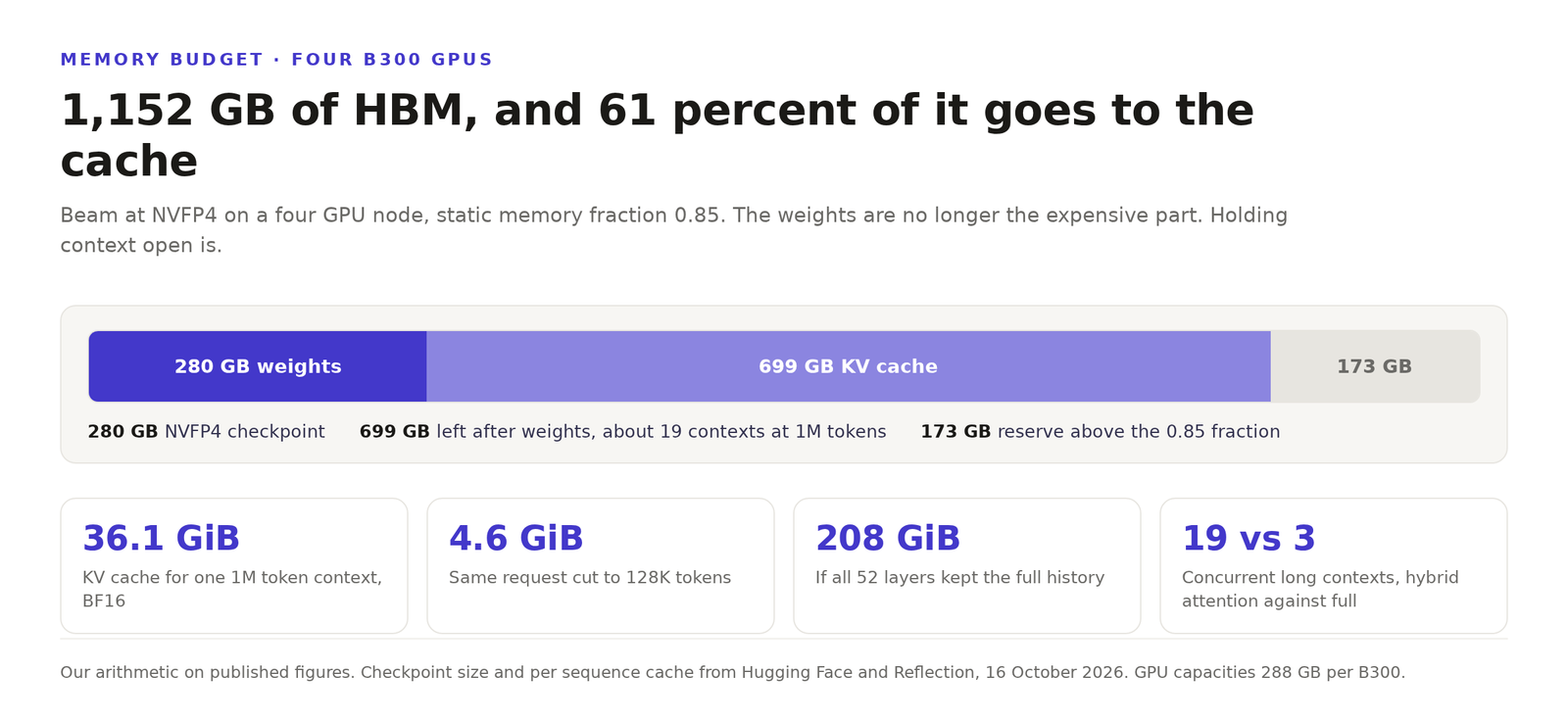
Only one of the two numbers sets your node count
Hugging Face lays out the architecture. Beam has 52 layers. Three are dense. The other 49 are mixture of experts blocks with 256 experts each, holding 98.4 percent of the model’s parameters.
Expert parallelism puts each expert on a device, so the device count has to divide 256. Run the BF16 build on eight H200s and each card carries about 139 GB of weights. An H200 has 141 GB. Nothing is left for activations or the cache.
Sixteen H200s brings it to about 78 GB a card, which is why the published vLLM recipe uses tensor parallelism across two eight GPU nodes. The cheaper route is precision. The NVFP4 build holds most weights at four bits and lands near 280 GB, and the SGLang recipe serves it on four B300s.
Forty-three layers stop growing, so long context stays affordable
Beam does not run full attention everywhere. Forty-three of the 52 layers keep a sliding window over the previous 512 tokens. Nine attend to everything, the final layer included. Only those nine grow as a context fills.
Hugging Face publishes the arithmetic. The cache grows by about 36 KiB for each token, against 208 KiB if all 52 layers kept the full sequence. At 1M tokens a single context occupies 36.08 GiB in BF16 instead of 208 GiB.
Run that against the four B300 node. Four cards at 288 GB give 1,152 GB of HBM. A static fraction of 0.85 leaves about 979 GB for weights and cache. Take out the 280 GB of weights and roughly 699 GB is left for KV cache memory, which is about 19 full length contexts at once. At 128K tokens, where a context costs 4.6 GiB, the same node holds roughly 150.
Full attention on the same hardware would manage three. Same weights, same cards, six times the long context concurrency. That gap is why most serious open models in 2026 ship a variant.
The cache is reserved rather than shared. A 1M token request commits 36 GiB until it finishes, and agents hold context open far longer than chat does. Throughput on short prompts tells you little about an agent fleet.
Day one support is why this shipped as a system
Reflection did not publish a checkpoint and walk away. Transformers, vLLM, SGLang, Unsloth, Axolotl and NVIDIA Dynamo all handled Beam on release day, and the release includes a DFlash2 speculative drafter that proposes up to 15 tokens for the model to check in one pass.
The partner list says it too. More than 40 integrations, managed endpoints from Baseten, Fireworks and Together, cloud placement on AWS, Microsoft Azure and Google Cloud, GPU clouds including CoreWeave and Nebius, and Dell and HPE behind the firewall.
For an operator the reading is unglamorous. Self-hosting a 501B model is a multi node commitment with a precision decision attached. Hopper means FP8 across eight H200s and less room for context. Blackwell means NVFP4 on four B300s and the memory comes back. On neither, managed endpoints are the only entry point.
Open weights still win in the estate that cannot reach an endpoint. Air gapped and sovereign deployments, and teams that will not send source code to a vendor API. Apache 2.0 removes the license review that used to stall those projects.
Three questions before the next hardware order. What context length do your agents reach at the 95th percentile, not in the demo? How much memory does one request hold for its lifetime, and how many fit on the box you are buying? And if experts rather than compute set your node count, what are you paying per concurrent context?
Related reading. We looked at how vLLM handed kernel writing to coding agents, and at why the 2029 AI capacity forecasts look about three times too big.
Get the next one before it is old news
Independent analysis of cloud-native infrastructure, Kubernetes and data center economics. No vendor spin.