


Executive Summary
Intel used the Open Compute Project to put a name and a specification on the inference accelerator it has teased for a year. The Intel GPU D-series, formerly code-named Crescent Island, offers up to 480 GB of LPDDR5X memory, 1.5 TB/s of bandwidth, 1.3 petaflops of FP8 compute and a 350 watt envelope on an air-cooled PCIe card. The wager is that inference is constrained by memory capacity rather than memory bandwidth, so it trades expensive high-bandwidth memory for commodity LPDDR5X and wins on cost and power.
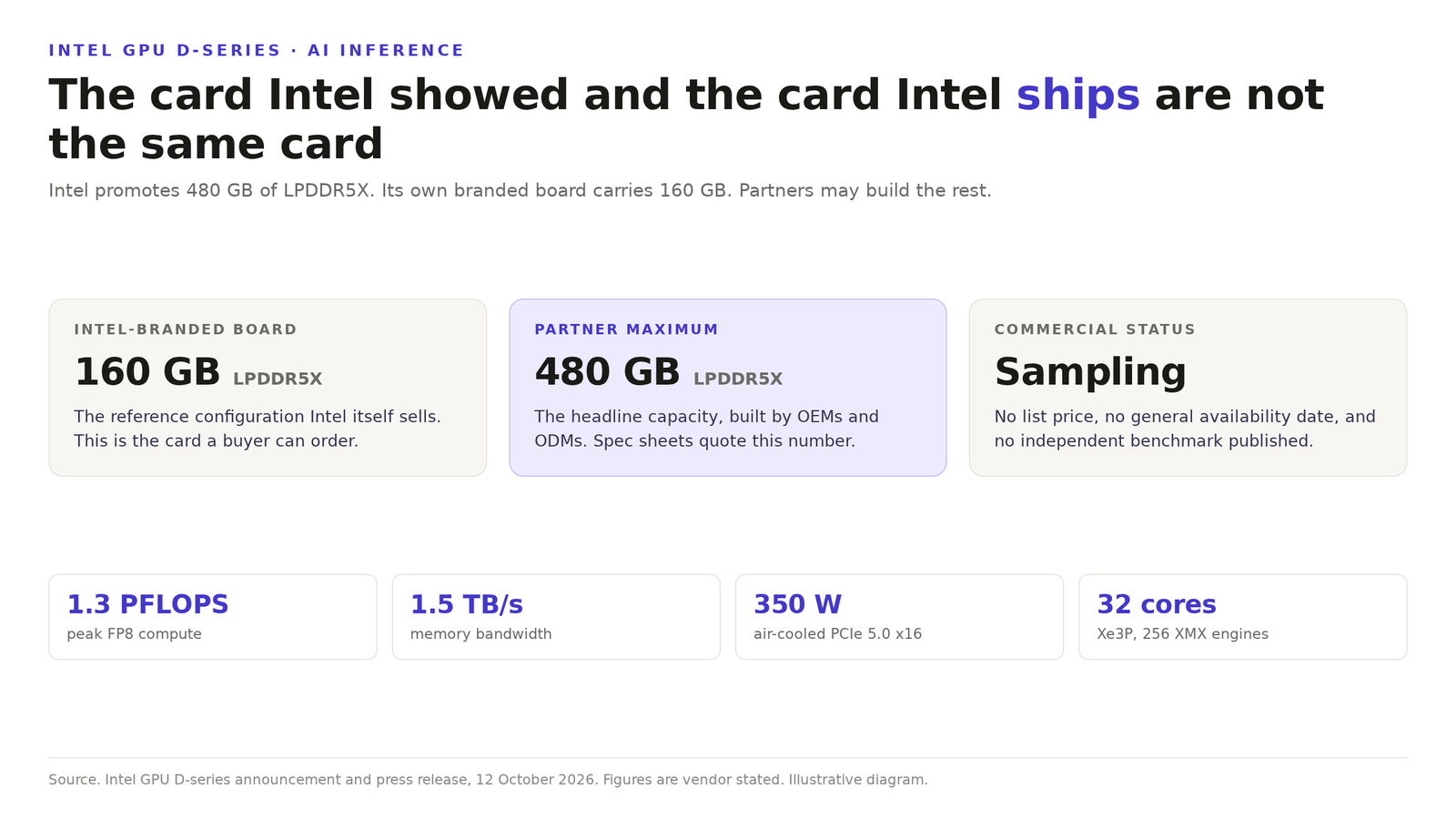
The detail that decides the purchase is not the headline. Intel’s own branded board carries 160 GB and partners may build up to 480 GB, so a buyer comparing a 480 GB specification sheet is comparing a configuration most will never be quoted. Intel has run this play before, and its previous AI accelerators did not win the major clouds. Sampling is under way with no list price, no general availability date and no independent benchmark. Watch for the first named deployment rather than the peak number.
Inference is not training. A trained model sits still. Serving it is a memory problem, because every session that is open at once keeps its own KV cache, and long context makes that cache grow. The weights have to stay resident as well. A card can look slow on paper and still be the right purchase if it holds enough, and that is the case Intel is making.
The Intel GPU D-series carries up to 480 GB of LPDDR5X, 1.5 TB/s of memory bandwidth and 1.3 petaflops of FP8 compute inside a 350 watt envelope, on an air-cooled PCIe 5.0 x16 card. Intel’s announcement positions it for large language models, long-context work and concurrent inference services, and claims models up to 300 billion parameters on a single card.
The bottleneck Intel is betting on is capacity, not bandwidth
The design choice is the story. High-bandwidth memory has been the tightest part of the AI supply chain for two years, and it is the reason accelerators cost what they cost. Intel skipped it. LPDDR5X is cheaper, denser and easier to source, and the trade is bandwidth for capacity. That only makes sense if capacity is what binds first on a production rack, which is exactly the claim Intel is making about agentic serving, where many models and tool calls share one pool of memory.
Both halves of that argument are worth separating. More memory lets you hold a larger model, a longer context and more concurrent sessions without swapping. Less bandwidth slows every token you generate. Intel is telling buyers to optimise for the first and accept the second, and it pairs the card with Xeon rack designs built on the Open Compute Project‘s Open Rack v3 specification, with software support for the vLLM serving stack.
The number on the slide is not the number on the order form
Intel’s own branded board carries 160 GB of LPDDR5X. The 480 GB figure is the ceiling its OEM and ODM partners can build to. A buyer weighing the D-series against HBM-based accelerators is likely to compare a 480 GB specification sheet against parts they can order today, and then be quoted a 160 GB card.
The arithmetic is worth doing before the call. At FP8 precision, 300 billion parameters is roughly 300 gigabytes of weights. On a 160 GB board that single-card claim only closes at 4-bit weights, which leaves little headroom for context and concurrency, the two things the card was designed for. The capacity advantage is real. It arrives at a smaller size than the promotion suggests.
There is also a software precedent to weigh. Intel’s previous AI accelerators did not win deployments at the major clouds, and the software stack was the reason. The D-series runs on the same Xe software foundation as Intel’s existing GPUs and Intel claims day-zero enablement for new open models, but day-zero support in a release note and tuned kernels in production are different things.
Air cooling is why this fits a rack you already own
The part an operator can act on is the form factor. A 350 watt card in a standard PCIe slot means inference capacity goes into a server you may already own, without a liquid loop and without a rack rebuild. The fastest accelerators now assume liquid cooling and purpose-built halls, which is a different capital project with a different lead time.
That is the honest case for the D-series. If you have power headroom and existing air-cooled racks, the card offers a way to add capacity without a facilities programme. If your constraint is tokens per second on a fixed bill, the missing bandwidth matters, and no benchmark has been published that would settle it. Intel says sampling is under way. Pricing, general availability and independent results are all still outstanding.
Related reading. AMD is making the same memory bet on the host side with LPDDR5X on SOCAMM2 modules. The reason capacity matters more than bandwidth is the KV cache spilling out of HBM. And AMD’s agent rack makes the CPU half of the same argument.
Get the next one before it is old news
Independent analysis of cloud-native infrastructure, Kubernetes and data center economics. No vendor spin.