


Executive Summary
AM Intelligence placed two orders on 5 October for 20,000 Nvidia Rubin GPUs, deployed as Vera Rubin NVL72 rack-scale systems in India and Malaysia. That lifts its order book to 29,000 GPUs and about 100 megawatts of contracted capacity, delivered in the second quarter of 2027. The order matters because it publishes the three numbers the sovereign AI cluster announcements of the past month left out. Power, dollars, delivery date.
The finding is that the price moved the wrong way for anyone hoping capacity gets cheaper. The first 100 megawatts were committed at $6 billion, which is $60 million per megawatt. The next 300 megawatts carry an estimated investment of over $20 billion, which is more than $66 million per megawatt. Rack power density lands near 250 kilowatts and is liquid cooled throughout, and the company says the same footprint will accept successive generations of silicon. The verdict for buyers is that power delivery and thermal design now set the schedule, and the dollars follow them rather than the chip.
Four governments announced GPU clusters in late September and almost none of them said what the capacity cost. One buyer in India did. Greenko promoters built AM Intelligence, and the release led with numbers rather than ambition.
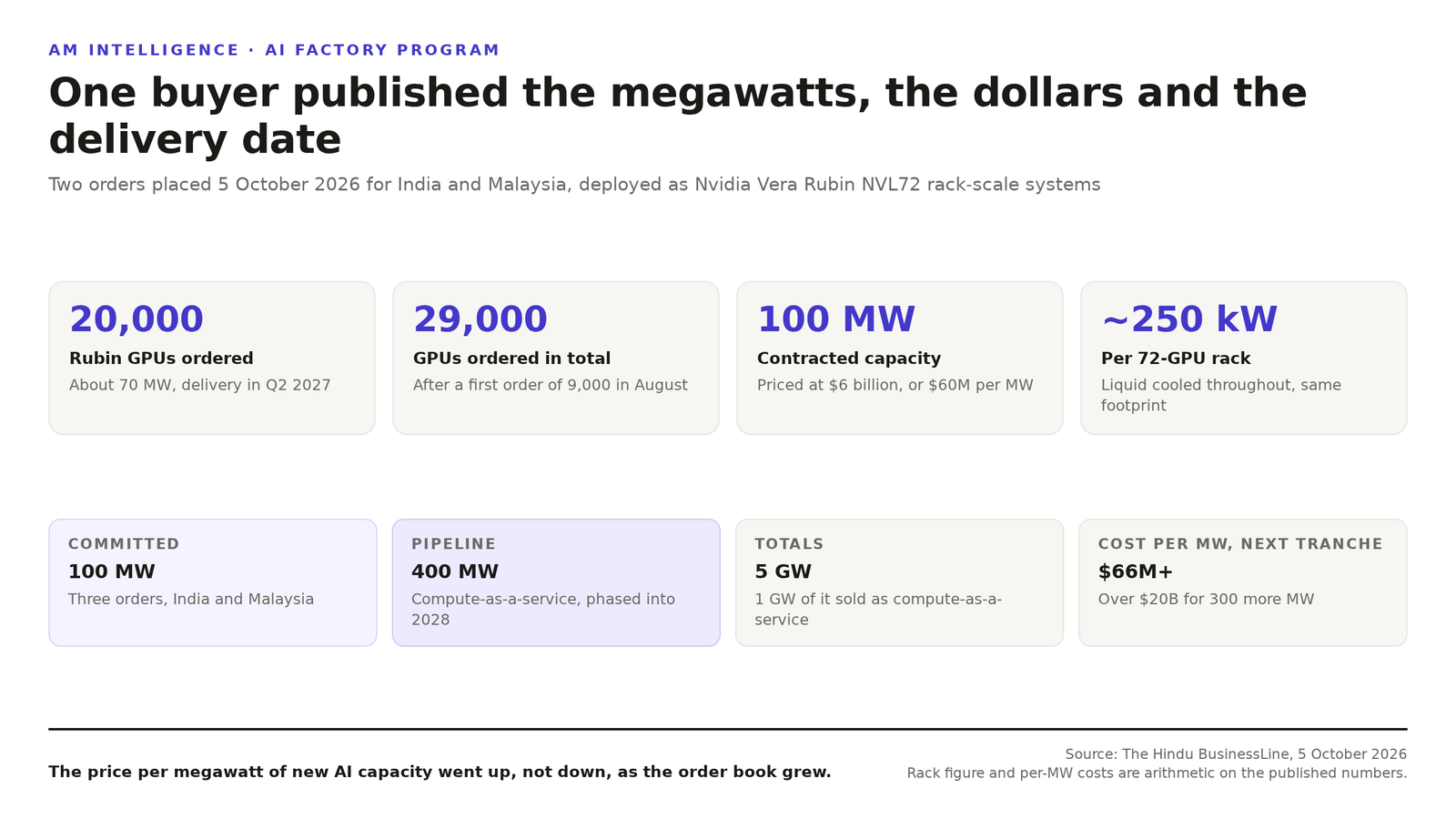
AM Intelligence ordered 20,000 Rubin GPUs across two sites, in India and Malaysia, for delivery in the second quarter of 2027. The release puts the new capacity at about 70 megawatts, deployed as Nvidia Vera Rubin NVL72 rack-scale systems. A first order of 9,000 GPUs went in during August for the company’s first AI factory in Hyderabad. Total order book, 29,000 chips and 100 megawatts.
The order book grew and the price per megawatt grew with it
The first 100 megawatts were funded with $6 billion already committed. That is $60 million per megawatt of AI capacity. The company now says it will bring another 300 megawatts to market within 15 months at an estimated investment of more than $20 billion, which works out above $66 million per megawatt.
That number is the one to sit with. The sovereign AI data center cost per megawatt is rising as the program scales, not falling. Successive rack generations draw more power than the ones they replace, so a megawatt bought in 2027 is a different package from a megawatt bought in 2024. The second tranche also carries the cost of building the shell, the interconnection and the cooling plant rather than fitting into an existing one.
250 kilowatts a rack makes liquid cooling the entry ticket
Vera Rubin NVL72 is a rack-scale product, so the unit of delivery is one enclosure holding 72 GPUs. Twenty thousand GPUs is roughly 278 racks. Spread 70 megawatts across that fleet and each rack draws about 250 kilowatts, in the same band as the AMD Helios rack at 225 to 245 kilowatts.
Anil Chalamalasetty, the chairman of AM Intelligence, said each site is engineered for high rack power density and liquid cooled throughout, so the same physical footprint can accept successive generations of AI silicon. That is a bet on the shell rather than the chip. The Open Compute Project specifications the industry writes for power delivery and liquid cooling are the reason a building can be planned for silicon that does not exist yet.
Compute-as-a-service is a quarter of the pipeline
The three orders are described as the first committed tranche of a pipeline of about 400 megawatts of compute-as-a-service capacity across India, the US, Europe and Malaysia. The rest is under development for phased delivery in 2027 and early 2028. The company plans to sell 1 gigawatt as compute-as-a-service inside a larger program of 5 gigawatts of powered AI data centers.
That framing changes who the counterparty is. A company that builds generation and then sells capacity is not reselling somebody else’s hardware. The power contract is the product, and the customer rents the outcome. It also puts delivery risk on the operator, because if the interconnection or the cooling plant slips, the customer hears about it before the chip ever arrives.
Three questions for your own capacity plan. Does your supplier publish a megawatt figure and a delivery quarter, or only a chip count. If you buy rack-scale systems, who carries the support boundary when rack density exceeds what your floor was designed for. And on your next capacity order, is the thermal plant costed into the deal or treated as a later surprise.
Related reading. Four countries announced GPU clusters and almost none said what they cost, Vera Rubin NVL72 reached production, and a 1 MW rack broke the 54 volt bus.
Get the next one before it is old news
Independent analysis of cloud-native infrastructure, Kubernetes and data center economics. No vendor spin.
[…] Read the full analysis. […]