


Executive Summary
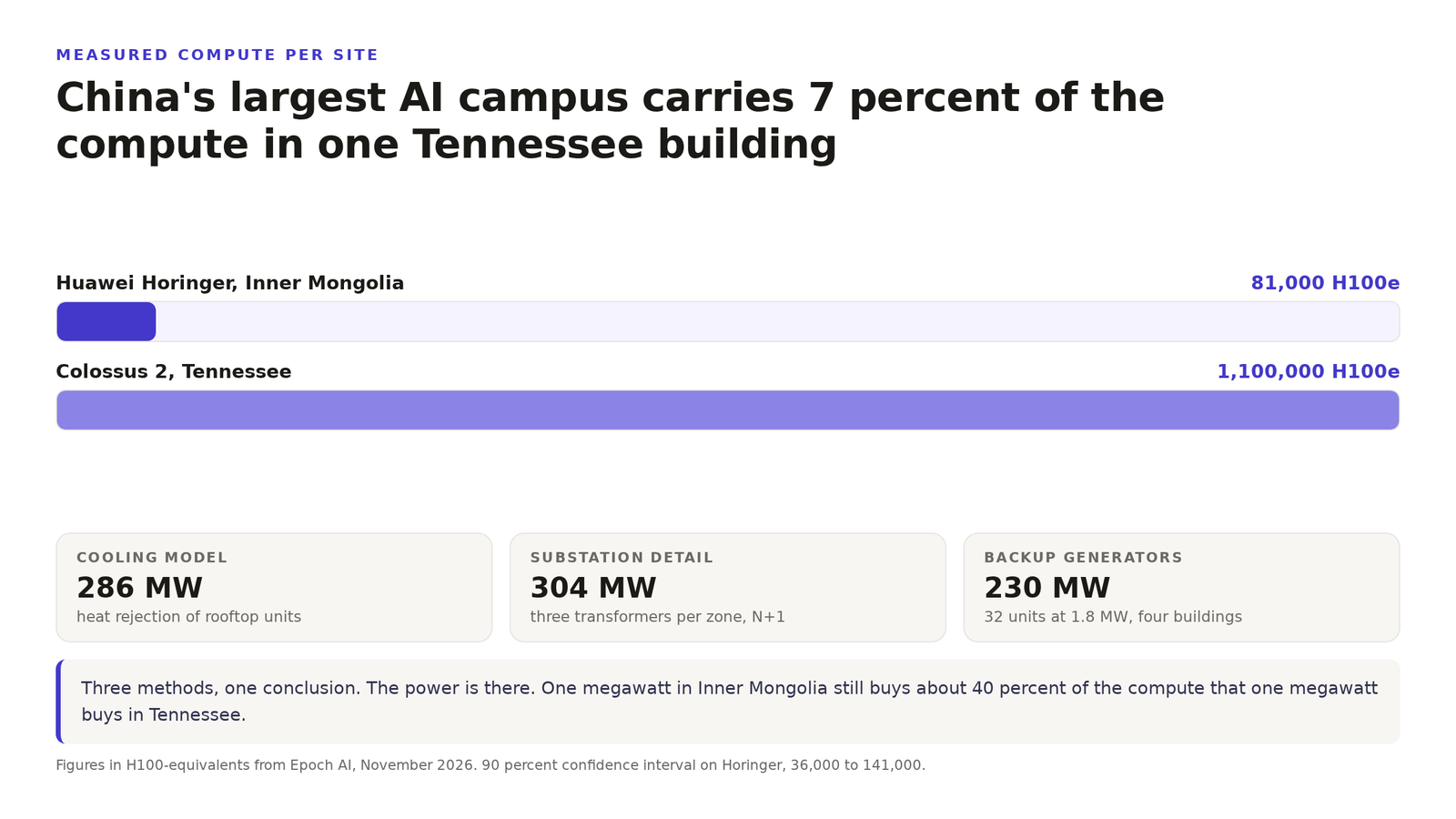
Epoch AI measured the Huawei Horinger campus in Inner Mongolia without entering it. Three independent methods, a model of the rooftop cooling equipment, substation transformer detail and a count of backup generators, put IT power capacity between 230 and 304 megawatts. From that the report lands on roughly 81,000 H100-equivalents of installed compute, with a 90 percent confidence interval of 36,000 to 141,000. Colossus 2 in Tennessee holds about 1.1 million on the same scale, so one campus is 14 times the other.
The size gap is the headline and not the finding. Horinger is not short of land, power or grid access. It is short of compute per watt. The Ascend 910C delivers about 0.76 of an H100 per chip at roughly 2.5 times worse energy efficiency, so a megawatt there supports around 40 percent of what a megawatt supports in a US facility. The next building does not fix that, because the Ascend 950 it will run is less efficient per joule than the chip it replaces. The constraint behind China’s largest AI campus is the silicon.
A satellite cannot see a GPU. It can see a cooling tower, and cooling turns back into megawatts, and megawatts into chips, if you know which chip sits underneath. Epoch AI ran that arithmetic on the Huawei Horinger data center and published it on 6 November.
A rooftop with a quarter of the cooling is not an AI building
Horinger sits in Inner Mongolia, part of China’s East Data West Computing program, split into three zones that act as availability zones. From orbit the buildings look interchangeable. The North zone does not. It carries far fewer cooling towers and chillers on the same footprint, and less heat rejection means less power density. AI servers run more than ten times the power density of the industry average, so a building with a fraction of the cooling is not an AI building whatever its floor plan says.
Epoch dropped the North zone and modeled the four remaining high-density buildings at 286 megawatts of IT capacity. Substation detail agrees, about 304 megawatts across two zones on three 100 MVA transformers each with N+1 redundancy. Backup generators agree at about 230 megawatts.
Then the question of whether anything is switched on. Epoch found steam above an evaporative cooling tower, and coloured ghosts trailing cooling tower fans in another frame, which is what a sensor records when a fan spins as it catches wavelengths a fraction apart. Three of the four buildings are running.
The megawatts were never the binding constraint
Huawei has published no performance figure for the Ascend 910C, so Epoch reconstructs one. The evidence points to about 1,504 tera-operations per second in 8-bit integer format against 1,979 for the H100, about 0.76 H100-equivalents. SemiAnalysis put the chip’s draw at 1.56 kW inside a CloudMatrix 384 supernode.
Nvidia’s B200 and B300 sit near 5,000 tera-operations and are about 2.5 times more energy-efficient again. That ratio is the story. A site built on Nvidia-class efficiency turns a megawatt into two and a half times the compute Horinger turns it into, so the same power in China supports around 40 percent of a leading US site.
Power into chips, then. Epoch allocates Horinger’s occupied racks from Huawei chip sales with a four month deployment lag, assumes the 76 percent occupancy the wider Horinger area reported in September, and lands on about 105,000 Ascend 910C and 8,000 910B installed. That is 81,000 H100-equivalents, on an interval that runs from 36,000 to 141,000.
The next building adds power and keeps the same share
A fifth high-density building is going up in the South zone. Public disclosure puts it at 100,000 accelerator cards on the Ascend 950, and Epoch models 76,000 of the 950DT variant at 76 percent occupancy, needing 135 megawatts. Epoch’s roadmap work is why that is a problem rather than a win. The 950 is less energy-efficient than the 910C, 516 gigaflops per joule against 964.
The grid will carry it. Five more transformers at each zone substation could lift campus power by up to 3.5 times, which puts Horinger at about 141,000 H100-equivalents by early 2028 against a Colossus 2 projection of at least 1.8 million. The ratio lands close to where it started, and the money going into US power is the reason why.
One caveat matters. A campus this size is usually several separately networked clusters, so the total cannot necessarily be combined into one training run. What it can still do is large. Ten percent of Horinger, about 8,100 H100-equivalents, trains a model the size of DeepSeek-V4-Pro in a month.
The read for operators is how capacity gets counted. If your site plan is a megawatt number and a delivery date, you have measured the half a utility can solve and left the half your accelerator decides. Two halls with the same power budget and different silicon are not the same capacity, which is why Alibaba’s 20 gigawatt plan is really a chip story.
Three questions for your own estate. How many H100-equivalents per megawatt does your site deliver, and has anyone computed it? What does your accelerator’s joules-per-operation gap do to cost per token at 70 percent utilization? When the next hall opens, does your share of the frontier improve, or hold while the spend doubles?
Get the next one before it is old news
Independent analysis of cloud-native infrastructure, Kubernetes and data center economics. No vendor spin.