

Executive Summary
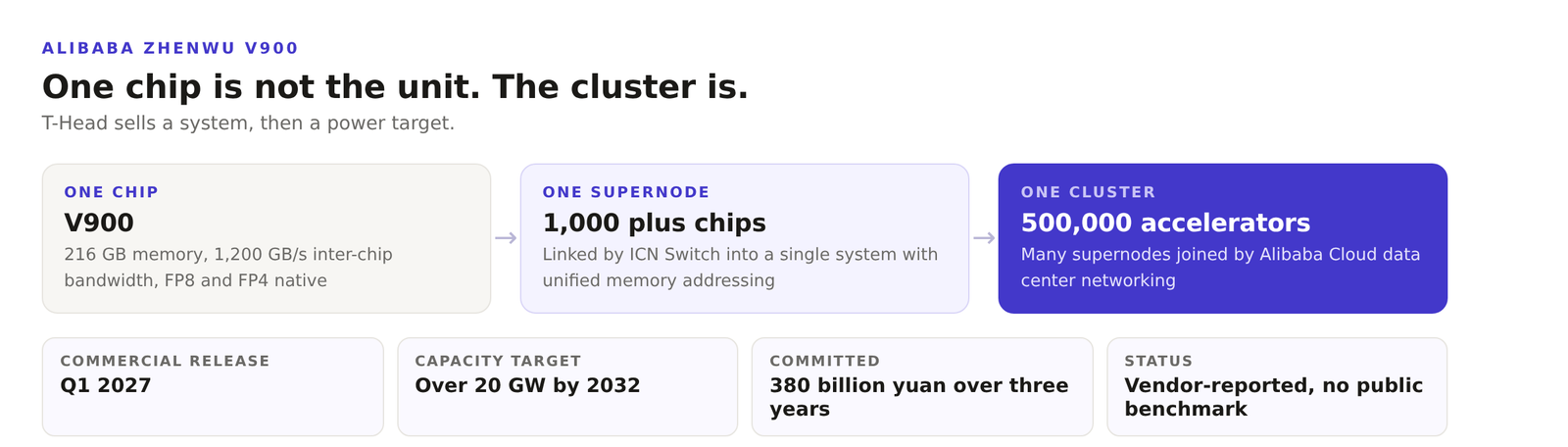
Alibaba unveiled the Zhenwu V900, an accelerator built by its T-Head chip unit, with 216 gigabytes of memory and 1,200 gigabytes per second of inter-chip bandwidth. T-Head claims three times the performance of the M890 it shipped in May, and has published no benchmark to check that against. Production is set for the first quarter of 2027.
The chip took the headlines. The number beside it will decide whether the chip matters. Alibaba Cloud targets more than 20 gigawatts of global data center capacity by 2032, against a three-year commitment of 380 billion yuan and no disclosed price for the gigawatts. A chip roadmap is a promise. Twenty gigawatts is a grid connection, a supply chain, and a land bill, and Alibaba has not said who pays for it.
A new Alibaba AI chip is easy to announce. Twenty gigawatts is not. The company did both in the same breath this week.
The chip is called the Zhenwu V900. It comes from T-Head, Alibaba’s chip design unit, and the design treats it as a component in a larger machine rather than a card you install.
T-Head pairs each V900 with its own ICN Switch interconnect silicon. More than 1,000 of the chips can act as one system, sharing unified memory addressing across the group. T-Head calls that a supernode. A cluster built from those supernodes can reach 500,000 accelerators.
A chip ships on a schedule. A gigawatt does not.
Alibaba Cloud now targets more than 20 gigawatts of global data center capacity by 2032. That is 20,000 megawatts of power delivered to buildings that mostly do not exist yet.
The company has committed 380 billion yuan over three years to cloud and AI infrastructure. It has not attached a capital figure to the gigawatt target. A capacity goal and a spending plan are different documents, and only one of them has been funded.
Supply is the constraint Alibaba itself names. Chief executive Eddie Wu said the global shortage in the AI data center supply chain is “currently limiting the speed at which we can scale our compute infrastructure.” That is an unusual thing to admit on the same day you ship a product.
The interconnect is where the claim gets tested
The V900 carries 216 gigabytes of memory and 1,200 gigabytes per second of inter-chip bandwidth. Its predecessor, the M890, shipped in May with 144 gigabytes and 800 gigabytes per second.
T-Head’s argument is that at trillion-parameter scale, raw compute stops being the limit. Memory capacity and chip-to-chip data movement do. The supernode exists to cut the cost of splitting a model across chips and moving weights between them.
That reframes the comparison. Nvidia wins on per-chip numbers and a mature software stack. T-Head is selling a system, and systems are judged on how well the parts fit. No public benchmark exists for the V900, so the threefold claim over the M890 is vendor arithmetic until someone else runs it.
The domestic alternative is the pressure behind all of it. Huawei shipped a new accelerator the week before, and Alibaba’s own silicon exists partly so its cloud depends less on imported parts.
Every gigawatt has a jurisdiction
Twenty gigawatts of global capacity means capacity outside China. For a European or North American buyer, the question is not whether the silicon is fast. It is who can legally reach the data and the inference running on it.
That question already governs sovereign cloud procurement. Alibaba will be judged on contracts, jurisdiction, and exit terms, not on a benchmark chart.
Related reading. Sovereignty became a contract term when Bell signed one, and workload sovereignty is the only sovereignty a buyer can test.
Three questions for your own evaluation. Which numbers in this story are commitments and which are targets. If the chips are only available as cloud capacity, what is your exit plan. And does the jurisdiction of the accelerators match the jurisdiction of your data.
Sources. Alibaba Cloud press room.
Get the next one before it is old news
Independent analysis of cloud-native infrastructure, Kubernetes and data center economics. No vendor spin.
[…] reading. We covered Alibaba’s twenty gigawatt plan and the Texas permit freeze that stalled a 445.8 GW queue. Both are the same forcing function from […]