


Executive Summary
Broadcom put vSphere Express on sale this week, three years after telling small VMware customers to buy a private cloud suite or leave. The new edition is a real product with a real cap. It runs on vSphere 9, it carries the working set a small estate touches, and it stops dead at 128 cores. Each instance stands alone with no central management, and reseller listings describe a pack licensed whole, one per customer, with no route to add cores later.
The verdict is that Broadcom priced the bottom of the market back in without restoring the ladder that sat under it. Outgrow 128 cores and the next stop is vSphere Foundation at a published per core rate. And nobody outside the channel can see the new number, because Broadcom confirmed a per core subscription priced well below Foundation and Cloud Foundation, then declined to publish a dollar amount. A discount you have to ask a distributor to quote is not a price. It is a negotiation.
The smallest VMware purchase exists again. Broadcom started selling VMware vSphere Express this week, a 128 core package on vSphere 9 built for shops that wanted a hypervisor and a console, not a private cloud.
We flagged this on 30 October from a reseller catalogue, when it was an orderable line item. It is now official, with a spec sheet and a channel model.
The pack carries ESX, vCenter Standard, vMotion, High Availability, the distributed switch, vCenter Quick Patch and TPM 2.0, per Broadcom’s briefing. That is the working set a small estate actually touches. Reseller listings for the part number leave out DRS, memory tiering, SR-IOV, GPU support and vSAN, which is where Broadcom drew the line on cost.
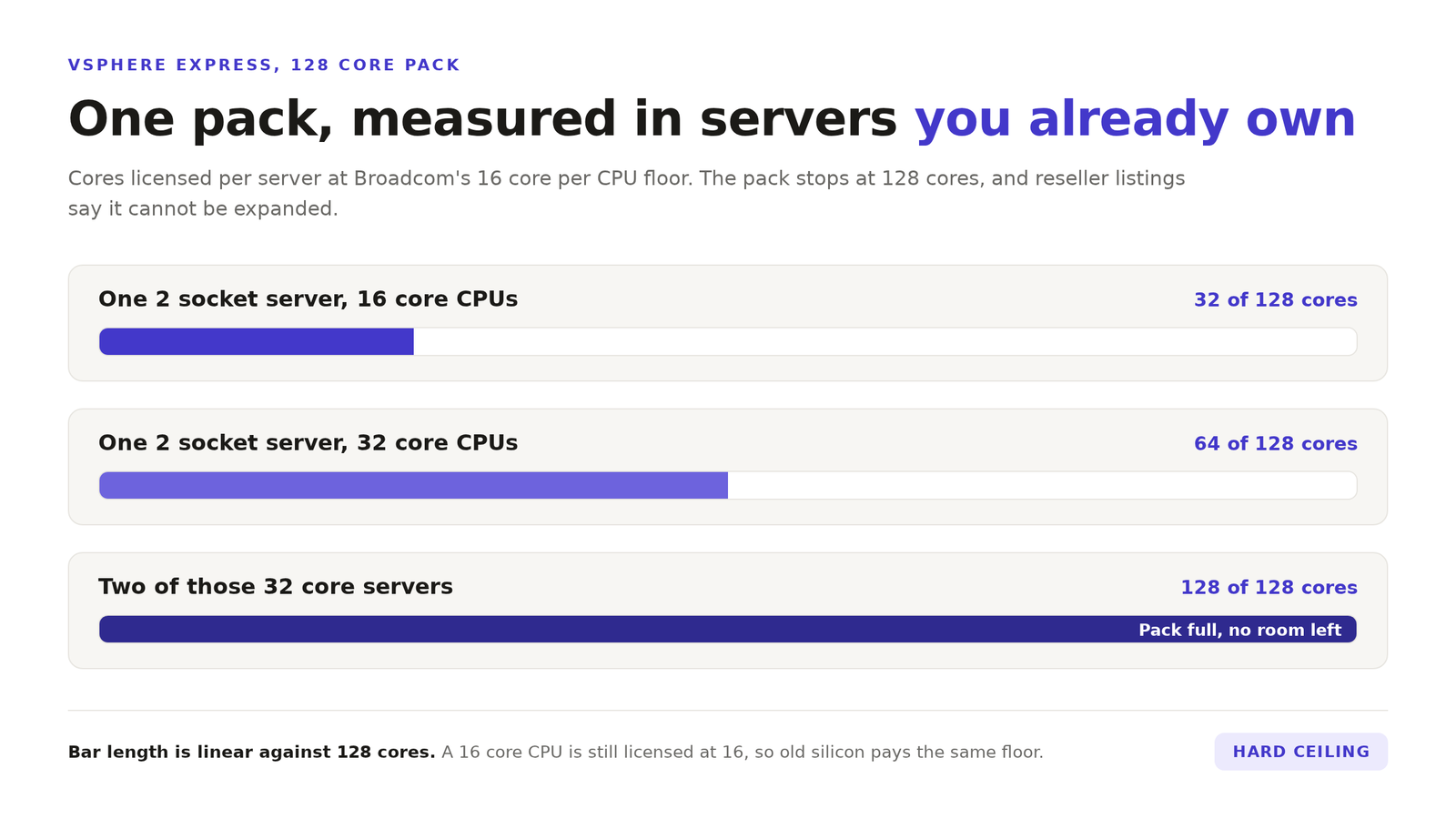
The ceiling is the whole product
Cores stop at 128, and that number does real work. Reseller listings describe a single subscription licensed whole, one per customer, with no capacity expansion. Grow past it and the next stop is vSphere Foundation.
Put the cap into hardware you can buy today. Broadcom licenses per core with a 16 core floor per processor, a figure our licensing tracker has followed since 2024. A two socket server on 16 core CPUs consumes 32 of the 128. Two sockets on 32 core CPUs consumes 64. Two of those fills the pack completely.
So the realistic footprint is one rack of modest hosts, or half a rack of current generation ones. Fine for a branch office or a lab. Not a size that survives three years of ordinary growth, and the growth path exits the product.
Broadcom cut the resellers who used to serve this buyer
Broadcom cut the number of resellers in VMware’s channel program hard after the acquisition, and the ones it kept no longer suit a small buyer. Small buyers used to buy an Essentials kit from a local reseller. That route is largely gone.
vSphere Express sells through distributors instead, most of which run cloud marketplaces where affiliated resellers transact. The channel calls it two tier distribution. It functions, but the smallest customer now buys through a listing rather than a conversation with someone who knows their estate.
Simon Sharwood reported the launch for The Register, quoting Prashanth Shenoy, vice president of product marketing for VMware Cloud Foundation. Shenoy said the company had been listening to the market at the low end, and that buyers there want a basic core server virtualization platform. He also said each instance would be discrete and not centrally manageable, and that Broadcom does not want a customer running this on thousands of cores.
That last line is the honest one. A vendor that wanted the segment would build a path out of the floor edition. Broadcom built a floor edition on the condition that you stay there.
The price is real. The number is not public.
Broadcom confirmed a per core subscription priced significantly lower than vSphere Foundation and Cloud Foundation, and declined to publish a dollar figure. A spokesperson told The Register that interested customers should contact their local reseller. Read that as a buying instruction rather than a disclosure. Until a number is public, nobody can compare Express to Proxmox or Hyper-V on paper, and the negotiation happens with the information gap on your side.
One regional wrinkle. In the European Economic Area, Broadcom keeps vSphere Standard 8 and vSphere Enterprise Plus 8 on sale until 31 October 2027, with extended support to 31 October 2028, roughly a year longer than buyers elsewhere get on the same SKUs. European regulators have spent two years on Broadcom’s licensing, and the carve-out reads as a response to that pressure rather than a product decision.
The wider portfolio keeps moving. Broadcom outlined its next Cloud Foundation release for its fiscal first quarter of 2027, heavy with automated AI infrastructure deployment and native object storage on vSAN. None of that lands on a 128 core estate.
Three questions for the quote. Does your three year forecast stay under 128 cores, and what happens to the price the year it does not. Can your team run a set of discrete vCenters with no shared management plane. And is today’s discount worth the jump to vSphere Foundation later, at a rate Broadcom will have moved by then.
Get the next one before it is old news
Independent analysis of cloud-native infrastructure, Kubernetes and data center economics. No vendor spin.
[…] reading. Broadcom brought back the cheap VMware edition with a 128 core ceiling, and Europe’s regulators are now Broadcom’s biggest VMware […]