


Executive Summary
European Union antitrust officials have sent cloud providers a detailed questionnaire about Broadcom’s VMware licensing and partner changes, Bloomberg reported on September 11. The questions ask how essential VMware products are to European cloud services, whether rivals can replace them, whether the new certification rules are unfair, and how large the European cloud market is. Three years of subscription-only bundles and withdrawn reseller channels produced the complaint file. Regulators are now assembling the market evidence that turns a complaint into a case.
The timing carries more weight than the paperwork. Broadcom’s revised partner program ends subscription sales rights for some smaller providers on March 31, and the Commission can impose interim measures long before any verdict. Fines can reach 10 percent of worldwide annual revenue, although they rarely land at that level. Broadcom calls the CISPE complaint hyperscaler funded and says it misrepresents the market. For anyone mid-migration, the practical signal is that European licensing terms are now a regulatory variable rather than a vendor decision.
Broadcom did not lose a ruling this week. It lost the benefit of the doubt. European Commission officials spent July gathering evidence from the cloud providers least able to absorb another Broadcom VMware licensing change, and Bloomberg obtained the questionnaire on September 11. Nobody has been charged with anything yet. That is the point. This is the stage where an inquiry either finds a market problem or quietly closes.
The questions themselves point one way. Regulators want to know how important VMware is to European cloud offerings, how easily customers can swap it for something else, and whether Broadcom’s certification rules restrict who can sell the software. They also asked for estimates of the size of Europe’s public and private cloud markets. You only size a market when you are weighing remedies.
The questions are the story, not the complaint
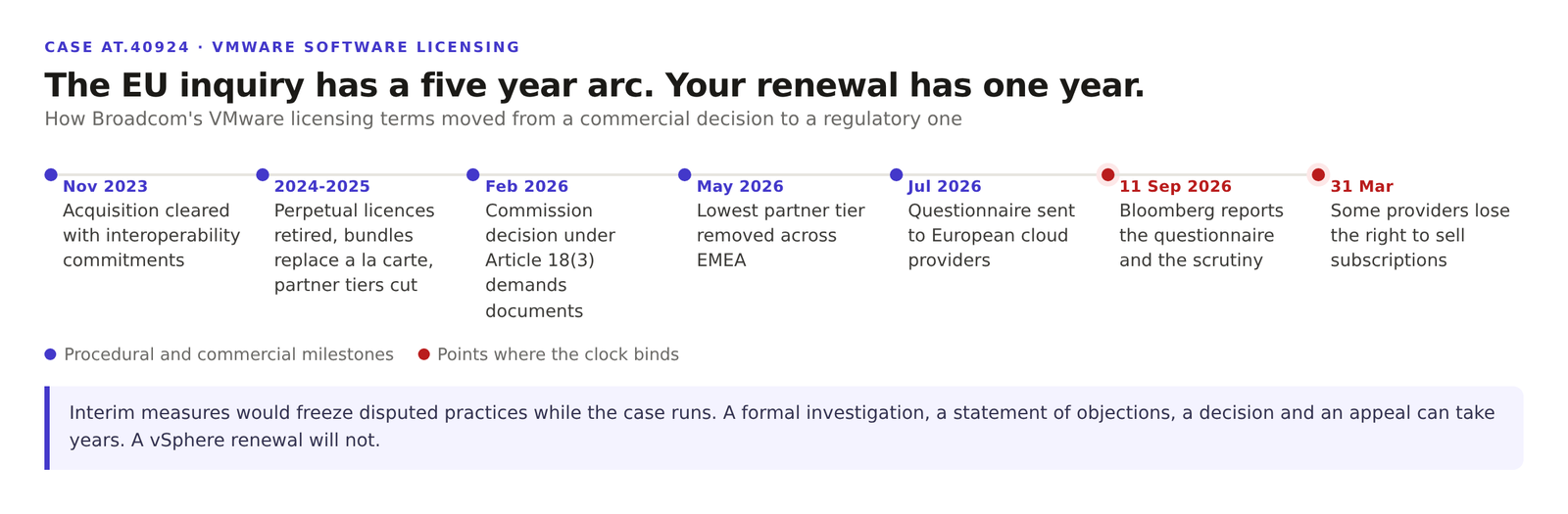
This file is older than the headlines suggest. The Commission opened a proceeding under Article 18(3) of Regulation 1/2003 as Case AT.40924 and issued a decision in February 2026 demanding documents. Broadcom and VMware International challenged that demand at the General Court in Case T-280/26, arguing it reached material held outside the EU and non-EU legal advice. The court refused to block the Commission from obtaining US attorney-client documents in early August.
Separately CISPE, the European cloud infrastructure association, asked the Commission to suspend the termination of the old VMware Cloud Service Provider program and to readmit partners. Broadcom’s answer, given to CRN, was blunt. It said CISPE is funded by hyperscalers and that the claims misrepresent the realities of the market. That is a fair argument in public. It is a harder one to make to regulators who are already collecting market numbers.
Everything the Commission does now lands on a company whose VMware software carries roughly 79 percent margin while the AI silicon business carries the growth. [VERIFY margin] The licensing model is the profitable half of that story. It is also the half a regulator can actually change.
March 31 is the deadline that creates the urgency
Broadcom narrowed its partner program after the 2023 acquisition. The four-tier Broadcom Advantage program lost its lowest tier across EMEA in May 2026, and the older cloud service provider program was wound down. Under the current terms, some providers lose the ability to sell VMware subscriptions after March 31. [VERIFY year] For those businesses the licensing change is not an abstraction. It deletes a product line. Broadcom has also signalled a revived vSphere Standard aimed at smaller environments, with specifics promised for October.
A deadline cuts both ways. Under EU competition rules the Commission can order interim measures while a case runs, which would force Broadcom to keep disputed practices in place. Fines of up to 10 percent of global annual revenue are available, though the Commission rarely pushes for the maximum. Broadcom has taken procedural fights to Luxembourg before and can do it again. Appeals take years. A renewal decision does not wait.
Plan for the ruling, do not wait for it
The honest read is that regulation is a slow tailwind for anyone leaving. A formal investigation, a statement of objections, a decision, an appeal. That arc runs five years. A vSphere renewal runs twelve months.
So the work stays the same. Price the full exit, not the renewal quote, and count year four as well as year one. Put conversion tooling and target platform licensing in the same spreadsheet, because the expensive parts are the ones nobody quotes. If you buy through a partner that loses its sales rights in March, find out now rather than in April.
What this inquiry changes is the cost of staying. When a regulator sizing your market asks whether your platform can be replaced, your account team’s answer is no longer the only one on file.
Related reading. Our analysis of why a full VMware exit only pays off if you count year four, the two bundle paths Broadcom is selling and why the exit costs more than the invoice, and what the Distributed Hybrid Infrastructure market says about the exit wave.
The economics behind this migration wave, including the three year cost model and why exits run long, are in the 2026 State of Enterprise Infrastructure report.
Get the next one before it is old news
Independent analysis of cloud-native infrastructure, Kubernetes and data centre economics. No vendor spin.
[…] Read the full analysis at the breakdown of the EU inquiry and the March deadline. […]
[…] reading. Europe’s regulators are now Broadcom’s biggest VMware problem. Broadcom cut off the VMware tool that migration vendors depend on. Attackers chained three JFrog […]
[…] reading. Europe’s Regulators Are Now Broadcom’s Biggest VMware Problem covers the Commission’s evidence request. Broadcom Cut Off the VMware Tool That Migration […]