


Executive Summary
Firebird has secured a US export license for 45,000 NVIDIA GB300 GPUs for the first phase of a national AI factory at Data Center Valley in Kazakhstan, built with Kazakhtelecom and targeting commercial service in the third quarter of 2027. The project is estimated at 5 billion dollars and plans cluster capacity of up to 109 megawatts, with a second phase taking the country total toward 500 megawatts and the government describing phased expansion to a gigawatt.
The finding that should shape how you read the announcement is arithmetic. Forty five thousand GB300s at the 1,400 watt per GPU draw that Meta documented need 63 megawatts before networking, storage or cooling, which is 58 percent of the announced site envelope. The verdict is that the binding constraint on sovereign AI has moved off the export license and onto the energization date, so every project in this category is really two builds, one that clears in Washington and one that clears with a utility.
The Firebird announcement for the Kazakhstan AI factory is specific where these things are usually vague. A first phase under construction with Kazakhtelecom at Data Center Valley, a commercial launch target of the third quarter of 2027, more than 130 permanent jobs and an estimated 5 billion dollars of investment. A planned second phase would take Firebird’s total potential capacity in the country to roughly 500 megawatts.
A license is a permission, not a capacity number
The export license is the part that makes the headline, and it’s also the cheapest thing in the project. It authorizes 45,000 Grace Blackwell parts to leave the United States. Once it clears, the countdown that matters starts somewhere else entirely.
NVIDIA framed the Astana visit as the moment the country moved from plans to deployment. Jensen Huang met President Kassym-Jomart Tokayev at the Akorda Presidential Palace and spoke alongside Deputy Prime Minister Zhaslan Madiyev, who also holds the AI portfolio, at the Alem.AI center.
A license and a megawatt aren’t comparable units, and coverage of this class of project treats them as if they were. A license authorizes a shipment. A substation delivers a number of megawatts on a date. The first is decided by a regulator in Washington, the second by a grid operator and a construction schedule, and only the second can slip by years without a revised press release.
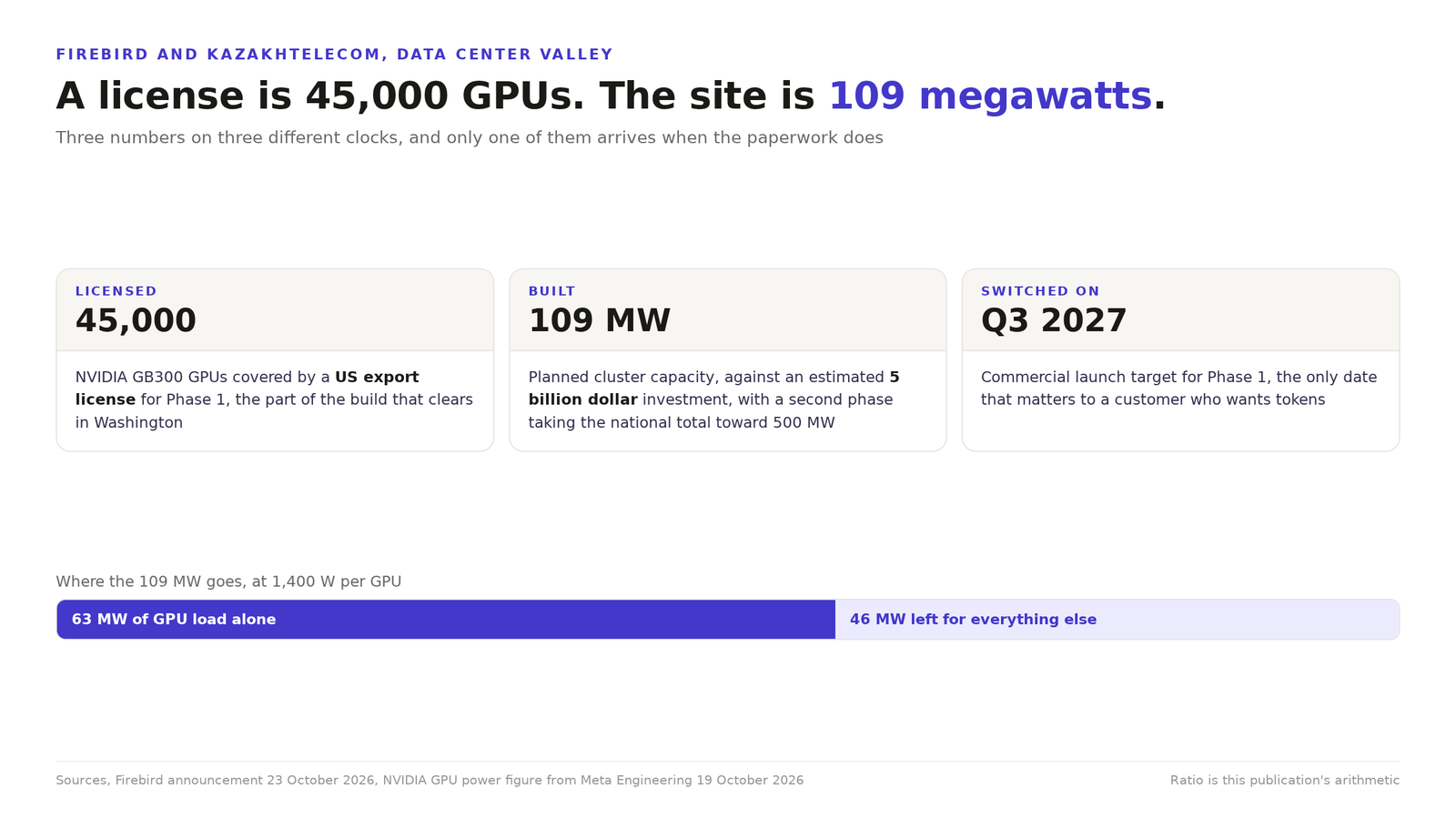
Only 58 percent of the site can be accelerators
Firebird describes a cluster with potential capacity of up to 109 megawatts. Meta puts individual GPU load at 1,400 watts on Blackwell class parts. Multiply 45,000 by 1,400 and you get 63 megawatts of GPU draw alone, which leaves 46 for the network fabric, storage, the cooling plant and every other load in the building.
That’s the tight part. A GB300 rack talks at 800 gigabits per second per GPU through ConnectX-8 SuperNICs, and none of those ports is free, because a switch draws power whether or not the fabric is busy. Add direct to chip liquid cooling and you inherit pumps, coolant distribution units and a heat rejection plant. The accelerators end up a bit over half the site, which is normal for an AI factory and nothing like the headroom a conventional colocation contract assumes.
Read the 109 megawatt figure as a ceiling on what can be installed, not a deliverable. A gigawatt campus and a 109 megawatt cluster are different commitments, and only the second is what a customer can buy tokens from.
Cheap power is the product, and the product has to be exported
Madiyev put the strategy in one line. Reliable, competitively priced energy is the foundation of affordable intelligence. Huang’s version was blunter, that a country could stop exporting energy and start transforming it into intelligence instead. He also told the room that a country’s data belongs to it.
That framing explains why this class of project keeps appearing outside the usual markets. Energy is an input a government can control, a license is a formality once Washington agrees, and the customer can sit anywhere. What the framing doesn’t fix is the schedule. A GPU arrives when it ships. A cold plate loop, a transformer and an interconnection agreement arrive when they get built, and the second list is longer.
What the announcement left out matters as much. No dollars per megawatt, no energization date, no named buyer for the tokens. Data Center Valley is described as a national hub with phased expansion toward a gigawatt, which is a target and not a connection. Firebird is also funding a local lab for founders, which is the part that outlives the hardware.
Three questions for the next sovereign AI announcement you read, including this one. What is the energization date, as opposed to the launch date. What share of the site power envelope is the accelerators, and has anyone outside the vendor checked the arithmetic. And who is the first paying customer, because a license and a megawatt both look identical until somebody gets billed for tokens.
Related reading. Humain is building 84 megawatts for a buyer it hasn’t named, and Project Star shows what a gas plant costs per gigawatt of compute.
Get the next one before it is old news
Independent analysis of cloud-native infrastructure, Kubernetes and data center economics. No vendor spin.