

Executive Summary
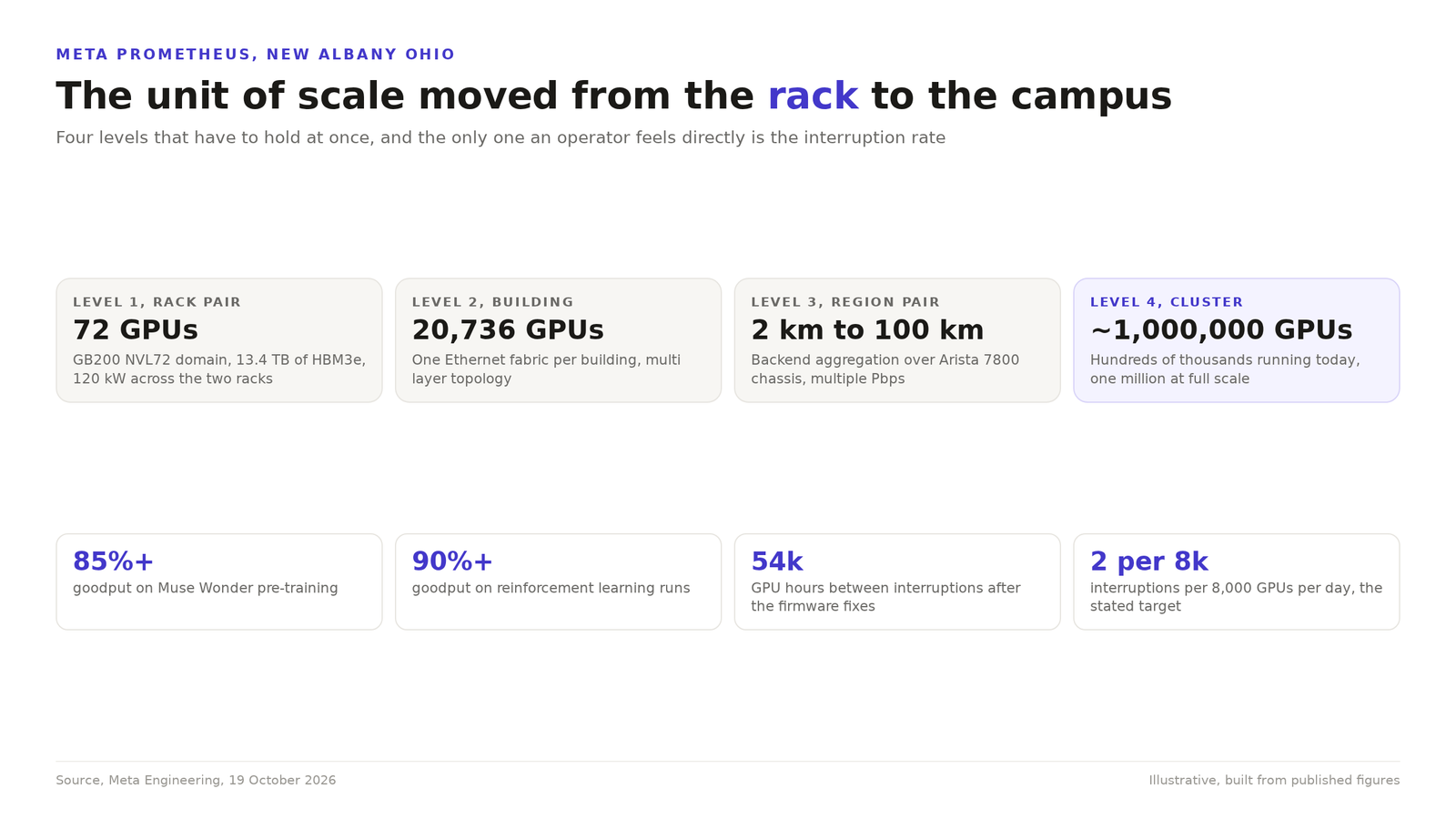
The Meta Prometheus cluster in New Albany, Ohio reached its first phase running above 85 percent goodput on pre-training and above 90 percent on reinforcement learning, with hundreds of thousands of GPUs live against a target of roughly one million. The finding to carry into a capacity plan is where that yield came from. Not more accelerators. Firmware settings for HBM, a better error correction algorithm for LPDDR, millisecond fabric monitoring and predictive retirement of degrading devices, which lifted mean time between interruptions from about 47,000 GPU hours to more than 54,000. The stated north star is two interruptions per 8,000 GPUs per day, or roughly 100,000 GPU hours.
The verdict is that a gigawatt cluster is an operations problem before it is a procurement problem, and the fifteen points between 85 and 100 percent goodput are the largest unbooked line in the cost of training a frontier model. Any infrastructure plan handed to you this quarter should carry a measured interruption rate rather than a peak FLOPS number.
The Meta Prometheus supercluster sits in New Albany, Ohio, on a site that served web traffic two years ago. Meta says engineers reworked that footprint into training infrastructure for frontier models, and the completed phase trained the Muse family, including the Muse Wonder models now running agentic tasks.
That is more useful than the accelerator count. An existing building already has concrete, a substation, fiber rights of way and a permitting history. What it doesn’t have is power density per rack, a fabric that reaches across buildings, and a coolant loop sized for cold plates. Meta’s account of all three reads like a maintenance manual rather than a launch note.
A degraded host can stop a 72 GPU domain
Inside the first phase the working unit is a pair of racks. Catalina, Meta’s GB200 NVL72 deployment, runs the Ariel variant, 36 Blackwell GPUs per rack joined by NVLink into one 72 GPU domain. The published numbers are 13.4 terabytes of HBM3e, 130 terabytes per second of NVLink bandwidth and about 120 kilowatts across the two racks.
That power figure is the retrofit in one number. A rack pair at 120 kilowatts is not a load a hall built for web traffic was designed around. Meta stress tested how power supply modules and voltage regulators behave under the 1,400 watt draw of a single GPU.
The failure mode isn’t a crash. It’s a pause. An issue on a single host can slow down or stop an entire job. A fault inside an NVLink switch compromises the whole 72 GPU domain, so fabric health is watched at millisecond resolution and traffic is rerouted around failing components without a job interruption.
Cooling moved at the same time. The newest AI buildings run direct to chip, closed loop liquid cooling, which Meta says is how it fits more GPUs onto a rack. None of that is retrofittable in a weekend, which is the honest argument against assuming every operator can follow the same path.
The number to demand is hours between interruptions
During the Muse Wonder runs, mean time between interruptions sat around 47,000 GPU hours. Firmware fixes across the fleet pushed it past 54,000. At 8,000 GPUs that works out to one interruption every 6.75 hours, or about three and a half a day. That figure is my arithmetic. The stated target of two interruptions per 8,000 GPUs per day implies 100,000 GPU hours, or one event every 12.5 hours.
Getting there was unglamorous work. Memory scrubbing. Refined HBM firmware. An improved error correction algorithm for LPDDR. Pattern based detection that retires a degrading device before a running job finds it. Hardware level fault detection at the spine of the backend aggregation network, which spans 2 kilometers to more than 100 kilometers between buildings on Arista 7800 chassis running Broadcom Jericho3 silicon at multiple petabits per second.
None of that list is a purchase. It’s a discipline, and it doesn’t appear on a quote.
Every platform after this one draws more power
Clemente, the GB300 NVL72 platform, takes HBM per GPU to 288 gigabytes, about 1.5 times the GB200 part, with ConnectX-8 SuperNICs delivering 800 gigabits per GPU as the baseline rather than an option. Vera Rubin follows at 72 GPUs per rack, 288 gigabytes of HBM4 each, more than 170 kilowatts per rack, and 10 to 20 percent better performance per watt.
Meta is already converting the lesson into the next site. Hyperion in Richland Parish, Louisiana is being designed from scratch with full grid connectivity through Entergy, with Meta paying the full cost of the connection.
Three questions to put to any AI infrastructure plan this quarter. What is the measured interruption rate per thousand GPUs per day, and does the operator publish it. What share of the site power envelope is the accelerators themselves, before networking, storage and cooling. And when a device starts degrading, does something retire it, or does a running job find out first.
Related reading. I worked through what a behind the meter gas plant costs per gigawatt of compute in the Project Star numbers, and how Saudi Arabia sized its first national cluster in the Humain build.
Get the next one before it is old news
Independent analysis of cloud-native infrastructure, Kubernetes and data center economics. No vendor spin.
[…] Read the full analysis at Why 85 percent goodput is the number that decides a gigawatt cluster. […]