


Executive Summary
The binding constraint on AI capacity has moved from chips to interconnect dates, and two disclosures this week put a number on it. Nscale carries $103.4 billion in contracted value against $2.6 billion active at 31 August. NextDC halted trading in its own shares to rework fiscal 2027 guidance after a power delay at its Melbourne campus. Neither company has a demand problem.
What both have is a contract that starts paying on a date no electricity network operator signed up to. Microsoft canceled its Loughton lease because the Essex grid connection slipped into the 2030s, which is a rational place to move 23,040 GPUs away from. Bernstein puts credibly executable US capacity at roughly 35 percent of the announced pipeline. The verdict is that energization timing now sets the value of an AI capacity backlog, and anyone buying capacity for 2027 delivery is underwriting a date they do not control.
Nscale’s flagship UK data center had everything a site needs except electricity. It had Microsoft as anchor tenant, 23,040 GB300 GPUs leased from the first quarter of 2027, and a 50MW footprint inside a 90MW allocation. What it did not have was a grid connection, and the date for that has now slipped into the 2030s.
A data center is a power contract with a building around it
Nscale announced Loughton in January 2025 at around $3 billion, for 50MW of AI and high performance computing capacity with up to 90MW of total allocation. Microsoft was to fund the supercomputer and take the capacity, originally live in late 2026. Data Center Dynamics reported the withdrawal and the new grid date.
Nscale says it remains committed to the site and is exploring alternative power sources, and calls the problem London-wide with no impact on its other contracts. Microsoft declined to comment. The consequence is that the largest announced AI site in the UK now has no publicly named customer, which is a different problem from having no demand.
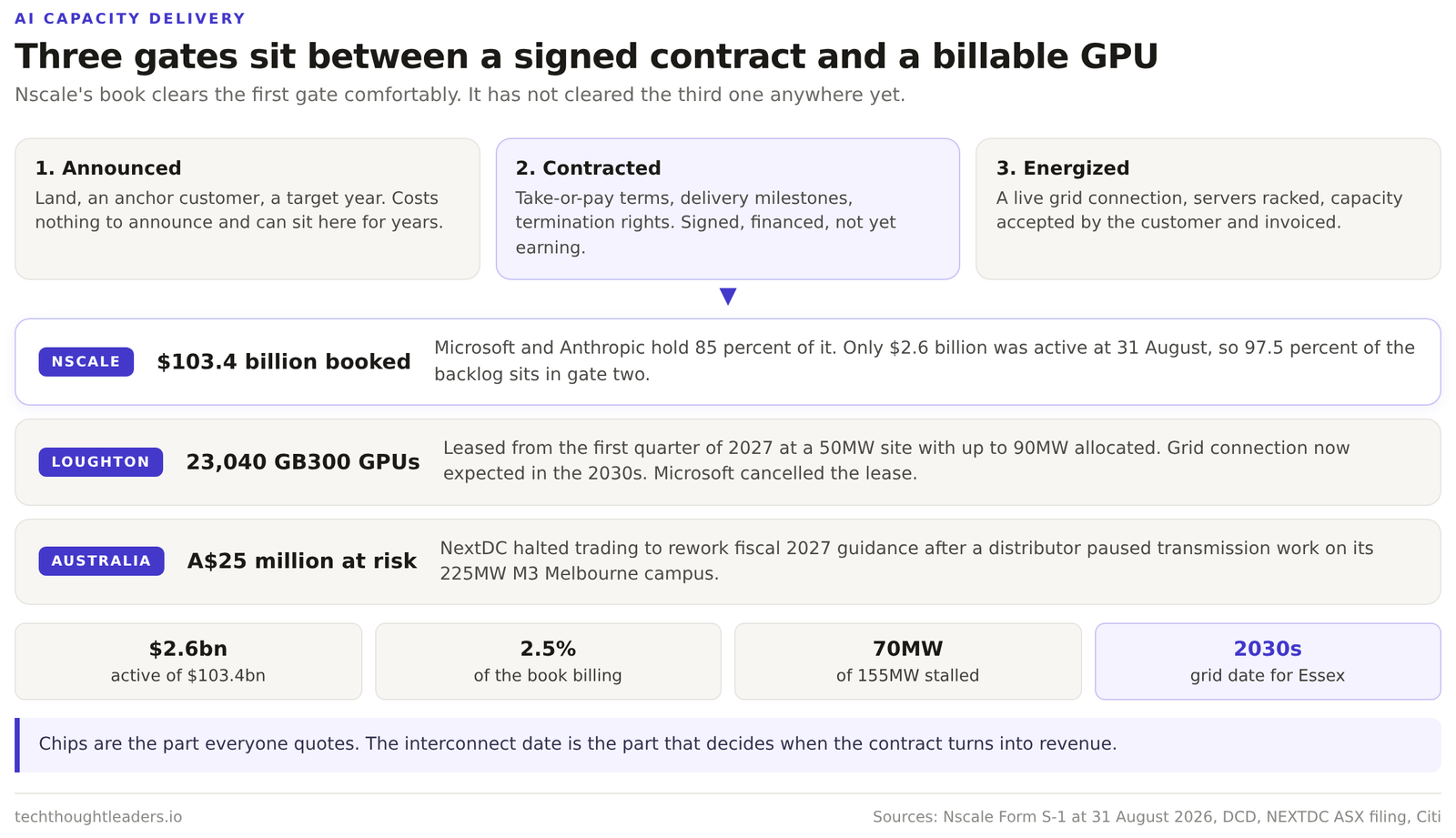
The backlog is real and almost none of it is billing
The prospectus is where this stops being a story about one site. Nscale reported $103.4 billion of active and contracted total contract value at 31 August. Statements of work with Microsoft provide for payments of up to about $43.8 billion through December 2033. Four agreements signed with Anthropic on 25 August provide for up to about $44.6 billion. Two customers, 85 percent of the book.
Only $2.6 billion was active. The filing states that Nscale had not obtained binding commitments for the financing required to perform under the Anthropic agreements. The company lost $1.02 billion on revenue of $140.6 million in the first half of 2026, and its largest customer was 52 percent of that revenue. TechCrunch noted that Anthropic can terminate a tranche if delivery milestones slip.
Read that against Loughton. The capacity that is live is paid for. The capacity that is promised depends on energization dates held by somebody else, and the customer on the other side has a termination right when a date moves. That is the shape of AI data center power risk in 2026, and it is a contract problem before it is an engineering one.
Australia halted a share price over the same variable
NextDC filed a trading halt request with the ASX on Monday, asking to stop trading until it can tell the market what a power delay at M3 in West Footscray does to fiscal 2027 guidance. The halt runs until the earlier of that announcement or normal trading on Wednesday.
M3 is a 225MW campus. An estimate from Citi, reported by Capacity, puts about 70MW of the 155MW of incremental Victorian billing NextDC assumed for fiscal 2027 at risk, or roughly A$25 million of operating earnings. That is about 6 percent of the midpoint of a guidance band of A$385 million to A$410 million. The attributed cause is a distributor pausing work on high voltage transmission.
Same pattern, different continent, one trading day apart. The variable that moved in both cases was the construction schedule for a cable and a transformer. NextDC cannot buy its way out of that with a bigger GPU order.
Two things follow for anyone buying AI capacity this quarter. Ask for the energization date in the contract rather than the delivery date in the slide deck. And keep billing separate from booking when you brief your own board, because the gap between those two numbers is now measured in years instead of quarters.
Three questions worth answering about your own plan. Which of your committed megawatts sits behind a grid connection with a firm date, and who carries the risk if that date slides. What termination right does your provider hold if it misses delivery, and have you actually read it. And when the spend review comes, are you quoting contracted value or active capacity.
Related reading. Your 2029 AI capacity plan is about three times too big covers the forecast version of this gap. QumulusAI is billing 7MW of AI capacity ten weeks after signing shows what the other end looks like.
Get the next one before it is old news
Independent analysis of cloud-native infrastructure, Kubernetes and data center economics. No vendor spin.
[…] reading. Microsoft walked from 23,000 GPUs because the grid says the 2030s is the same constraint from the buyer side. Your 2029 AI capacity plan is about three times too big […]
[…] is not a small caveat. Microsoft walked away from 23,000 GPUs at its Loughton campus because the grid connection was not going to land until the 2030s. A 14 day install does not […]