


Executive Summary
OpenAI opened its Agents API to public beta. The service packages the agent harness behind Codex, along with context management, tool calls and execution environments, into one managed service. A developer describes the task, the model, the tools and the runtime, and OpenAI handles the rest. There is no platform fee. Customers pay for tokens and tool use.
The convenience is real and so is the dependency. When the model, the orchestration, the conversation state and the sandbox all come from a single vendor, the cost of leaving climbs. Analysts flagged lock-in on the first day. The larger story is that the agent runtime has become a product in its own right, and the large vendors are racing to own it.
Building an agent that survives production is mostly infrastructure work. The model call is the easy part. Underneath it sits a job queue, a state store, a fleet of sandboxes, a context compaction routine and a retry policy. Someone has to own and page for each of them. OpenAI just offered to take them off your hands.
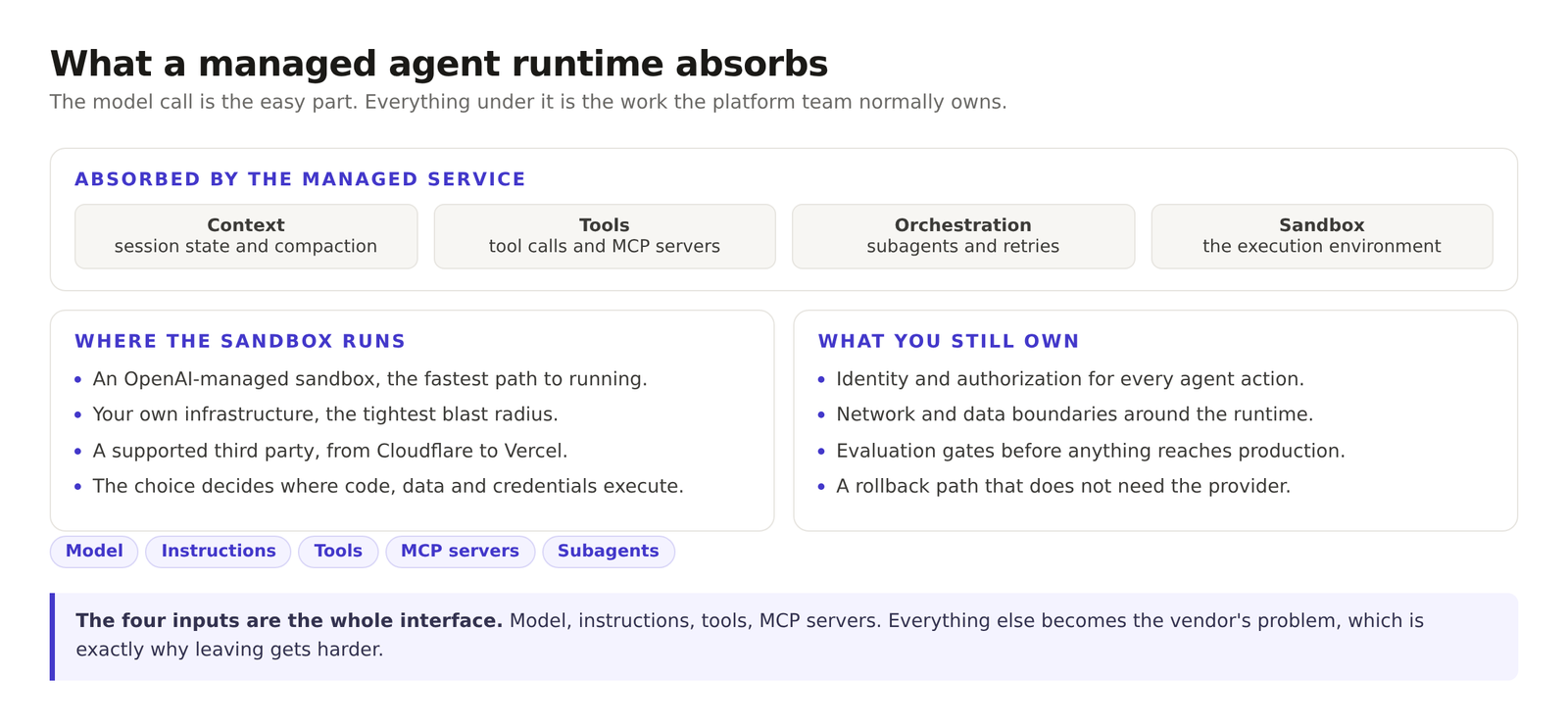
Four inputs and a managed runtime
Agents API is built on four primitives. An agent specifies a model, a set of instructions, the tools it may call and any MCP servers it should reach. Describe those and the service can run the agent in a single API call. The Agents API also supports subagents, so a task can be split into parallel work and recombined by a coordinating agent. Support for MCP is native from launch, which plugs agents into the tool servers that already exist across the industry.
Where the agent runs is the real decision
OpenAI offers three places for the execution environment. An OpenAI-managed sandbox, the customer’s own infrastructure, or a supported third party. The third-party list includes Blaxel, Cloudflare, Daytona, DigitalOcean, E2B, Modal, Oracle, Runloop and Vercel. That list carries more weight than it looks. It is the part of the stack that decides where code, data and credentials actually execute.
For platform teams the question maps to something familiar. Do agents run inside your cluster, under your network policy and your identity provider, or do they run on someone else’s runtime behind an API key? Both answers can work. Only one keeps the blast radius inside your own boundary.
Managed convenience buys a longer exit
Analysts were direct about the tradeoff. Pareekh Jain of Pareekh Consulting called lock-in the biggest concern, because one vendor holding the model, the context, the tools, the orchestration and the execution environment makes a move expensive. Amit Kumar Jena of Kanerika added that the dependency weakens an enterprise’s position on price and terms. Phil Fersht of HFS Research said regulated sectors may slow adoption for the same reason.
OpenAI is not first and will not be last. Anthropic shipped a managed agent layer earlier this year. Google packaged a comparable platform. DeepSeek is staffing up the sandbox system behind its own agent workloads. Every one of them is betting that the runtime, not the model, is where the customer sticks.
For most teams the call comes down to one question. Is agent execution part of your product, or is it plumbing you would rather rent? If it is plumbing, a managed runtime removes a lot of pages. If it is product, the sandbox fleet and the state store are the parts you keep in house.
The decision is not all or nothing either. A team can rent the sandbox and still keep identity, policy and evaluation in house. That split keeps the vendor on the boring parts and leaves the controls you will be asked about in an audit inside your own perimeter. Rent the runtime, own the accountability.
Related reading. We wrote about giving agents their own resource discovery layer, about the discovery gap MCP left open, and about why agent rule files are code.
Get the next one before it is old news
Independent analysis of cloud-native infrastructure, Kubernetes and data centre economics. No vendor spin.
[…] reading. OpenAI Just Made the Agent Harness a Managed Service. A Full VMware Exit Costs More Than Three Years of Broadcom’s Bill. Dynatrace Davis AI Stops […]