

Executive Summary
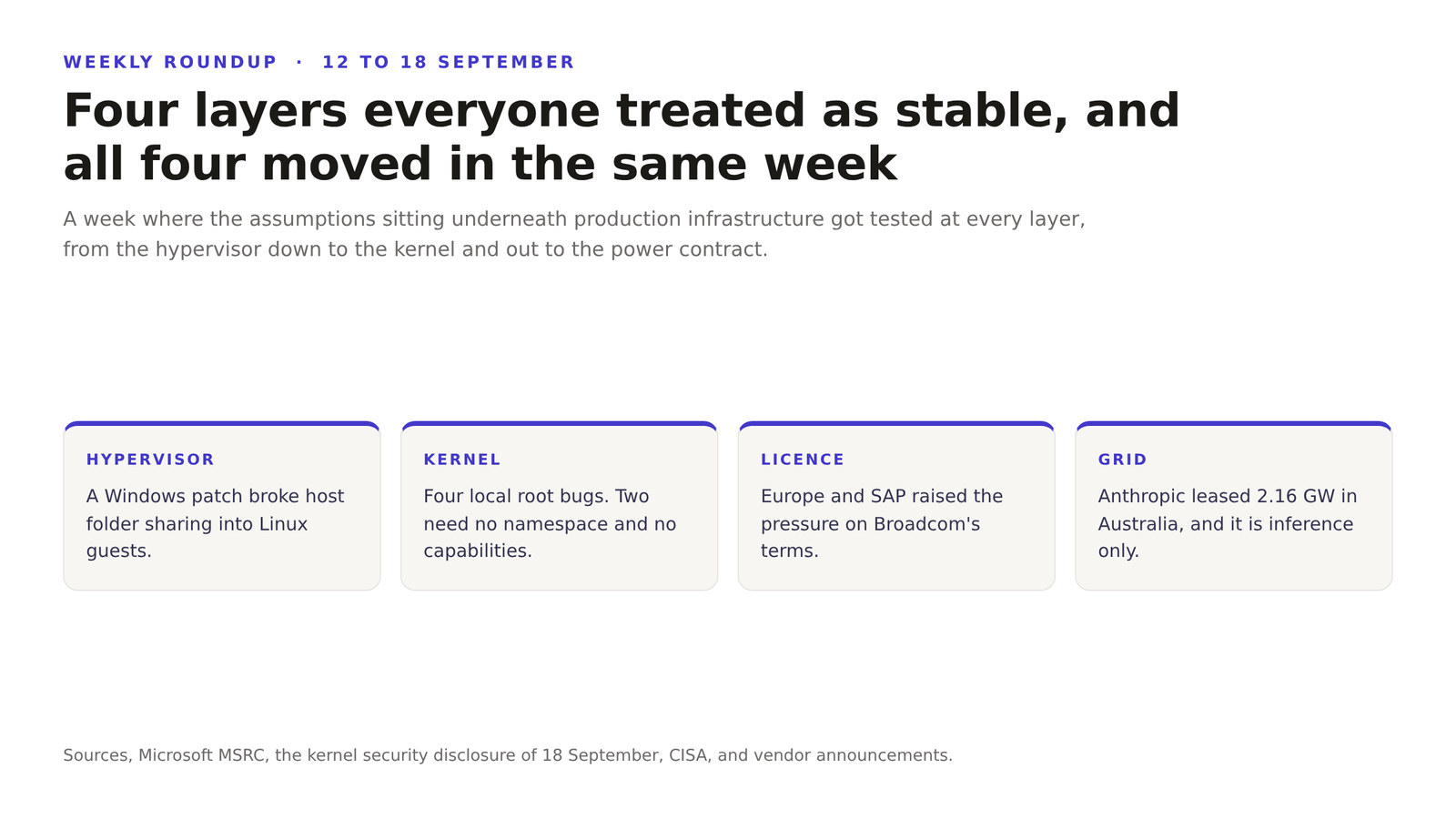
A Windows update broke host level folder sharing into Linux guests. Four kernel privilege escalation bugs went public, two of them needing no namespace and no capability to reach root. European regulators and SAP both raised the pressure on Broadcom licensing terms. And Anthropic signed for 2.16 gigawatts of Australian power that will feed inference only.
Those four do not share a cause, but they share a shape. Each is a layer that platform teams treat as a fixed floor, and each moved inside the same seven days. The pattern worth watching is that the assumptions doing the most work underneath production infrastructure are the ones nobody audits, because nobody expected them to change. Patch volume is now large enough to break guests, kernel flaws sit beneath the isolation policies meant to contain them, and power has become an infrastructure contract rather than a facilities line item.
The most expensive incidents come from the layer you stopped questioning. This week four of those layers moved, and not one of them announced itself as a platform change.
Nothing here was a surprise launch or a roadmap reveal. Each item was a quiet change to something teams had already filed as solved.
A Windows patch reached inside the hypervisor
Microsoft shipped its largest batch on record, 974 CVEs with 964 needing customer action and 104 rated critical. Two of the flaws were already being exploited, and CISA set a 22 September deadline for federal agencies.
The part virtualization teams should read twice came days later. An out-of-band update fixed Hyper-V host folder sharing inside Linux guests, Remote Desktop Services consoles, and multichannel USB audio. A host level Windows patch had reached into guest behaviour. The MSRC update guide carries the detail.
We covered the record release and the repair that followed in full. The lesson travels further than Hyper-V. If a monthly update can disturb a hypervisor, the maintenance window stops being a formality and becomes a platform change.
The kernel sits under the isolation you trust
Four Linux kernel privilege escalation bugs went public on 18 September, all in ordinary, widely enabled networking code. The worst, DiagSpill, needs no unprivileged user namespace and no capabilities. Where SCTP diagnostics are reachable, a container is the shortest path to root. The researcher published the writeup and working exploit code at the same time, and the fixes are in the kernel stable trees.
The uncomfortable finding is that AppArmor and SELinux both failed to block the reported exploit paths during testing. A kernel flaw sits beneath the container isolation that plenty of platform teams treat as their security boundary. We saw the same pattern in the containerd CRI flaws earlier this month, where the newest layer kept trusting metadata it should not have.
The slow part is not patching. It is node recycling, which lags far enough behind the update that a cluster reporting itself current can still run a vulnerable kernel for weeks. Our breakdown of all four bugs lists the reachability questions worth asking of each cluster.
The licence and the grid became infrastructure decisions
Broadcom had a commercial week rather than a technical one. European regulators kept the pressure on, SAP joined the organizations talking publicly about their exit, and the vendor pulled public downloads of the VDDK tool that migration products depend on. We looked at what the European pressure actually changes, and the short answer is the negotiating position rather than the contracts.
The other end of the stack moved too. Anthropic leased 2.16 gigawatts of power in Australia for a facility that will run inference and nothing else. The number is the story. Capacity gets bought in gigawatts now, and power procurement has moved into the IT budget, where platform teams have to plan around it.
Put the licence and the grid in the same frame and the shape is clear. The control points deciding what you can run, and whether you can afford to run it, are increasingly commercial and physical rather than technical.
Related reading. Our look at what Kubernetes 1.37 changed in native histograms, what Cilium handed to cloud providers, and why root on one node is every identity on it.
Get the next one before it is old news
Independent analysis of cloud-native infrastructure, Kubernetes and data centre economics. No vendor spin.