

Executive Summary
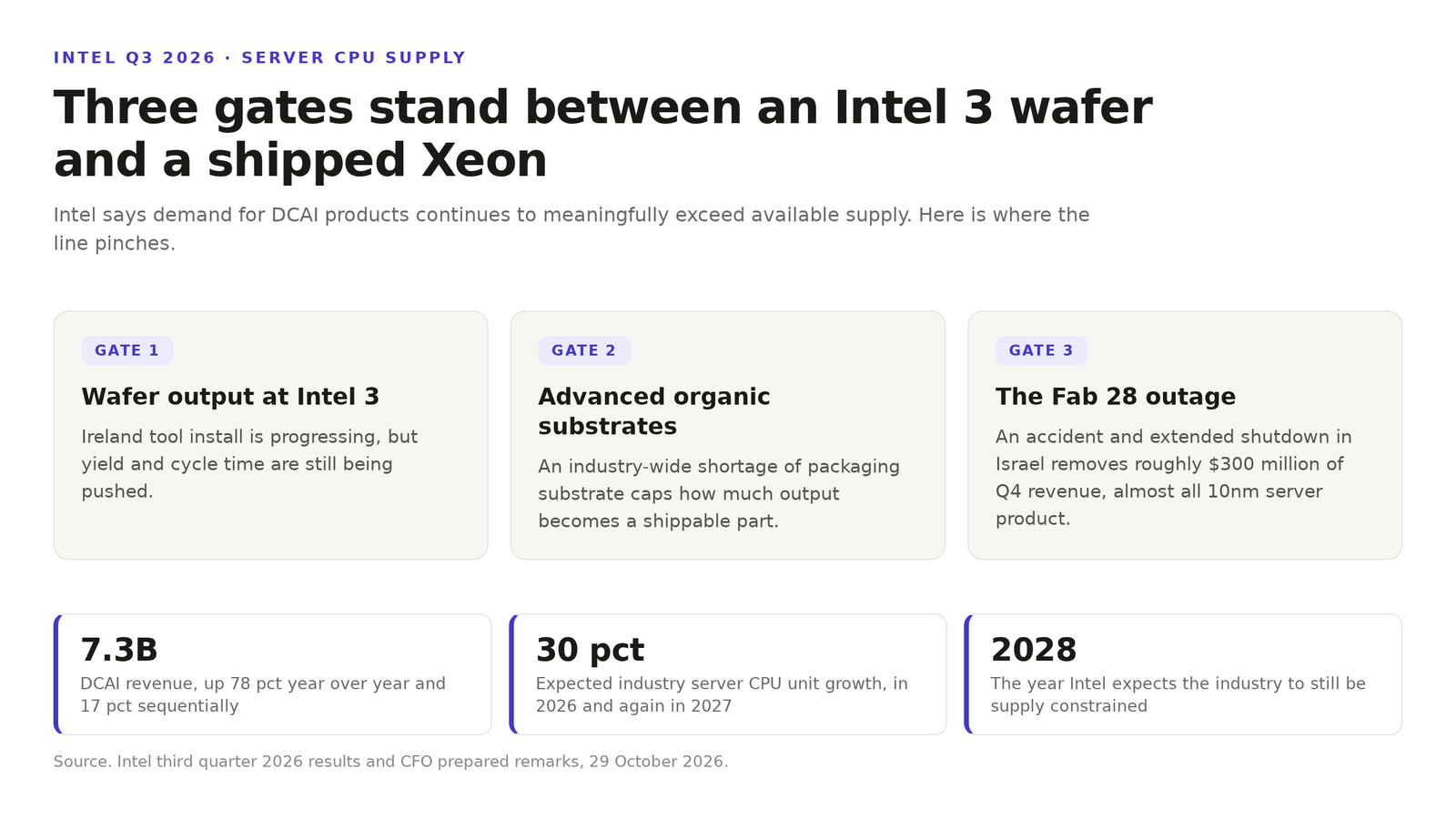
Intel’s data center and AI segment grew 78 percent year on year to $7.3 billion, and the company still could not build enough processors to meet demand. Industry server CPU unit growth is now expected to exceed 30 percent in 2026 and again in 2027, with supply short through 2028. The limit is not transistor density. It is packaging substrate, wafer output at Intel 3, and a plant shutdown in Israel that removes roughly $300 million of fourth quarter revenue.
That turns into a planning problem for anyone sizing clusters. Host CPUs have become a lead-time item alongside memory and accelerators, and the number that now shapes a row is cores per rack. Intel showed Clearwater Forest configurations above 46,000 cores in about 133 kilowatts. Treat the demand framing from a vendor with care and treat the supply math as real. Budget the host layer early, because the alternative is a building full of chassis waiting for a part.
Lip-Bu Tan opened with an admission most chip executives would pay to make. “I am disappointed that we were not able to meet strong customer demand in this quarter,” Intel’s chief executive said on the call on 29 October. Data Center and AI revenue came in at $7.3 billion, up 78 percent from a year earlier and 17 percent from the prior quarter. Operating profit in the segment was $3.0 billion, 42 percent of revenue.
Intel expects DCAI revenue to finish 2026 nearly $10 billion above where it expected to land when the year began. That gap is the server CPU shortage, seen from inside a fab. Fourth quarter guidance is $15.0 billion to $16.0 billion, with DCAI up mid-teens sequentially, so the ramp does not stop, it hits a ceiling.
The gate is packaging, not the transistor
Two of the three limits Tan named sit in packaging and component supply rather than device physics. Intel 3 yield and cycle time are improving, and tool install in Ireland is progressing. What caps output is an industry-wide shortage of advanced organic substrates for EMIB packaging, the layer that turns a die into something you can mount on a board. Tan thanked substrate, memory, foundry and equipment suppliers in the same breath. That list is the bottleneck map.
The third limit is physical. An accident at Fab 28 in Israel led to an extended shutdown that Intel expects to cost roughly $300 million of fourth quarter revenue and 200 basis points of gross margin, and almost all of it lands on 10nm server product. Firm purchase orders to equipment suppliers rose nearly 40 percent sequentially, 2026 capital spending holds at $20 billion, and 2027 goes up strongly.
Forty-six thousand cores in one rack rewrites the floor plan
The figure to take into your capacity review is 46,000. Intel says select Clearwater Forest configurations scale beyond 46,000 cores per rack at roughly 133 kilowatts of total rack power. That is a host layer dense enough to change the power and cooling design of a whole row. Granite Rapids is now the largest product family in the server portfolio, and Clearwater Forest, the first Intel 18A server part, is shipping for revenue.
The driver is architectural. Agentic workloads spend more time orchestrating than generating. Tan argued that GPUs are good at thinking tasks while CPUs are better at finding tasks, and put the gap in energy. A reasoning query on a GPU can cost multiple watt hours, he said, while a CPU based query can cost joules. He is selling CPUs, so discount the framing. The direction still matches what operators see, which is a rising share of the rack going to the part that schedules the work.
Treat the $200 billion forecast as a vendor number
Tan estimated that the server CPU addressable market could grow as much as five times over five years, from $40 billion to more than $200 billion, mostly on agentic workloads. That is a forecast from the company that gains if it lands, built on assumptions about how many agents run per CPU. Keep it as a direction and not as a budget input.
The client side of the same call is the more useful signal for supply. Intel expects the 2026 PC unit market to fall about 12 percent, with second half units down more than 20 percent, and is planning for another 10 percent decline in 2027. Memory prices did that, and Intel said it is adjusting client wafer starts to current demand. So ask your supplier how much of that capacity lands on server product in 2027, and on what schedule.
Three questions worth taking into a 2027 plan. Where does the host CPU sit in your lead-time tracker today, next to memory or below it? If a single rack now holds 46,000 cores, where did the power and cooling plan account for it? And if supply stays short into 2028, which workload gets the scarce hosts, inference or batch training?
Related reading. Our analysis of the memory contracts that already run to 2029 covers the same squeeze one layer down, and Microsoft’s capex quarter shows how a delivery date, not demand, decides what gets billed. For the investor view, see CNBC’s report on the quarter.
Get the next one before it is old news
Independent analysis of cloud-native infrastructure, Kubernetes and data center economics. No vendor spin.