

Executive Summary
DeepSeek V4.1 Flash sits at the top of HuggingFace’s trending board with 131,000 downloads. A community quantized build of the same weights has 1.58 million. Seven of the thirty most trending models are quantized community builds rather than originals.
The gap between what the board rewards and what gets downloaded tells you where the actual demand is. People are not running the newest model. They are running the newest model that fits on hardware they already own, which is a different and more useful question for anyone building on this supply. Two other numbers point the same way. An image model has pulled more volume than any language model on the board, and a trillion parameter Mistral release has 278 downloads because almost nobody can host it. Total parameters have become a marketing figure. Active parameters are the cost, and the deployment tier is where the real usage sits.
HuggingFace ranks models by a trending score, which is roughly how fast attention is arriving. It is a good signal for what the field is talking about. It is a poor signal for what is actually being used, and the difference between the two is visible in the same table.
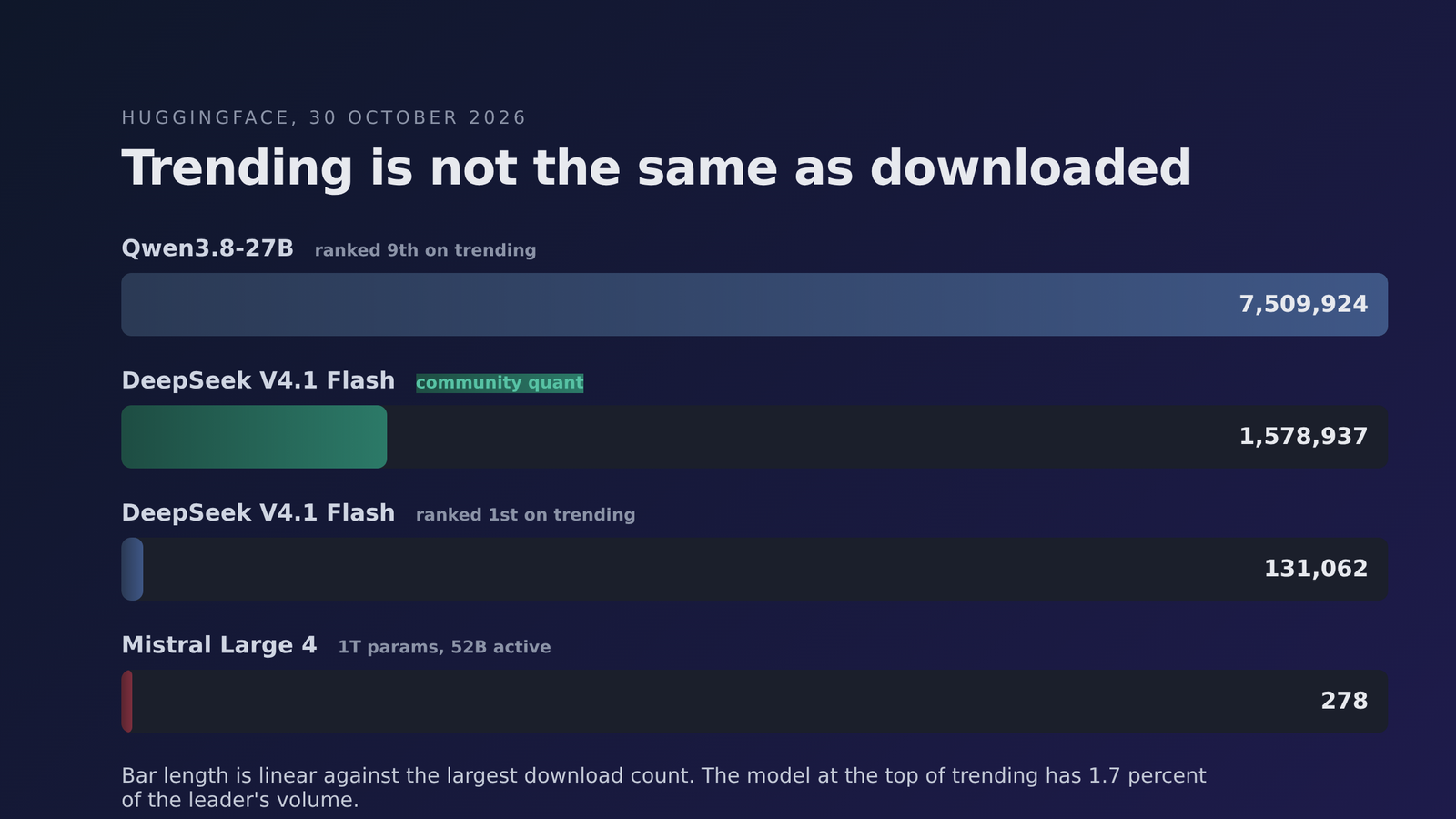
DeepSeek V4.1 Flash leads trending at 878 with 131,062 downloads on its model page. Qwen3.8-27B, which you can find here, is lower down the trending list at 304, with 7.5 million downloads and 18,693 likes. A community quant of the DeepSeek weights, published by a third party, has 1.58 million downloads, twelve times the original.
Quantized builds are how open weights actually travel
A GGUF or AWQ build is a re-upload of someone else’s weights, compressed and reshaped so it runs on a single consumer GPU or a laptop. The trending board itself ranks by attention, not by volume. It is not a new model. It is a distribution channel, and it is outrunning the original upload by an order of magnitude.
Seven of the top thirty most trending models are these re-uploads. Two image models have pulled more volume than any language model on the board, with LTX-2.5 at 2.27 million downloads and an uncensored Qwen-Image quant at 2.17 million.
That pattern is not an accident of the ranking. It is the same constraint showing up twice. People want to run inference on hardware they control, and the weights that make that possible are the ones getting downloaded.
Mistral shipped a trillion parameter model nobody can run
Mistral-Large-4-1T-A52B has 1,236 likes and 278 downloads. One trillion total parameters, fifty two billion active. It is a demonstration of capability at a scale that almost nobody has the hardware to host.
As a portfolio statement it matters, because it shows a European lab still competing at the frontier. As a usage story it is irrelevant, and the download number says so in plain terms.
This is the split worth watching. Total parameters have become a marketing number. Active parameters are the cost. A model can be impressive without ever being run, and the trending board does not distinguish between them.
What this means for anyone buying inference
The supply side is bifurcating. There is a frontier tier that ships for benchmarks and a deployment tier that ships for hardware. The deployment tier is where the downloads are, and it is almost entirely Chinese labs plus quantized community builds.
That matters because it sets the floor on price. A model you can run on hardware you already own has a marginal cost close to your electricity bill. Every API provider competes with that floor whether they acknowledge it or not, and the usage data on the largest routing platform suggests buyers have already internalised it.
The practical read for a team choosing a model this quarter is less glamorous than the leaderboard. Check what has a maintained quant, check what a community has actually put on disk, and treat trending rank as a press-release metric until the downloads agree with it.
We look at the demand side of the same shift in our analysis of which models buyers actually route traffic to.
Get the next one before it is old news
Independent analysis of cloud-native infrastructure, Kubernetes and data center economics. No vendor spin.
[…] we covered quantized community builds outrunning their originals on this same board. This is the other half of that shift. Demand is landing in workloads that […]