


Executive Summary
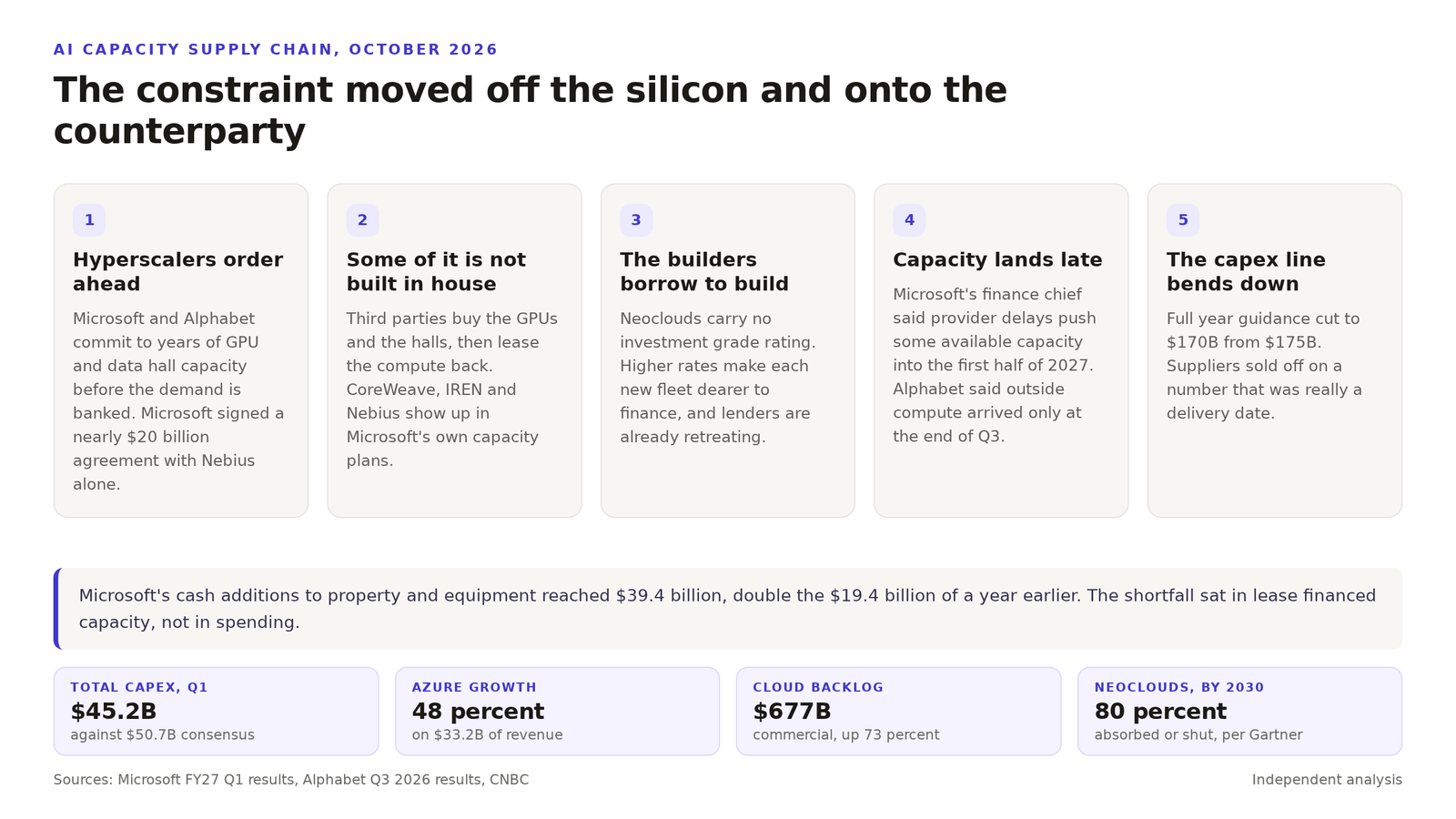
Microsoft finished the September quarter with $39.4 billion of cash spending on property and equipment, roughly double the $19.4 billion of a year earlier. Its headline capital expenditure still missed consensus at $45.2 billion against $50.7 billion, and the company cut full year guidance to $170 billion from $175 billion. The shortfall was in leased capacity, not in demand.
Both Microsoft and Alphabet reported third party capacity arriving late, and Microsoft’s finance chief pushed some of it into the first half of 2027. That matters because the third parties doing the building are neoclouds, and neoclouds finance GPU fleets with debt they can no longer raise cheaply. The market read a demand signal. The numbers describe counterparty risk in the middle of the supply chain, with Azure growing 48 percent and the commercial backlog up 73 percent to $677 billion at the same time.
Microsoft spent $39.4 billion of cash on property and equipment in the September quarter. A year earlier the same line was $19.4 billion.
Revenue came in at $92.3 billion, up 19 percent. Azure did $33.2 billion, up 48 percent. Commercial remaining performance obligation, which is the backlog, rose 73 percent to $677 billion. Nothing in those three numbers says customers slowed down.
Cash spending doubled and the headline number fell
Total capital expenditure including finance leases was $45.2 billion, up about 30 percent, against a $50.7 billion average estimate. Microsoft then trimmed its full year forecast to $170 billion from $175 billion. On paper that is a company braking.
The gap between the two capex lines explains it. Cash additions doubled while lease financed capacity shrank as a share of the total. Microsoft’s own earnings deck said growth ran ahead of capex because of timing differences between receiving goods and paying for them, and because of a lower mix of finance leases.
A finance lease is how a hyperscaler books capacity it did not build. Somebody else bought the GPUs and the halls, and the cloud company rents them. When that somebody else delivers late, the lease never lands in the quarter. The cash line keeps climbing while the headline number dips.
The middle layer borrows, and the borrowing got expensive
Microsoft’s finance chief, Amy Hood, said third party providers of GPUs had delays that push some available capacity into the first half of 2027. She expects capital spending to accelerate then, on higher component costs and the late deliveries.
Microsoft depends on CoreWeave, IREN and Nebius for a slice of its capacity, among others, and signed a deal worth nearly $20 billion with Nebius late last year. Those companies buy GPUs with borrowed money. None of them carries an investment grade rating, rates have risen, and lenders are pulling back from the market.
That is the loop. Higher rates make the build dearer, lenders get nervous, delivery slips, hyperscaler guidance bends, and the market marks the builders down again. CoreWeave and Nebius fell almost 5 percent after Microsoft’s report. IREN fell about 3 percent.
Your 2027 megawatt has a counterparty, not just a GPU
Alphabet showed the same mechanism from the other side. Google Cloud revenue rose 103 percent to $30.7 billion. Its finance chief told analysts that outside computing power came online only at the very end of the third quarter. Capital expenditure was $51.36 billion against $55.09 billion expected, and the shares fell about 10 percent.
The build is not collapsing. Hyperscaler capex is expected to top $1 trillion next year, and Goldman Sachs sees it rising 50 percent to $1.2 trillion. Gartner analysts expect 80 percent of neoclouds to be absorbed or shut down by 2030. Both can be true, and that is the uncomfortable part for anyone signing a multi year capacity contract.
If you are buying AI capacity for 2027 and 2028, the risk in the contract is no longer whether the GPU exists. It is whether the company that bought it can keep financing the hall around it for the length of the term.
Three questions are worth asking of any capacity deal this quarter. Who owns the GPUs behind each megawatt, and is that entity the same one that sends the invoice. What happens to your price if the capacity lands six months late. And who is lending to the supplier, if the supplier has no investment grade rating.
Related reading. The $40 billion GPU loan nobody else could get explains why the neocloud credit story started where it did. CoreWeave is buying network shows where the capacity physically goes. Agents pushed GitHub to 7.4 billion commits a month covers the software side of the same demand curve.
Get the next one before it is old news
Independent analysis of cloud-native infrastructure, Kubernetes and data center economics. No vendor spin.