

Executive Summary
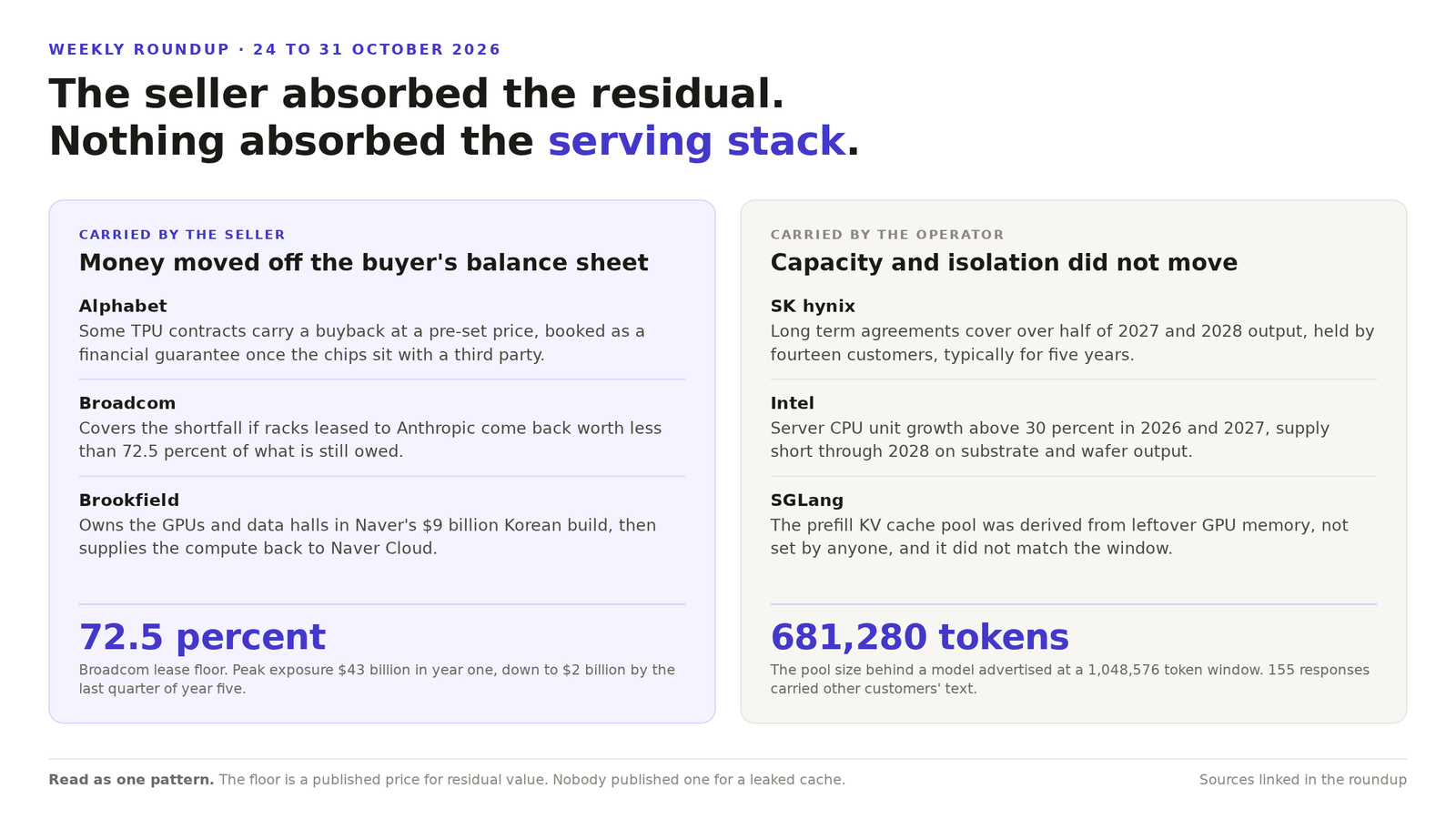
Three structures published this week put the seller behind the resale value of AI hardware. Alphabet disclosed a TPU buyback it books as a financial guarantee once the chips reach a third party. Broadcom put a 72.5 percent floor under racks leased to Anthropic. Brookfield took ownership of Naver’s Korean capacity through a vehicle that rents the compute back. SK hynix said separately that long term agreements already cover more than half of its 2027 and 2028 output, held by fourteen customers.
The verdict is that AI capacity allocation for 2028 now runs through contracts rather than purchase orders, and the residual risk on that hardware has moved to whoever profits from selling it. That is a good trade for the seller and a poor one for everybody else. A 72.5 percent floor is a public estimate of what a five year old accelerator is worth, printed by the people who have to fund it. Price memory and host CPUs before accelerators, and treat the serving stack as the one layer where nobody has agreed to absorb the loss.
Two numbers decided this week. One was a floor under a lease. The other was a cache pool smaller than the context window printed on the model card. Only the first came with a guarantee.
Three deals put the seller behind the resale price
Alphabet filed its third quarter accounts and put the option in the revenue note. Some TPU contracts let the buyer hand the hardware back at a price agreed in advance, and once those chips sit with a third party Alphabet books the arrangement as a financial guarantee. Backlog reached $567.7 billion at 30 September. Long term debt went from $46.5 billion to $125.1 billion in the same period.
Broadcom went further and published the schedule. Four banks committed $63 billion on 26 October to buy Broadcom accelerators and lease them to Anthropic. If the returned racks are worth less than 72.5 percent of what is still owed, Broadcom covers the difference. Peak exposure is $43 billion in year one, falling on a straight line to $2 billion in the final quarter of year five.
Naver took the other route and put the metal on somebody else’s books. Its $9 billion agreement with Brookfield on 27 October funds GPUs and data halls through a vehicle Brookfield controls, then supplies compute to Naver Cloud. The first 55 megawatts arrive in the first half of 2027.
Allocation for 2028 got signed while you were budgeting
SK hynix earned an 80 percent operating margin on 104.6 trillion won of quarterly revenue, then said the shortage runs through 2030. Long term agreements now cover more than half of its 2027 and 2028 capacity. Fourteen customers hold them, and the terms typically run five years. An operator outside that group bids for residual at a price the supplier can move inside a band.
The host layer has the same shape. Intel grew data center revenue 78 percent to $7.3 billion and still could not ship enough. Server CPU unit growth is expected above 30 percent in 2026 and again in 2027, with supply short through 2028, limited by packaging substrate and wafer output at Intel 3.
Then read Anthropic’s filing for the contract language coming next. Fixed and minimum guaranteed compute commitments reached $265.6 billion at 30 June against $54.6 billion six months earlier. The terms run 20 years, carry annual escalators, and pass an uncapped fuel bill to the tenant.
The isolation failure was arithmetic, and the arithmetic was published
Cloudflare confirmed that 155 responses from one model on Workers AI carried text from other customers’ requests, between 27 August and 9 September. The prefill KV cache pool held 681,280 tokens while the model was advertised at 1,048,576. SGLang also admitted a request its own scheduler had already rejected. The fixes shipped in v0.5.20, v0.5.21 and v0.5.22.
The pool size is the part to keep. SGLang derives it from whatever GPU memory remains after the weights load, so nobody sets it. It moves when quantization, tensor parallel width or CUDA graph sizing changes.
Mistral Large 4 made the same arithmetic visible from the other side, with vLLM reporting about 7.9 times the KV cache capacity once decode context parallelism spreads across eight GPUs. A one million token window is a marketing number until the cache can hold it.
GitHub hit the wall in storage. Seven and a half billion commits in September, roughly five times the year before, against a design where every write waited on a quorum of five full replicas. The fix narrowed serialization to a single reference and stopped counting replicas that never join the quorum.
None of those three was a surprise. Each number was written down before the failure, in a config file, a launch note or a design document, and each one stopped being true under load.
Related reading. Broadcom reopened the bottom of the market with a budget vSphere edition that reportedly drops memory tiering, in the week memory got contracted to 2029. Tesco is moving its stores to Proxmox while it sues Broadcom over a 175 percent renewal. And CIQ put agent tools behind three tiers that are fixed when the process starts.
Get the next one before it is old news
Independent analysis of cloud-native infrastructure, Kubernetes and data center economics. No vendor spin.