


Executive Summary
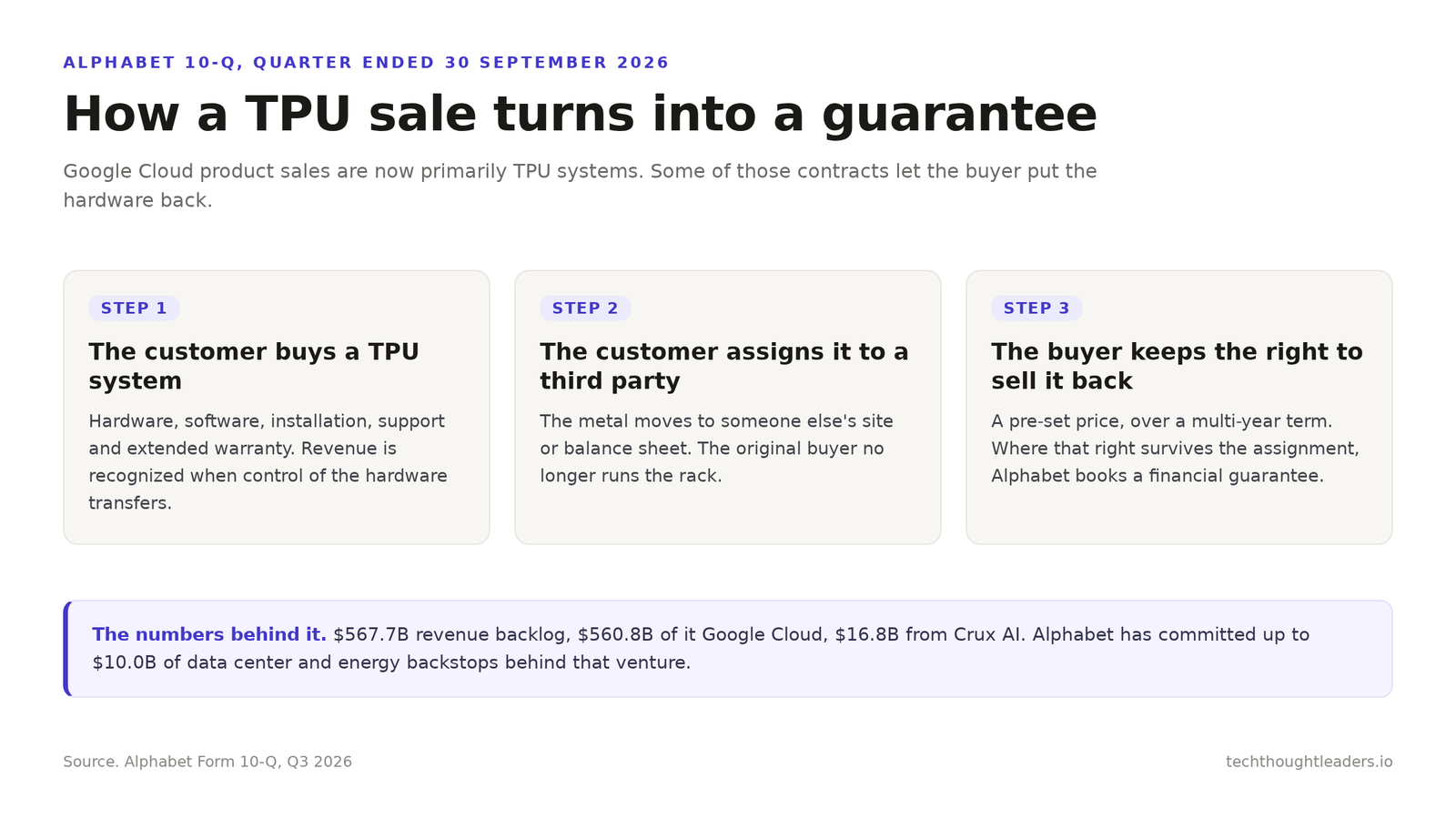
Alphabet is now underwriting the residual value of the hardware it sells. Its third quarter filing discloses that some TPU contracts can be unwound by the buyer, and that Alphabet treats the arrangement as a financial guarantee once those chips have been handed to a third party. The seller has become the buyer of last resort on its own silicon.
The numbers set the shape. Revenue backlog reached $567.7 billion at 30 September, $560.8 billion of it in Google Cloud and $16.8 billion of that from Crux AI, the joint venture Alphabet supplies. Alphabet has committed up to $10 billion of data center and energy backstops behind the same venture, against $5 billion of Blackstone equity. Capital spending ran $131.95 billion in nine months, more than double the $63.6 billion of a year earlier, while long term debt went from $46.5 billion to $125.1 billion. Supplier, landlord and lender are one counterparty here. That is a balance sheet decision, not a product decision.
A pre-set repurchase price is a put option. Alphabet wrote one, and the language survived into a public filing.
Read the revenue recognition note in Alphabet’s 10-Q, and the TPU stops behaving like a chip you own outright. Customer arrangements can carry an option requiring Google to repurchase the hardware and the embedded software at a pre-set price over a multi-year term. The buyer chooses whether to exercise. Google carries the consequence.
Rights of return and guarantees are not the same line
The filing splits the TPU buyback treatment in two. Where Google holds the buyback obligation to the customer who bought the chips, the option is generally accounted for as a right of return. That touches revenue at the point of sale, because product sales are booked net of estimated allowances for returns. Where the customer has assigned the TPUs to another party and still keeps the ability to force the repurchase, Alphabet accounts for the arrangement as a financial guarantee. Same hardware, same price, different instrument.
Why that distinction matters. A guarantee is not a refund you might process. It is a promise that stays on the books until the term expires, and it pays out exactly when the asset has lost the value everyone assumed it would keep. On accelerators superseded on a roughly annual cadence, a pre-set price several years out is nearly free for the buyer to exercise and expensive for the seller to honor.
The backstop already has a counterparty, and it is the supplier
The $16.8 billion of Crux AI backlog inside that $567.7 billion is the tell. Crux AI launched in September with a $5 billion equity commitment from funds managed by Blackstone, a plan for 500 megawatts of TPU capacity in 2027, and a roadmap toward 2 gigawatts. Alphabet holds a minority interest and accounts for it under the equity method.
Alphabet also committed up to $10 billion of data center and energy infrastructure backstops behind agreements the venture may sign. So one document holds Alphabet’s revenue from the venture and Alphabet’s obligation behind the venture’s power contracts and buildings. The neocloud is the customer. Alphabet is the supplier. Alphabet is also the credit behind the infrastructure that makes the capacity real, and the TPU it sells can come back at a fixed price.
Capex doubled and the funding mix moved with it
Purchases of property and equipment reached $131.95 billion in the first nine months, against $63.6 billion a year earlier. Net property and equipment climbed from $246.6 billion at the start of the year to $372.8 billion at the end of September. Long term debt went from $46.5 billion to $125.1 billion, with $85.2 billion of new debt.
Then the line that gives the model away. Inventory, which the filing describes as primarily TPU systems for sale to enterprise customers and Pixel devices, rose from $2.4 billion to $13.3 billion. A services business does not carry $13.3 billion of hardware. A hardware business does, and a hardware business that also writes puts on that hardware carries the price risk too.
None of this is a scandal. It is what a company does when the buyers of AI capacity cannot fund the build alone, so the vendor guarantees the economics to get the metal into the ground. It is the same structure that put Broadcom behind its own chips for Anthropic, now arriving at the company that designs the alternative to Nvidia. Call it the residual value backstop.
Three questions to ask of any capacity contract you are handed this quarter. Who owns the asset if usage falls short of plan? Who sets the price at which it comes back, and when? And who is the counterparty if the operator that took the assignment cannot pay?
Related reading. Microsoft’s capex miss was a delivery date covers the same week from the buyer side. Google’s TPU just became an ingredient explains why the chip now travels. Brookfield will own Korea’s AI factory shows the special purpose vehicle version of the same trade.
Sources. Alphabet filed its Form 10-Q for the quarter ended 30 September 2026, alongside the third quarter results.
Get the next one before it is old news
Independent analysis of cloud-native infrastructure, Kubernetes and data center economics. No vendor spin.