


Executive Summary
Bentaus, an energy-first neocloud, reported on 12 November that it cut power to an AMD Instinct MI325X cluster by 30 percent while holding 97 percent of token throughput. The mechanism is a real-time power cap run by its own Ziani software and tuned alongside a DriveNets AI Fabric built for AMD’s collective library. Jobs keep running at reduced clocks instead of stopping, which is a different answer to grid pressure than checkpointing a training run and draining the allocation.
Read the arithmetic rather than the headline. Power at 70 percent and throughput at 97 percent puts energy per token near 72 percent of its previous value, a saving of about 28 percent. That is a real gain and a quieter number than the one in the title. The open question is commercial. A cap that stretches wall clock only saves the operator money when capacity is billed by the token and not by the machine hour.
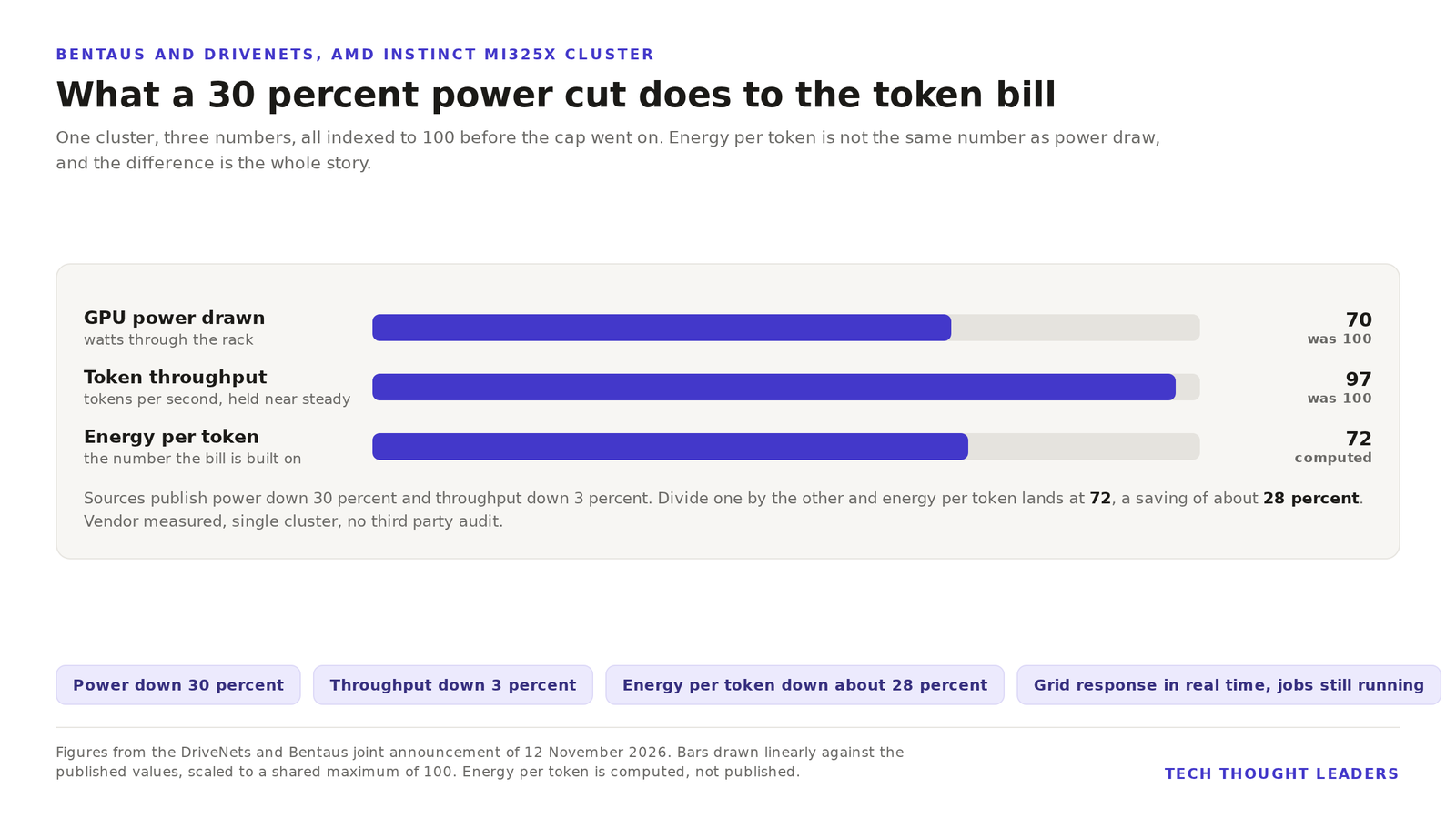
Before the cap went on, the GPUs were busy and keeping them busy was expensive. Bentaus now says it moved the first number down by 30 percent while barely touching the second.
Bentaus develops and operates its own AI infrastructure. The cluster runs AMD Instinct MI325X accelerators over a DriveNets Ethernet fabric, with Bentaus software called Ziani managing power draw. DriveNets published the joint result on 12 November. The figures are the companies’ own, from one cluster, and neither has published the workload mix behind them, which decides whether a 3 percent throughput loss is cheap or fatal.
The cap goes on the clock, not on the queue
Most of the AI grid conversation has been about curtailment. A campus promises a utility it will drop load when the grid is strained, the operator drains the job at a checkpoint, writes optimizer state to storage, and holds the allocation. The number that matters in that promise is the share of a campus that can stop mid-job, what we call the pause budget.
Ziani does something else. It lowers GPU and CPU power draw in real time and lets the workloads keep running. Nothing drains or restarts. An inference request still returns, at a slower cadence while the cap holds, and the cluster hands the watts back when the grid recovers.
A dimmer is easier to sell than a switch. Grid programs pay for a response that arrives when it is called, and a response that waits on a job reaching a safe boundary carries a delay. Continuous reduction removes it.
Thirty percent of the power is 28 percent of the energy
Divide the published numbers and the claim changes shape. Power sits at 70 percent of baseline and throughput at 97 percent, so each token costs 0.70 divided by 0.97 of the energy it used to. That is 0.72. The saving is about 28 percent.
The direction is right and the rounding is harmless. The wall clock also moves far less than the wattage. A fixed batch of tokens takes about 3 percent longer while the rack draws 30 percent less, and the two multiply out where the arithmetic said.
That is close to free on a service billed by the token. It is not free on capacity billed by the machine hour, because the dollar meter runs on the same clock either way and the saving lands on the utility bill rather than yours.
The grid wants a dimmer. A contract wants a number.
Power availability is replacing GPU supply as the limit on how fast capacity comes online. Sameh Boujelbene of Dell’Oro Group says so in the announcement. More than a dozen U.S. states have introduced data center moratoriums or paused legislation in 2026, and New York has enacted a statewide halt on new large-load permits, according to the same release.
Three questions decide whether a flex claim survives procurement. What is the baseline, because 30 percent off a capped number is not 30 percent off nameplate. What happens to the p99 at the bottom of the cap, because an average says nothing about the request that waited. And who carries the penalty when a response window is missed, because a grid program pays for delivery and a miss is a contract problem rather than an engineering one.
DriveNets is selling the other half. Its fabric is tuned end to end for AMD’s stack, from switch to NIC to the RCCL collective library, and the company positions it as the open, multi-vendor answer to a single vendor’s factory reference design. Its published benchmarks put the architecture about 5 percent ahead on throughput and 12 percent ahead on time to first token against publicly available results. Vendor figures on a reference design are a starting point, not a bake-off.
Related reading. NVIDIA Cut AI Factory Build Time to 14 Days covers the other half of this problem, where the build gets faster and the interconnection queue does not. And Google Bought a Gigawatt of Power It Has to Switch Off shows what a utility pays for the flex this cluster claims to provide.
Get the next one before it is old news
Independent analysis of cloud-native infrastructure, Kubernetes and data center economics. No vendor spin.