
Executive Summary
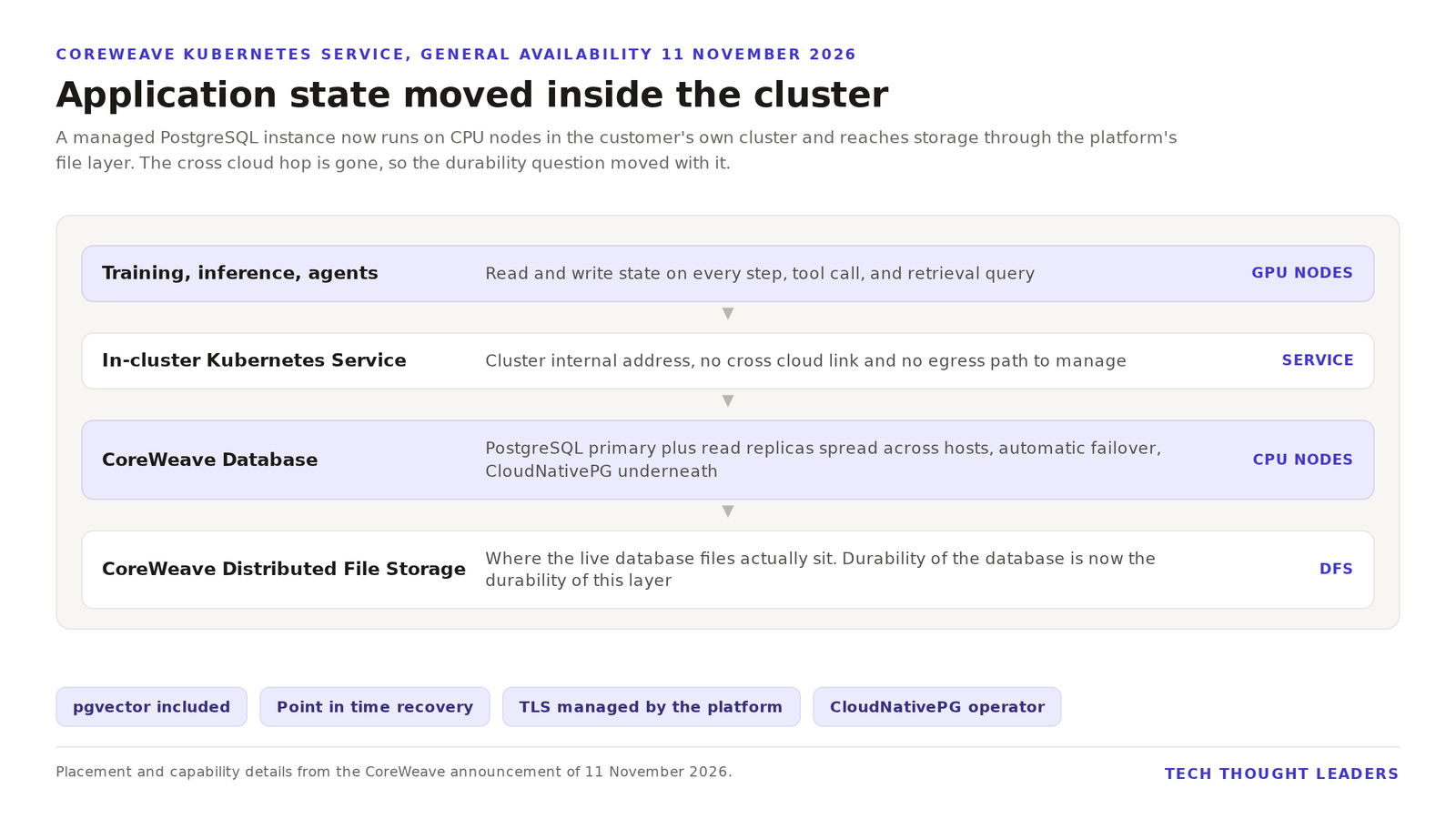
CoreWeave made its managed PostgreSQL service generally available on 11 November. It runs on CPU nodes inside the customer’s own CoreWeave Kubernetes Service cluster, answers over an in-cluster Kubernetes service, and keeps live database files on CoreWeave Distributed File Storage. The cross-cloud hop between an agent and its own state is gone.
The operator underneath is not new. CloudNativePG has handled primary and replica management for Kubernetes Postgres for years, and CoreWeave built around it rather than reinventing it. What is new is placement. Application state now sits inside the same platform boundary as the GPUs, which removes an egress path and a second security perimeter while coupling database durability to a file layer that also carries training data. The restore is the test that separates those two readings.
Every AI stack has a relational database in it somewhere. On CoreWeave, until this week, that database lived in another cloud or on a machine the customer ran itself.
Production AI touches the database constantly. Agents read and write state between tool calls, training runs log experiment metadata, and retrieval services query embeddings at every step. Keeping that database in a second cloud added a network hop, an egress path and a separate environment to secure, and CoreWeave says so in its own announcement without much dressing up.
State was the last workload living outside the cluster
Data gravity is usually an argument about object storage and model weights. Applying it to the operational database is newer, and easier to defend. Postgres queries during a request are small and frequent, which is the worst possible shape for a link across clouds. The latency lands on the p99 where users feel it, and the egress lands on the invoice where finance does.
Moving the database into the same cluster turns those calls into an in-cluster service and deletes the line item. That is the entire commercial argument, and it is a good one. Nearly every production stack keeps application state, workflow metadata and experiment tracking in a relational database, so this is not a niche service bolted onto a GPU rental business.
CloudNativePG handles failover. CoreWeave sells the operations.
Each database runs a primary plus read replicas spread across hosts, with automatic failover. Live data sits on CoreWeave Distributed File Storage, backups run continuously by default, and point-in-time recovery reaches any moment inside the retention window. A restore can land in a new cluster for validation before anyone points production at it.
Encryption covers data at rest and in transit, CoreWeave manages TLS certificates and security patches, and access still runs through native PostgreSQL roles, Kubernetes network policies and audit logging. pgvector is included, so embeddings and application rows live in one database instead of two systems that have to stay in step.
The operator is CloudNativePG, and that is the honest part of the design. CoreWeave did not write its own Postgres controller. It wrapped a known open-source one in a managed service and put upstream work into Barman’s S3 compatibility and the pgexporter metrics exporter, both of which help anyone running Postgres on Kubernetes rather than only its own customers.
Test the restore, then read the storage contract
Placement cuts both ways. The database no longer depends on a link to another cloud, and it now depends on the platform file layer, which is the same layer carrying training data and checkpoints. A storage incident stops being another team’s problem to page about.
Three questions belong in the evaluation. What retention window ships with the tier you are actually buying, because recovery to any moment means any moment inside a window somebody chose. What a replica spread across hosts means when you resize CPU nodes, because the database sits on nodes you scale and the failover topology follows that change. And what a degraded file layer does to a primary that cannot flush its write-ahead log, because a database that cannot write WAL is down regardless of how many replicas are listening.
The responsibility split is clean on paper. CoreWeave owns replication, failover, patching and backups. You own the schema, the queries, the users and the CPU nodes those databases sit on inside your CoreWeave Kubernetes Service cluster. On the first serious incident somebody will ask whose change it was, and that answer is easier to find before the database moves than after.
Related reading. CoreWeave paid $846 million in interest in a single quarter while building this platform, which is the context for every managed service it ships. And the residual value argument for rented GPU capacity explains why the services layer matters more than the silicon.
Get the next one before it is old news
Independent analysis of cloud-native infrastructure, Kubernetes and data center economics. No vendor spin.