


Executive Summary
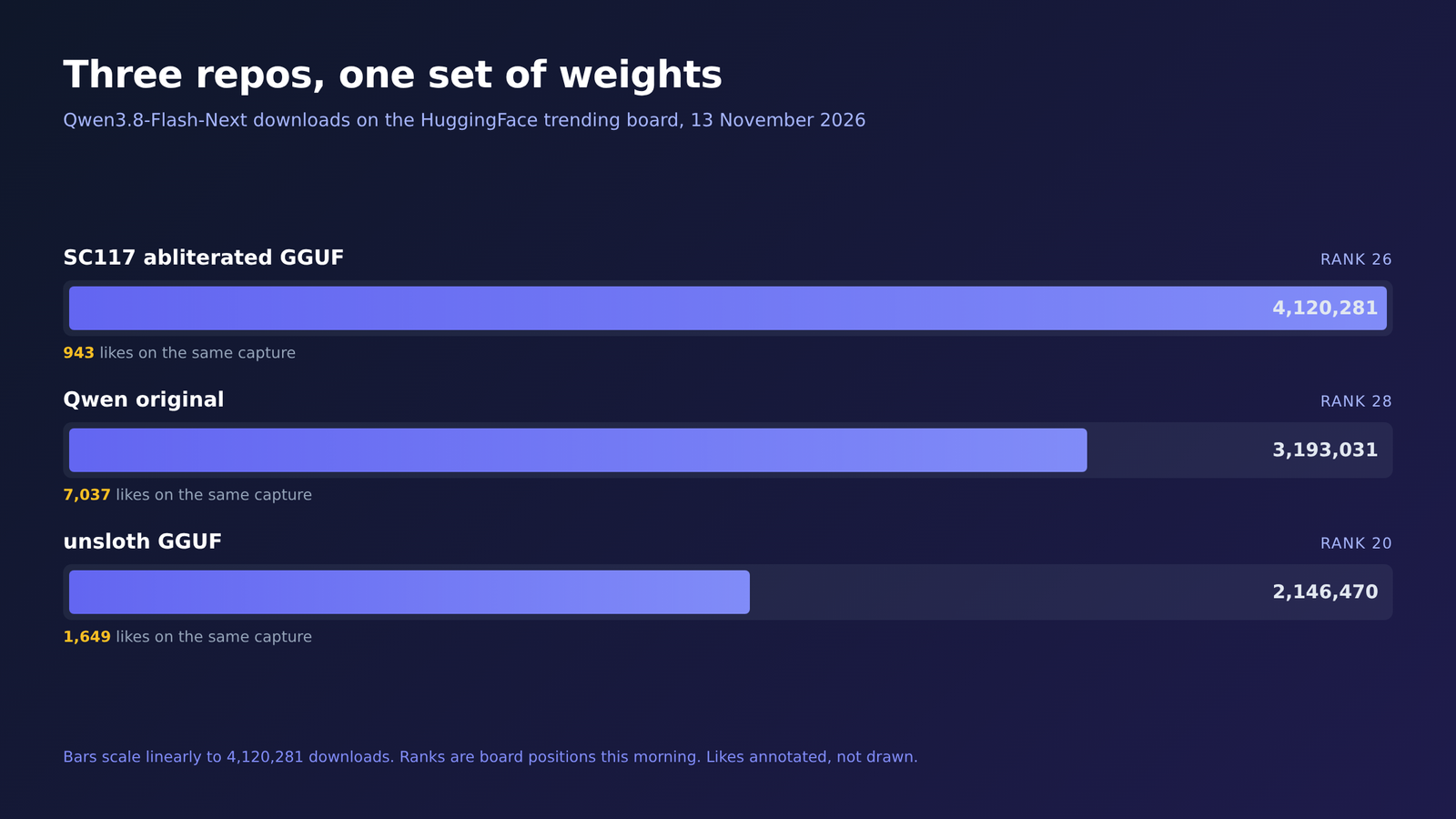
Fifteen daily captures of the HuggingFace trending board, and the repo Qwen publishes under its own name never appeared until this morning. Qwen3.8-Flash-Next landed at rank 28 with 3,193,031 downloads and 7,037 likes. Two community rebuilds of the same weights sit at rank 20 and rank 26, and together they hold 66 percent of the downloads across the three repos. Our 9 November report leaned on that absence. It no longer holds.
The three columns on that page disagree with each other. Downloads favor the abliterated copy by close to a million, likes favor the original by 7.5 to one, and the trending score orders all three a third way. Read the board as a deployment ranking and a team pins the wrong artifact. The gap between those columns is the story, not the ranking.
The model Qwen ships under its own name reached the HuggingFace trending board this morning for the first time in fifteen daily captures. It arrived at rank 28, behind two copies of itself.
Qwen3.8-Flash-Next shows 3,193,031 downloads and 7,037 likes on today’s capture. unsloth’s GGUF build holds rank 20 with 2,146,470 downloads and 1,649 likes. SC117’s abliterated GGUF holds rank 26 with 4,120,281 downloads and 943 likes.
Add the three and the copies account for 6,266,751 of 9,459,782 downloads, or 66 percent. The original trails the copy with the fewest likes by close to a million pulls.
Two thirds of the downloads, 27 percent of the likes
The two columns measure different things. Downloads count fetches of weight files, which includes every CI job, every container build and every pipeline that pulls the repo again. Likes count a person pressing a button once per account.
Across the three repos that split is 2,592 likes on 6.27 million downloads for the copies, against 7,037 likes on 3.19 million for the original. The original earns one like per 454 downloads. The abliterated copy earns one per 4,369.
That is not a quirk of this model line. It is what the column is. HuggingFace documents the download count as a rolling window over recent activity, not a lifetime tally, which is why it can fall while a repo is being fetched every hour.
None of the three columns agrees with the other two
Sort the three repos by any single number on that page and you get three different orders. Downloads put SC117 first. Likes put the original first by 7.5 to one. Trending score puts unsloth first at 195, ahead of SC117 at 165 and the original at 160.
The score is the column that decides rank, and it tracks neither total. That makes it a velocity reading, not a popularity reading. Yesterday SC117 lost 93,726 downloads between captures while gaining 32 likes. A demand collapse does not add likes.
The wider board shows the same thing without asking anyone to trust a formula. MiniMax-H3-Image showed up two mornings ago with 667 downloads. It sits at rank 2 this morning with 306,718, and its Comfy-Org intake copy is at rank 8 with 835,593.
The most downloaded of the three has its refusals removed
SC117’s repo is a GGUF conversion of an abliterated model. Abliteration removes the refusal direction from the weights, and the result will answer prompts the base model declines. It is not a quantized copy of Qwen3.8-Flash-Next but a different model with the same lineage.
By download count it is the most used of the three. A team that benchmarks Qwen3.8-Flash-Next and then serves whatever repo the manifest points at is comparing two behaviors and calling it one. The regression suite passes on an artifact it was never written for.
None of this argues against rebuilds. GGUF conversions are why a 27B model runs on one workstation, and most of the traffic on this board comes from people doing exactly that. The argument is narrower. Provenance changes behavior, and the board sorts on attention, so the top of the page is the last place to look for the weights you meant to pull.
Our September reading of the same board holds up. The ranking says what people are trying this week. The download column says what is running. Those are not the same question, and this morning is the cleanest case yet of the two answers landing four ranks apart.
Three questions worth putting to your own environment. Does the deployment manifest name a lab repo or a rebuild, and can you say which without opening the file? Is the evaluation baseline recorded against the same artifact the service loads? And when a rebuild ships a conversion update, does anything in your pipeline notice?
Related reading. Our 9 November report on why the rebuilds reached the board first, and the earlier piece on what the download column actually counts.
Get the next one before it is old news
Independent analysis of cloud-native infrastructure, Kubernetes and data center economics. No vendor spin.