

Executive Summary
Eight days ago MiniMax’s image model held rank one on the HuggingFace trending board with a score of 699. This morning it is not in the top thirty. Its download column rose 245,162 over the same stretch, so the board measures attention while the download column measures something much slower. The model gained users in the same week it lost the leaderboard.
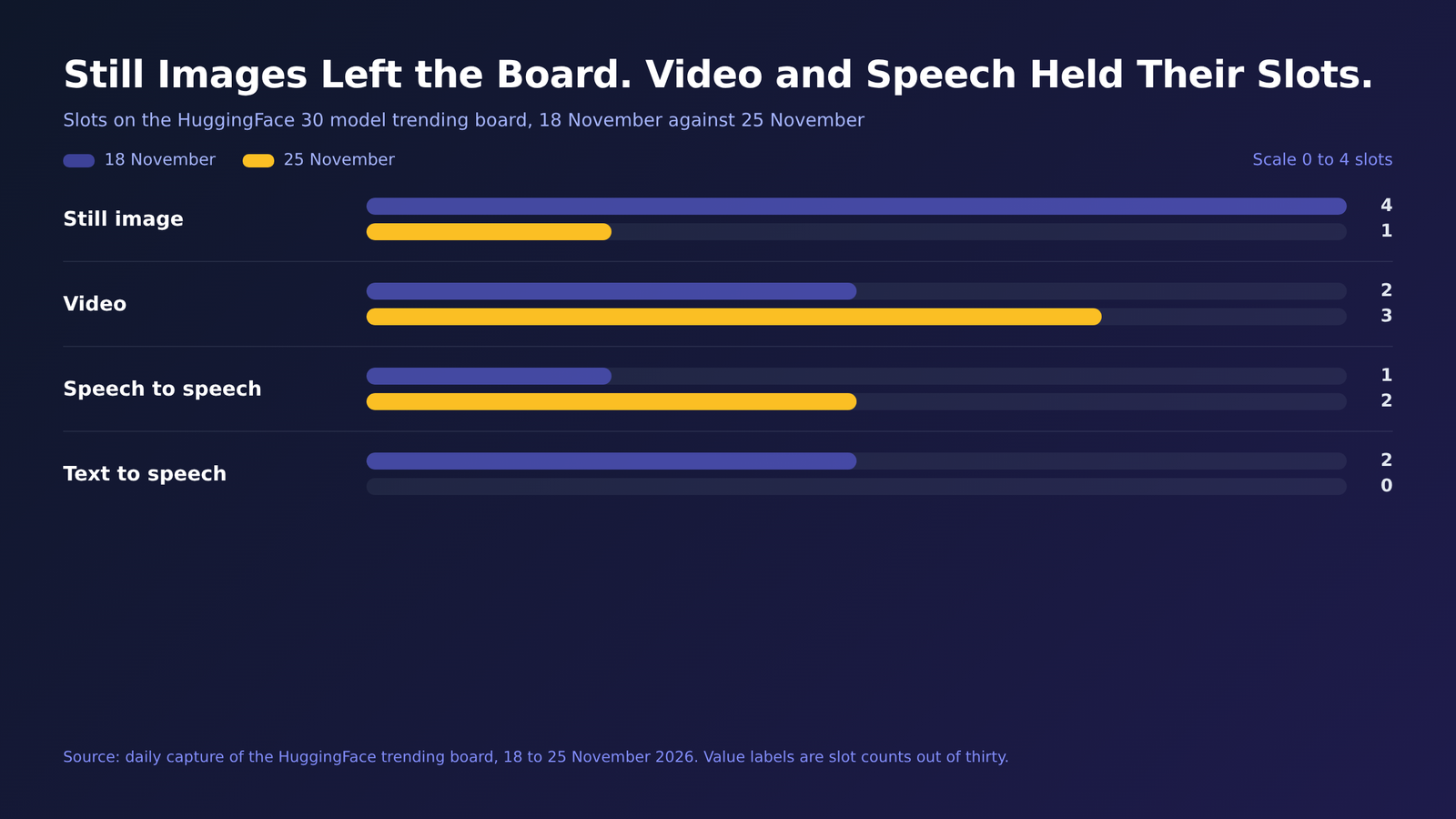
The slots it gave up went to moving pictures and to speech. Still-image repos fell from four of thirty to one. Video gained a slot. Speech to speech doubled. Text to speech went to zero. That rotation matters past a leaderboard, because a still image is a batch job you size for throughput and a conversation is a streaming request you size for time to first audio. One packs into a batch and bills per image. The other holds a connection open and bills per chunk.
On 18 November MiniMax-H3-Image held rank one on the HuggingFace trending board with a score of 699. This morning it is absent from the top thirty. The repository added 245,162 downloads and 982 likes across those eight days, and it moved down in every capture between.
The decline was orderly, which makes it worth reading. The score went 699, then 244.5, 200.5, 164, 147, 125, 96.5, then nothing. Nothing broke, and the model still ships.
The image category emptied out and one repo survived
Still-image models held four of the thirty slots on 18 November. This morning they hold one. The three that left were a vendor release and two community builds of it.
MiniMax’s own repo went from rank one to twenty-three before it fell out. The Comfy-Org rebuild went from rank nine and a score of 223 to rank thirty and 79, then off. Abiray’s quantized build went from twenty-nine to gone.
The survivor is a chatrlabs build of Qwen-Image-2.1, sitting at rank twenty-two with a score of 110. A week ago it was rank eight with 227.5. That is a 52 percent drop for the last standing repo in the category.
Read the direction and not the vendor. MiniMax didn’t have a bad week. Its downloads rose 33.7 percent while the board stopped scoring it, because the board measures what people try this morning.
Video gained a slot and speech doubled while voice output vanished
Video held two slots on 18 November and holds three today. Lightricks LTX-2.5 has not left the board in eight captures. It sits at rank eleven with a score of 159.5, down from 393 at rank four, while its download column rose 196,674.
Apple’s FastFrames-L went from rank twenty-three and 96 to rank thirteen and 151. Lakonik’s pi-H3 arrived at twenty-nine.
Speech is where the shape changed. Two audio-to-audio models now sit in the top seven. inworld’s voice-isolator climbed from rank twenty with a score of 110 on 19 November to rank three with 638. Its download column read zero through 24 November and 12,733 today, so the weights landed this week.
higurashi-ai Haru-4B was rank one on 19 November at 420 and sits at rank seven today at 219. Its downloads nearly doubled over the span. Text to speech is the branch that emptied. Zyphra’s ZONOS3-Mini and n4ze3m’s tiny-voca both left the board and nothing replaced them.
A still image is a batch job. A conversation is a deadline.
This is where it reaches a GPU budget. A still-image request is finite work you can queue and pack. Denoising runs in a loop, the scheduler fills the gaps with other requests, and the unit you optimize is images per second per dollar. Continuous batching was built for exactly that pressure.
Speech in and speech out is a different contract. The request stays open for the length of the utterance, and the client waits for the first chunk of audio rather than a finished artifact. That puts a ceiling on how you pack the batch, because a request held open to keep a slot full is a request the user hears stalling.
Video inherits the same problem on a longer horizon. A five-second clip is not five seconds of waiting, but its first frames still carry a deadline that a batch of stills never faces.
The board settles none of this. What it shows is where attention went. The top three repos now hold 42.4 percent of the board’s total score, up from 16.8 percent on 19 November, and the shapes moving into that space are the ones that hold a connection open. If your capacity model was built on images per second, the number to measure this quarter is p95 time to first audio chunk.
Three questions before the next planning cycle. What share of your GPU hours is actually batchable, and does that share still match the roster you host. What is your p95 time to first audio chunk on the speech path, measured rather than assumed. And when a board slot moves, does anyone ask what the request shape underneath it became.
Related reading. MiniMax arrived on the board in November on an image model and took two slots. Yesterday’s capture counted four repos carrying one model name. And the download column is a trailing window, which is why it can keep rising while a score falls.
Get the next one before it is old news
Independent analysis of cloud-native infrastructure, Kubernetes and data center economics. No vendor spin.