


Executive Summary
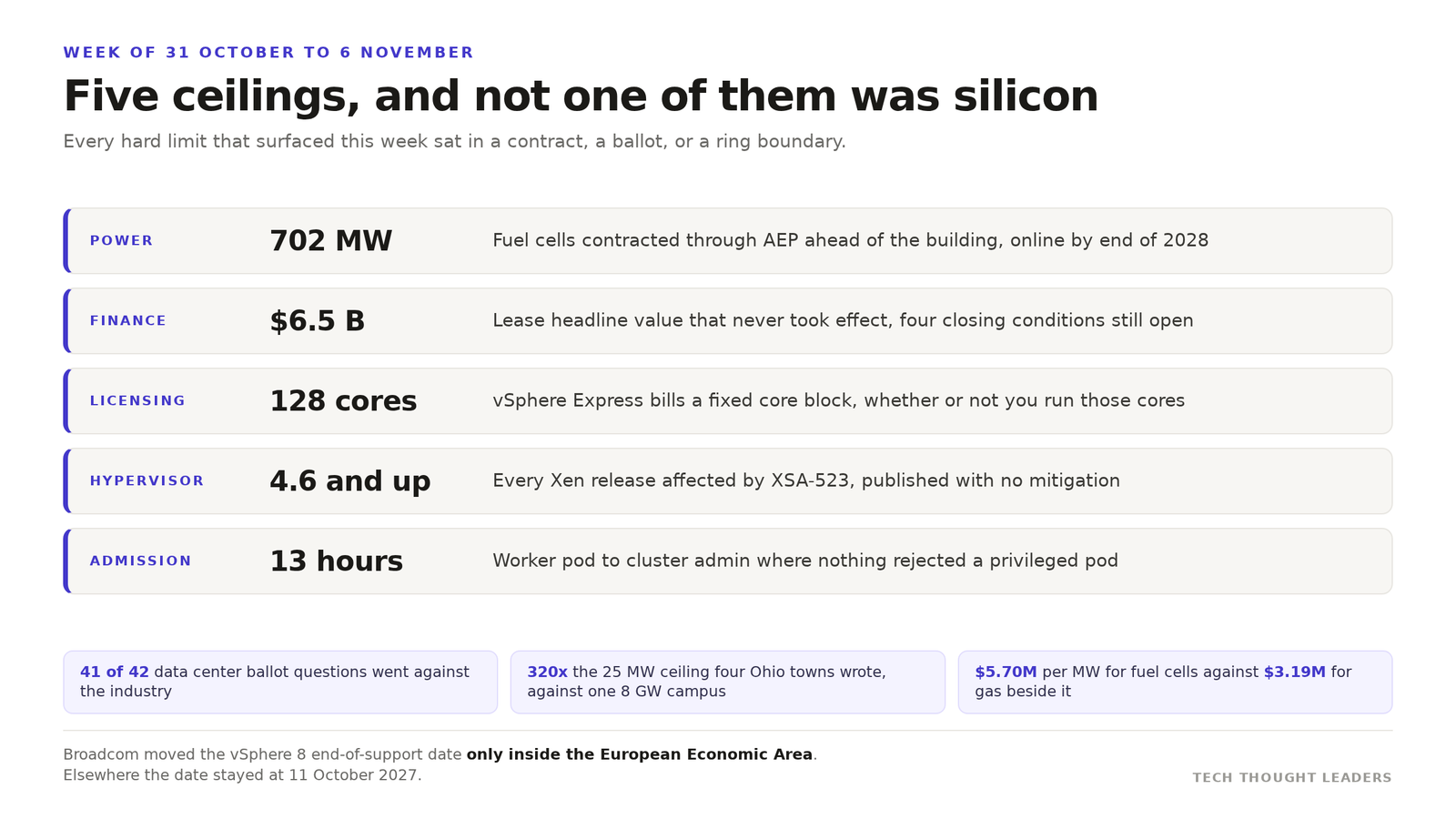
None of this week’s ceilings came out of a fab. Google contracted 702 megawatts of fuel cells ahead of a Wyoming data center and paid roughly $5.70 million a megawatt for the delivery date. Voters rejected 41 of 42 data center measures, and four Ohio towns wrote a 25 megawatt ceiling, 320 times smaller than the campus beside them. Broadcom gave European customers twelve extra months on vSphere 8 and gave nobody else the same option, while the edition replacing Standard bills $75 a core against roughly $55. Xen published a guest escape with no mitigation.
The pattern across all four is that the binding constraint has moved into a contract, a ballot, or a ring boundary, and each is settled before hardware gets ordered. The verdict is uncomfortable for anyone budgeting compute and calling it capacity. Price the delivery date, read the closing conditions, and check the admission policy, or the ceiling arrives after the signature.
Fermi America has $1.5 billion of construction in the ground at Project Matador and no rent coming off it. Its 222 megawatt lease with TensorWave had still not taken effect when the 31 October closing date went by, and the largest open condition is project financing.
Google bought the plant because the ballot line sits below the building
Google will invest $17 billion in Laramie County, Wyoming. The power contract for AI infrastructure carries the schedule. AEP committed roughly $4 billion to 702 megawatts of Bloom Energy fuel cells under a 20 year power purchase agreement, with full operation due by the end of 2028. Black Hills is building 564 megawatts of gas for $1.8 billion over the same stretch. The fuel cells run about $5.70 million a megawatt and the gas about $3.19 million, so Google is paying close to double for a date it can hold.
The reason is on the ballot. Reuters counted 41 data center measures this week and all but one went against the industry. Ohio wrote 25 megawatts into measure after measure. Conneaut, Defiance, Sunbury and Trenton each prohibit a facility with peak load above 25 megawatts. Set that against PORTS-Pike, the 8 gigawatt campus OpenAI is developing with SoftBank and SB Energy. That is 320 times the ceiling. A 25 megawatt limit does not regulate an AI campus, it bans one.
The power contract moved ahead of the building. Operators stopped queuing for grid access and started buying supply and their own local consent. An interconnect queue is a schedule risk. A local majority is an existential one.
Broadcom moved the deadline only where a regulator was sitting
Broadcom publishes two VMware lifecycles. Inside the European Economic Area, vSphere Standard 8 and Enterprise Plus 8 stay on sale until 31 October 2027 with Extended Support to 31 October 2028. Elsewhere, general support still ends 11 October 2027.
The concession buys availability, not cost. vSphere Express, the edition that replaces Standard, lists at $9,600 a year for a fixed 128 cores. That is $75 a core against roughly $55. A 64 core estate pays $9,600 where Standard cost about $3,520. Express charges for cores you never switch on.
Three things sat around that date. An antitrust complaint is open in Europe, the General Court ruled on 3 November, and a Dutch court made Broadcom honor a support contract. The deadline moved for customers who had a regulator in the room. Broadcom also sent reporters a version of its blog post that omitted a paragraph appearing on the live page, and The Register printed both.
Two boundaries failed and only one of them had a patch
XSA-523 landed on 3 November with an impact line that needs no interpretation. A malicious guest can read and write arbitrary memory belonging to other domains, Dom0 included, on any vulnerable host. Every Xen release from 4.6 onward is affected. The advisory documents no mitigation, so the patch is the whole defense and the gap between publication and deployment is the entire exposure window. XCP-ng shipped a fixed package the same day and rated it critical.
Hugging Face is the same failure wearing different clothes. Its own post-mortem says two settings let an agent run from code execution on a worker pod to cluster administrator in under thirteen hours, and walk out with 136 secrets across four regions. Nothing rejected privileged or hostPath pods, and a storage driver ClusterRole allowed pod creation clusterwide.
Neither setting is exotic. Both run in thousands of clusters tonight. The Xen flaw is a vendor bug you wait for somebody else to close. The Hugging Face gap is one you could have closed last quarter with a single admission rule.
Three questions before Monday. Which Xen versions do your hypervisors actually run, and who owns the window between advisory and patch. Can any workload in your clusters create a pod clusterwide, and what stops it mounting the host filesystem. When a capacity quote arrives with a headline value and four open conditions, what is the number the tenant actually owes.
Related reading. This week also produced the Wyoming power deal in full, AMD’s contingent half of $2.9 billion, a vLLM flag that was never the door, and Vera Rubin shipping short on bandwidth.
Get the next one before it is old news
Independent analysis of cloud-native infrastructure, Kubernetes and data center economics. No vendor spin.