


Executive Summary
XSA-523 fixes two memory safety flaws in Xen’s grant copy path, published on 3 November with an impact line that reads plainly. A malicious guest can read and write arbitrary memory belonging to other domains, Dom0 included, on any vulnerable host. Every Xen release from 4.6 onward is affected. The advisory documents no mitigation, so the patch is the entire defense and the window between publication and deployment is the whole exposure.
XCP-ng shipped a fixed package the same day and Vates rated the issue Critical. Qubes OS published its own advisory within hours. The discovery credits split three ways, with an Anthropic research effort working with Claude, an outside researcher validating it, and an AI security team reporting it independently. Two automated systems converged on a decade-old hypervisor flaw.
A guest virtual machine on a Xen host can read and write memory belonging to every other guest on that host, and to Dom0. There is nothing to switch off while you wait. The public advisory runs four sentences on impact, none of them hedged.
Xen moves data between guests with grants. A guest publishes a reference to a page it wants to share, and the hypervisor performs the copy on its behalf. Driver paths do this constantly, moving network frames and disk blocks, so the copy routine sits on the hottest path in the system. That is where the Xen grant copy vulnerability lives.
A cache in the copy path stopped rechecking its own answer
Batching is the normal pattern. A driver asks for a run of copies over adjacent ranges inside the same page, and Xen validates the batch once instead of validating every element. The advisory describes what went wrong in that cache in wording that rewards a slow read. The conditions on when to re-validate the internal data were not correct in some cases.
Two of those conditions failed. The frame number and the grant reference could be mixed up, tracked as CVE-2026-102703. Copying by frame number is only legal when the caller is touching its own memory, and the check that enforces that restriction sat in the wrong place, tracked as CVE-2026-102704.
Those two mistakes break the invariant that makes a hypervisor a security boundary. A copy by grant reference means the guest has shared the page. A copy by frame number means it has not, so the guest must only reach pages it owns. Confuse the two inside a batch and the copy lands in memory the guest never shared, including memory owned by another domain or by the control domain.
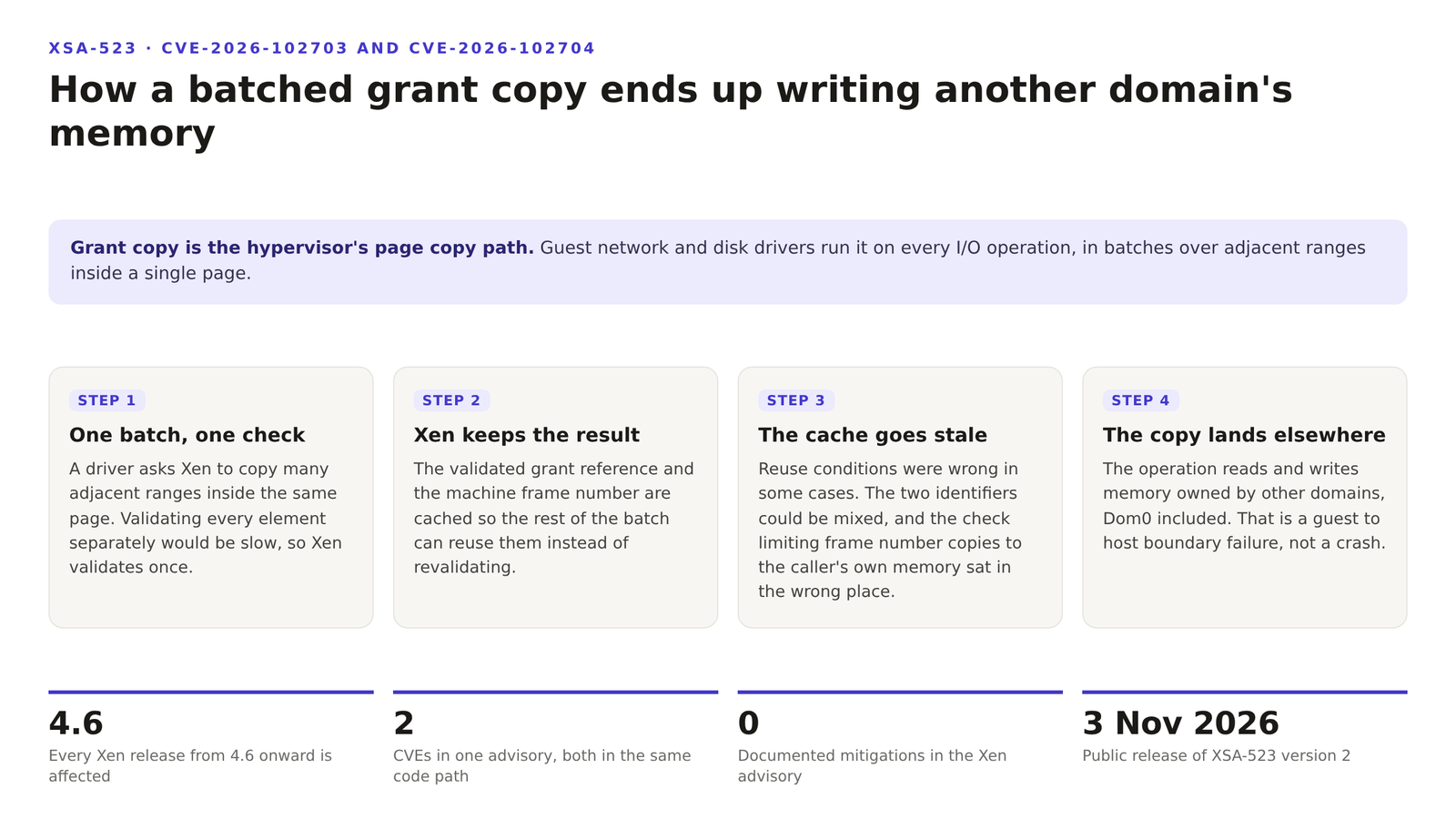
The affected range starts at 4.6, which puts the flaw in every release for roughly a decade. The fast path only fires for adjacent ranges inside a single page, and ordinary drivers have no reason to abuse it, so the code ran on every I/O operation without meeting an adversarial batch.
Two AI research teams reached the same hypervisor bug
The advisory credits the discovery to Anthropic, found using Claude, and to Stephan Lipp of Ada Logics for validation. It then carries a line most advisories omit. The issue was independently reported by the CodeAnt AI Security Research Team.
Read that as an operational signal, not a novelty. Discovery has always been gated by how many skilled people can read a large memory allocator closely enough to spot a cache invalidation scope that is too narrow. Automated search changes the price of that attention. Two unrelated teams landing on the same hypervisor flaw inside one disclosure window is what cheaper search looks like from the outside.
The consequence falls on maintainers and on anyone shipping a hypervisor inside a product. A bug class that surfaced once a year in a component this deep can now surface more often, which shortens windows and adds unscheduled upgrades.
There is no product called Xen to patch
Hypervisors do not ship on their own. XCP-ng 8.3 was affected, and the fixed package went out on publication day with Vates rating the issue Critical in its own advisory. Qubes OS published QSB-121 the same day with the plainest description of the consequence, that a compromised qube can reach other qubes and dom0. The XCP-ng update note calls it a guest escape.
Upstream patches split by branch, xen-unstable through 4.19.x on one track and 4.18.x through 4.17.x on the other. It moves through distributions, appliance images and the hosted platforms that resell virtual machines. A scanner that reads kernel versions will not answer the question, because a hypervisor package is a separate row in the list and a separate line in a vendor questionnaire.
If you rent virtual machines instead of running them, the question turns contractual. Ask when the provider shipped the fix rather than whether the platform is patched. We covered the KVM sandbox escape in October on the same boundary, and the lesson holds. Isolation is only as good as the patch cadence behind it.
Three questions are worth answering this week. Which of your hosts lets a tenant you don’t fully control reach a grant copy path. When did you last list hypervisor packages separately from kernel packages and compare their versions. And if the answer to the first question is that you rent those hosts, do you have the provider’s patch commitment in writing.
Get the next one before it is old news
Independent analysis of cloud-native infrastructure, Kubernetes and data center economics. No vendor spin.