


Executive Summary
Anthropic’s first public accounts turn a private question into disclosed numbers. Fixed and minimum guaranteed compute commitments reached about $265.6 billion at June 30, 2026, against $54.6 billion of non-cancelable purchase commitments six months earlier. Another $417 billion of future minimum payments sits against leases and cloud deals signed or amended after December 2025, plus an estimated $125 billion to $150 billion for capacity delivered from 2028.
The structure matters more than the totals. Twenty-year terms, annual escalators and an uncapped fuel pass-through make these contracts behave like owned assets with no exit. The verdict is that the obligations are serviceable on today’s demand, with net revenue retention near 900 percent and revenue up 1,368 percent year over year against compute expense up 300 percent. They stop working the moment that gap narrows, and that is now a public question.
Anthropic signed compute deals that run 20 years and pass an uncapped fuel bill to the tenant. That clause is the most consequential sentence in the Anthropic IPO filing, and the headlines stopped at the revenue.
The filing spells out the shape. It discloses long-term agreements with minimum purchase commitments, take-or-pay provisions and terms that obligate payment regardless of actual utilization. Then it names the worst, describing certain dedicated power and data center arrangements with 20-year initial terms, annual escalators, take-or-pay compute payments and “uncapped fuel cost pass-throughs that apply for the duration of the term regardless of actual utilization.”
A fixed capacity price with a floating input underneath is how airlines buy jet fuel. It is not how tenants used to buy colocation. The tenant now carries the running cost of the building for two decades, loaded or not.
The landlord risk moved to the tenant
One lease is expected to commence in 2027 and runs 20 years from the date the data center is delivered. That is a two-decade obligation against a building that does not exist yet. If construction slips, the term simply starts later.
The company also carries guaranty and cost reimbursement arrangements with developers, including for long-lead equipment, with maximum exposure of $0.8 billion at June 30. Its own risk factors concede that delays securing energy and water could mean it does not get the capacity it paid for.
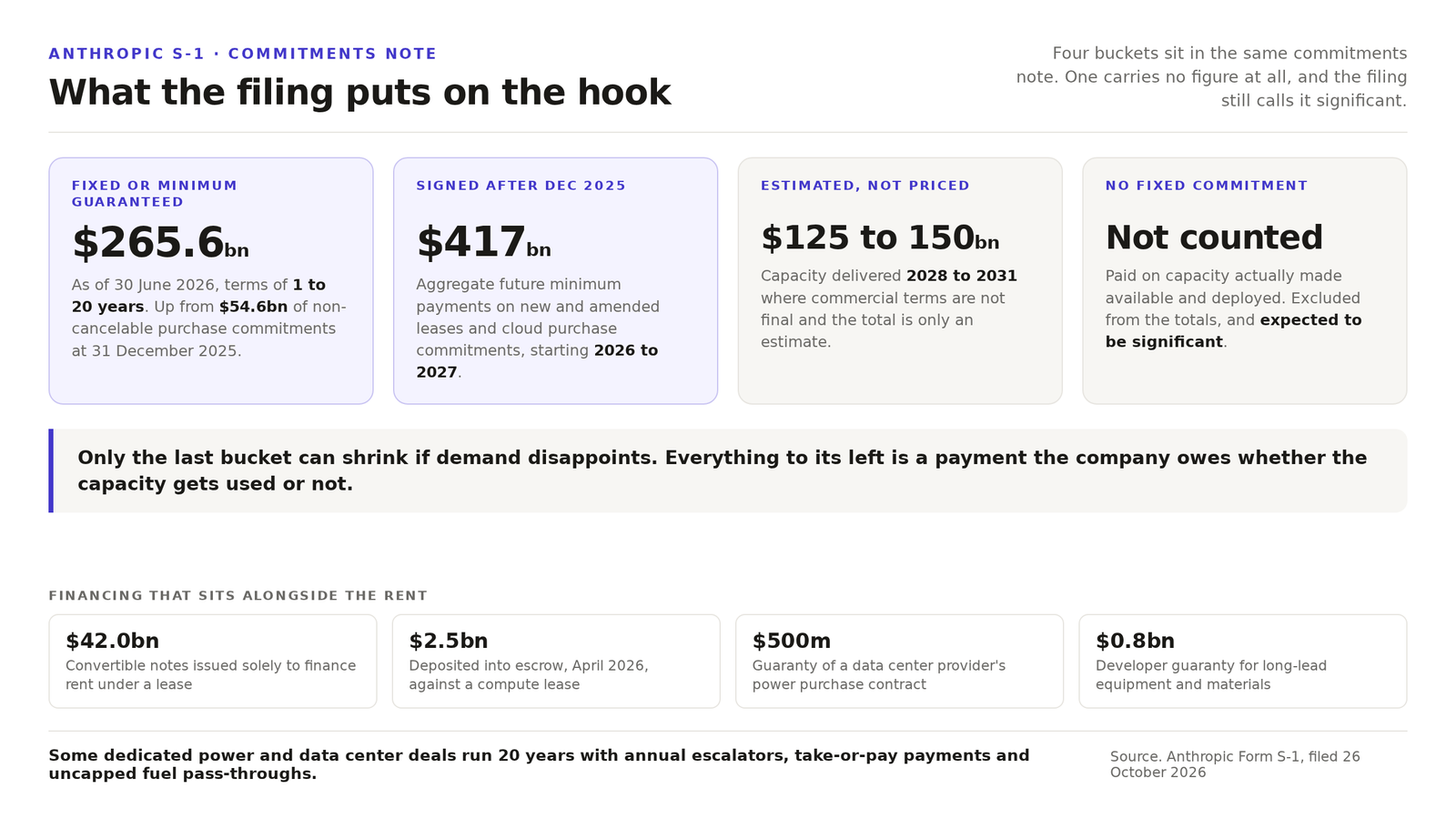
Three totals, and the biggest bucket has no number
Start with the table. Non-cancelable purchase commitments over one year ran $7.1 billion in 2026, $11.1 billion in 2027, $10.8 billion in 2028, $8.3 billion in 2029, $5.4 billion in 2030 and $11.8 billion thereafter. The total at December 31, 2025 was $54.6 billion.
Six months later the same category was $265.6 billion, on terms of one to 20 years. Roughly five times the year-end figure in half a year.
Then the leases. Agreements signed or amended after December 31, 2025 carry about $417 billion of future minimum payments, starting between 2026 and 2027. A further $125 billion to $150 billion is an estimate for capacity delivered from 2028 to 2031, where commercial terms are not yet final.
The bucket with no figure deserves the most attention. Some compute agreements specify no fixed or minimum dollar commitment at all. Payment follows capacity actually deployed, delivery timing and pricing. None of it appears in any total above, and the filing says only that it is expected to be significant.
Anthropic is underwriting its own suppliers
The financing is stranger than the rent. In March 2026 the company signed a note purchase agreement to issue up to $42 billion of convertible promissory notes solely to finance rent under a lease. Paying a landlord in your own convertible paper makes the landlord a stakeholder in your share price.
That month it also guaranteed a data center provider’s obligations under a power purchase contract, up to $500 million. In April it placed $2.5 billion in escrow against a compute and infrastructure lease. Cash and credit both move upstream before any capacity arrives.
None of this is reckless if demand holds. Revenue grew 1,368 percent year over year for the three months to June 30, while compute and infrastructure expense grew 300 percent. Net revenue retention was about 900 percent at September 30, and customers above $100,000 a year went from more than 950 to more than 11,900 in twelve months.
Profit quality is the counterweight. On its own adjusted basis the company reported a $1.6 billion operating profit for the first half, near a 10 percent margin, against a reported $80.7 billion net loss that was mostly a valuation charge on convertibles, as The Register set out.
Three questions before you sign anything this quarter. What is your annual escalator, and is the fuel component capped? How many years of take-or-pay can you carry if utilization lands at half of forecast? And if your provider is funded by convertibles tied to its own share price, what happens to your rate when that price falls?
Related reading. We covered the borrowing side in The $40 Billion GPU Loan Nobody Else Could Get, and why prepaid capacity arrives years after the money in NVIDIA Is Prepaying for Capacity That Ships in 2028. Anthropic’s Japan footprint was already public in Anthropic’s First Data Center in Japan Is a 500MW Bet on Osaka.
Get the next one before it is old news
Independent analysis of cloud-native infrastructure, Kubernetes and data center economics. No vendor spin.