

Executive Summary
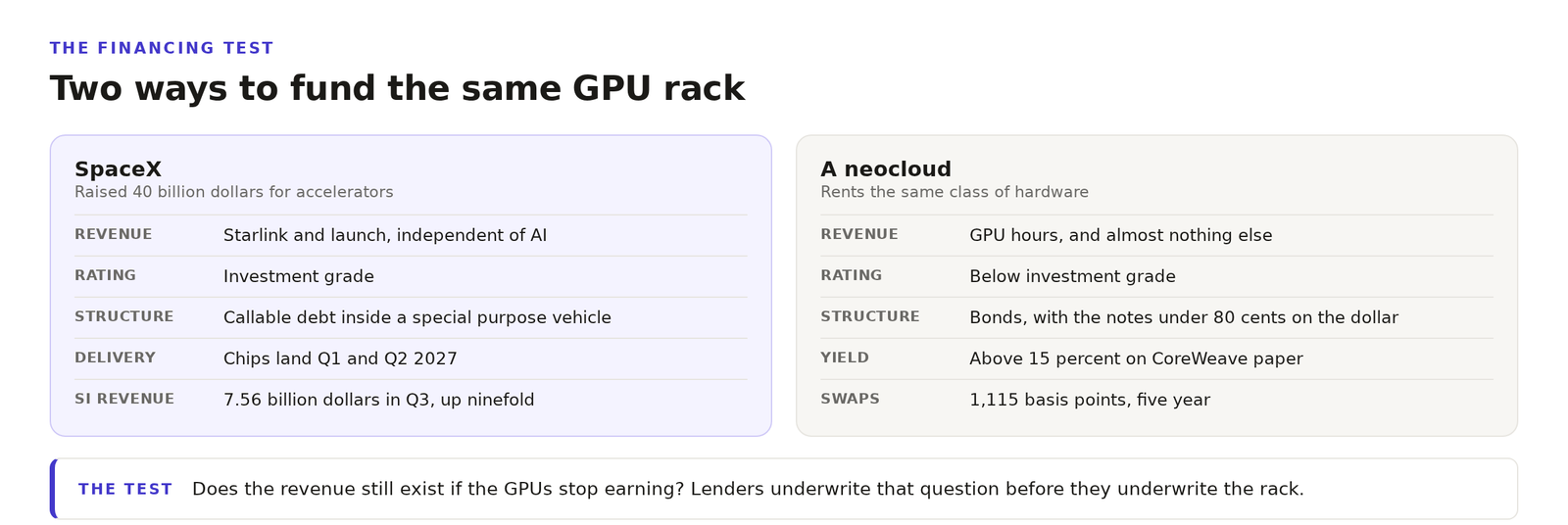
SpaceX closed 40 billion dollars of debt for GPUs on Sunday, routed through a special purpose vehicle so the borrowing stayed off the parent balance sheet, with chips arriving across the first half of 2027. The lender is underwriting accelerators and a company whose revenue does not depend on those accelerators. That is a different instrument from the paper the same market is now refusing to buy from a pure GPU landlord.
The finding that should move a capacity plan is that the gate on neocloud expansion is now the credit market, not silicon. Gartner expects more than 80 percent of neocloud providers to stop operating independently by 2030 and sees 3.5 trillion dollars of AI infrastructure spending exposed to impairment. The verdict is that a reserved GPU contract is a credit instrument before it is a service, so the clauses worth negotiating are assignment, termination and who holds the asset when the seller is sold.
Elon Musk posted the financing on X on Sunday and then spent the rest of the thread explaining that most of his competitors cannot do the same. Traders agreed by the opening bell. CoreWeave, Nebius and IREN all fell more than 4 percent before the market opened on Monday.
The capacity itself is not in doubt. SemiAnalysis expects 51.2 gigawatts of new data center IT capacity outside China next year, roughly double 2026, and counts more than 24 gigawatts already in advanced construction. The money behind that build is a different story. It is concentrating into the hands of companies that can borrow at investment grade.
The structure did more work than the headline number
CNBC, citing Bloomberg, reported that the facility sits inside a special purpose vehicle, a legal shell that keeps the debt off the SpaceX balance sheet and protects its rating. Musk later described it as callable debt, and said the GPUs land in the first and second quarters of 2027. Goldman Sachs led the talks, with Apollo among the investors.
What makes that loan bankable is not the hardware. It is Starlink and the launch business, two revenue streams that keep paying if accelerators lose value. SpaceX still grew its AI unit fast enough to matter. Third quarter revenue for the segment hit 7.56 billion dollars, up ninefold from 813 million a year earlier, and it is now the group’s largest unit.
We wrote in October that GPU debt had earned an investment grade rating. That was the promise. This is the first real test of it, and the answer depends on whose balance sheet the asset sits behind.
What the market charges CoreWeave to stay alive
The neocloud consolidation is not a forecast any more. It is a spread, and CoreWeave is the cleanest read on it. Its June notes, carrying a 9.625 percent coupon, have traded below 80 cents on the dollar, which puts the yield above 15 percent. Five year credit default swaps sit near 1,100 basis points, up roughly a third this month. The company carries about 50 billion dollars of debt.
The equity has already repriced. CoreWeave closed at 54.24 dollars on 23 October, down 38 percent from the end of September, and its market value fell from roughly 90 billion dollars to about 30 billion. The lenders moved first.
Executives at the other neoclouds spent Monday arguing that the market is wrong to treat them as one trade. Nebius chief revenue officer Marc Boroditsky told CNBC his company is not carrying the same debt load. IREN co-chief executive Daniel Roberts said customer demand had not changed. Both statements may be true. Neither changes the price of capital.
We covered the first sign of this on 23 October, when credit desks told CNBC they wanted data center permits resolved before they would fund the next build. The new detail is that the freeze is no longer about one project. It is about the shape of the borrower.
Ask who holds the paper before you sign the reservation
The Gartner forecast published this month belongs in every capacity committee deck. More than 80 percent of neocloud providers are expected to cease independent operations by 2030, through acquisition or failure, because cost pressure and a lack of a differentiated business model leave no room. The same note puts 3.5 trillion dollars of AI infrastructure spending at risk of impairment if capital spending keeps its current pace.
For a buyer, that forecast turns into a contract question. A three year reservation on a neocloud is an unsecured claim on a company whose main asset is hardware with a falling resale value. When the company is acquired, your contract is an asset that gets sold with the rest of the estate. Read the assignment clause before you read the price per GPU hour.
Three questions for the next negotiation. If the seller is acquired, does my contract survive on the same terms? What happens to my prepayment if the operator fails mid term? And who actually holds the accelerators, the operating company or a lender’s shell?
Musk is not a neutral observer. He is building a hyperscaler and telling you the competition will consolidate, which is exactly what a buyer with cheap capital would say. The credit spreads are the part of the argument without an incentive. They agree with him.
Get the next one before it is old news
Independent analysis of cloud-native infrastructure, Kubernetes and data center economics. No vendor spin.
[…] reading. We covered the borrowing side in The $40 Billion GPU Loan Nobody Else Could Get, and why prepaid capacity arrives years after the money in NVIDIA Is Prepaying for Capacity That […]