


Executive Summary
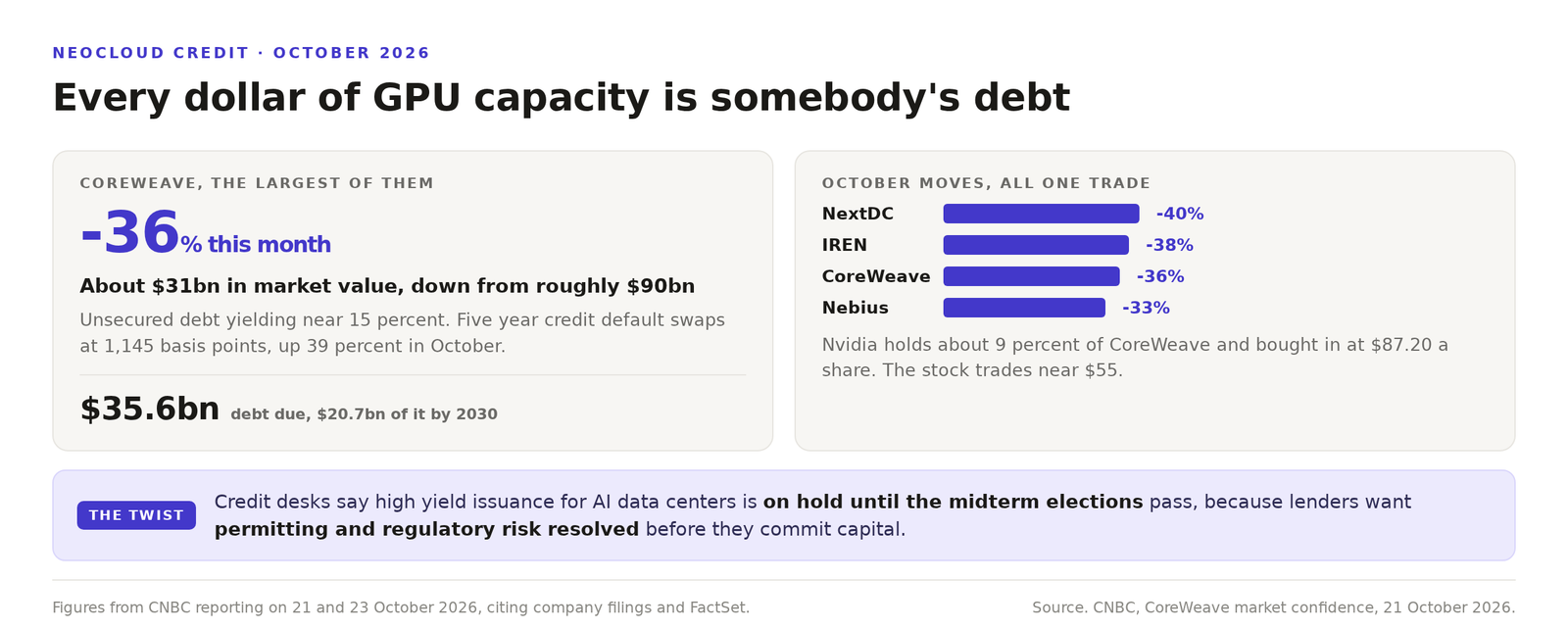
The AI buildout is borrowed money, and the lenders have started to reprice it. CoreWeave’s five year credit default swaps widened 39 percent in October to 1,145 basis points, and the company carries about 35.6 billion dollars of debt against a revenue base where more than two thirds of last year’s total came from one customer.
The finding that should change a capacity plan is that the freeze is not about chips. Credit desks told CNBC that high yield issuance for AI data centers is on hold until the midterm elections pass, because lenders want permitting and regulatory requirements substantially resolved first. The verdict is that the gate on AI capacity has moved from silicon to paperwork, and a build funded by sovereign money will outrun one that needs a bond buyer.
A neocloud sells GPU hours. What it buys with the revenue is a bond payment schedule, and the market has started to say the two don’t line up.
CoreWeave is the clearest case. It closed 10 percent lower on Friday 23 October, a day that also took Nebius down 7 percent. Two days earlier CNBC reported the stock down 36 percent for the month, with a market value near 31 billion dollars against a peak of roughly 90 billion three months after its 2025 listing.
The share price is the loud number. The quiet one is 15 percent, roughly the yield on CoreWeave’s unsecured debt.
The collateral loses value while the debt gets paid down
CoreWeave carries about 20.7 billion dollars of debt coming due through 2030 and another 14.9 billion after that. Its borrowing has drawn market scrutiny since mid October, when bond yields moved against it.
Against that sits a fixed asset base of accelerators. A GPU is productive for a few years and then it is a used part, and nobody has priced a large fleet of them through a real downturn. That is the question credit investors are asking. It is a fair one, because this asset class was underwritten during a shortage.
Concentration sharpens it. More than two thirds of CoreWeave’s revenue last year came from Microsoft, and Nvidia is its largest institutional holder at about 9 percent. Nvidia put 2 billion dollars in for that stake in January at 87.20 dollars a share. The stock trades below that.
The freeze is about permits, not chips
This is the part an operator should read twice. Credit desks told CNBC the high yield market is effectively closed to this sector until after the midterm elections, and the reason is not GPU supply or demand. Fixed income investors want permitting and regulatory requirements substantially resolved first.
Put plainly, the people who lend money to build data centers have started pricing the local planning process as a credit risk. That did not use to be their problem. It was a project management problem, filed under 2027.
Barclays credit analyst Andrew Keches wrote to clients that sentiment was decidedly negative. Baird’s Rob Oliver estimates CoreWeave may need roughly 30 billion dollars of capital in 2027. Analysts expect its negative free cash flow to reach 10.1 billion this quarter, the highest since it began reporting.
Sovereign capital does not need a bond buyer
Compare that with the 84 megawatt HUMAIN plan Nvidia set out in Saudi Arabia this week, which reserves 50 megawatts of Vera Rubin capacity for an unnamed US customer from June 2027. That building is backed by the kingdom’s Public Investment Fund. It does not need a credit committee to approve a power permit, and it does not care what high yield does after the midterms.
Two markets for the same hardware now exist, and they price risk differently. One is a debt-funded lessor answering to bondholders and a share price. The other is a sovereign fund answering to a 2030 capacity target.
For anyone buying capacity, the practical effect is a split in what your contract is worth. A provider with a refinancing wall ahead of it is a different counterparty from one with a state balance sheet behind it, even when both quote similar hourly rates.
Three questions for your own supply chain. If your capacity sits behind a neocloud, what happens to your contract if that provider can’t refinance at a workable rate? How long is your power permit good for, and would you lend against it? And do you know your provider’s largest customer, or only your own?
Related reading. Our piece on why Nscale’s 103 billion dollars of booked compute still could not fill its IPO covers the same gap from the seller’s side. Our breakdown of Meta’s new supercluster shows what the capacity costs to build.
Get the next one before it is old news
Independent analysis of cloud-native infrastructure, Kubernetes and data center economics. No vendor spin.
[…] repricing of CoreWeave debt is the clearest case. Five year credit default swaps widened 39 percent in October to 1,145 basis […]
[…] have covered the credit side of this constraint before. Lenders already want permitting resolved before they fund a build. Oregon just showed what […]