


Executive Summary
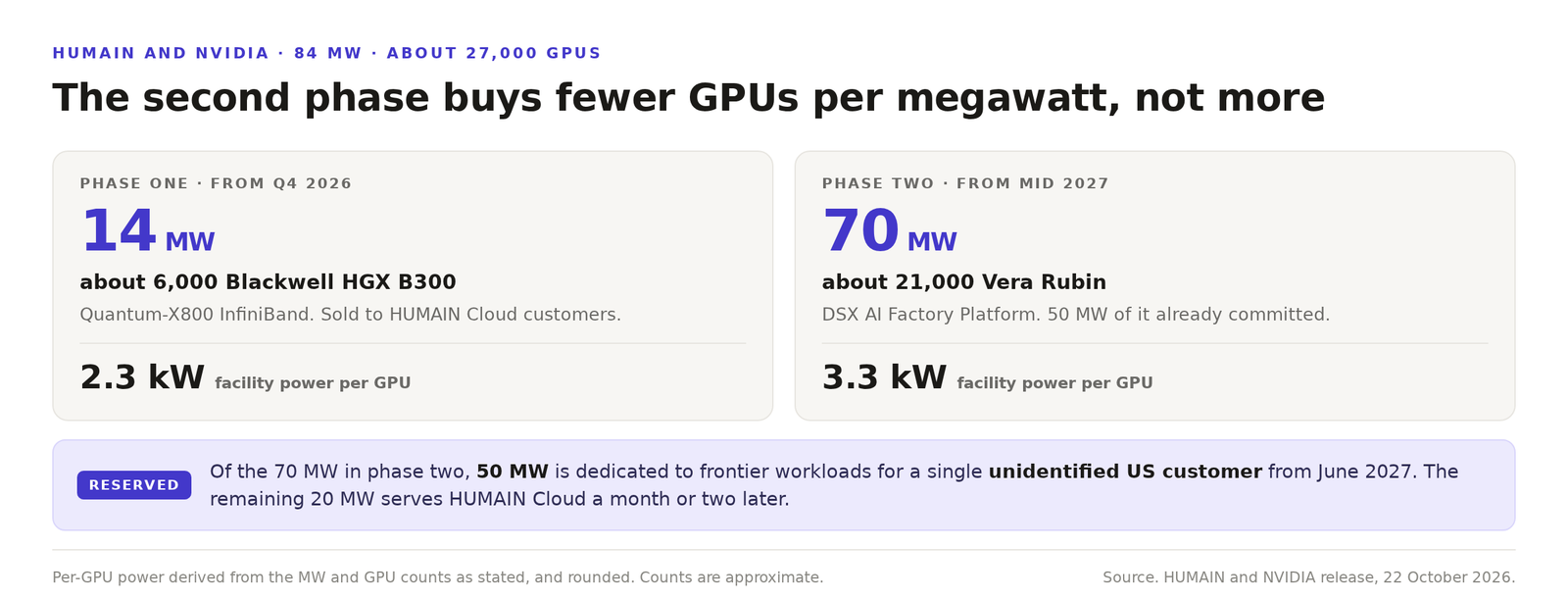
Two numbers decide what HUMAIN’s Saudi build means for anyone planning capacity in 2027. The first is 50 of 70, the share of the Vera Rubin phase already reserved for a single unnamed American customer from June 2027. The second is 3.3 kilowatts, the facility power that phase implies for each accelerator against 2.3 in the first, a 43 percent rise across one generation.
The verdict is that Gulf sovereign capital is now underwriting American frontier training rather than hedging against it, and that the constraint landing on operators is delivered power per accelerator, not chip supply. HUMAIN plans about 3 gigawatts of capacity by 2030, which makes this week’s capacity a schedule signal rather than a scale signal. Read it as a statement about who gets the first tranche.
If you’re planning frontier training capacity for 2027, part of the Gulf’s newest build is already spoken for. Not by a local champion. By an American customer that neither company will name.
The claim is 50 of the 70 megawatts in the Vera Rubin phase, which starts deploying in June 2027. HUMAIN Cloud takes the remaining 20 megawatts a month or two later. Ahead of that, 14 megawatts of Blackwell Ultra HGX B300 arrives from the fourth quarter of this year, wired with Quantum-X800 InfiniBand.
The total is 84 megawatts and about 27,000 GPUs, set out by both companies on 22 October. What matters sits under it.
Vera Rubin wants 43 percent more power for each GPU
Do the division on the published figures. Phase one works out to about 2.3 kilowatts of facility load per accelerator. Phase two works out to about 3.3. The GPU counts are rounded and the megawatts are ceilings, so treat the ratio as directional. It still points one way.
That is 43 percent more power for each chip across a single generation, and it’s what breaks a facility plan. Power per GPU sets rack density, coolant volume and the amperage you booked with the utility. None of those move as fast as a chip roadmap.
A row designed around 2026 Blackwell density won’t quietly accept the 2027 part. It forces a different cooling loop, a different rack, and in many buildings a different hall.
Sovereign money is building for American frontier training
Nvidia’s material describes the 50 megawatt tranche as support for frontier scale AI workloads for a US based client. The client is unnamed, the site is Saudi, and the capital is the kingdom’s Public Investment Fund, which owns HUMAIN. The company is chaired by Crown Prince Mohammed bin Salman.
That combination is the shift. Gulf siting used to get described as a hedge, a way to keep a regional option open. A 50 megawatt commitment to one foreign buyer with a fixed start date is not a hedge. It’s a booked building.
The HUMAIN Nvidia deal also extends an existing framework rather than replacing it. The two companies laid out a five year plan in May 2025 for up to 500 megawatts and hundreds of thousands of chips, beginning with 18,000 Blackwell processors. This week’s capacity is a slice of that promise.
Eighty four megawatts is the pilot, not the plan
HUMAIN targets about 3 gigawatts of data center capacity by 2030 and more than 6 gigawatts by 2034. Against 3 gigawatts, this is under 3 percent of the plan. The National notes the UAE is building a 1 gigawatt Stargate cluster as phase one of a planned 5 gigawatt campus.
So read the megawatts as a schedule signal rather than a scale signal. It tells you which customers get capacity first, and it tells you the answer isn’t the one waiting in your procurement queue.
That’s the pressure on an operator. Not that Saudi Arabia is building AI capacity. That the first tranche of a specific generation is committed before general availability, and the commitment went to one buyer.
Track power per accelerator, not just chip counts. Then ask who already holds the claim on the capacity you’re counting on.
Three questions for your own 2027 plan. What facility power per accelerator does your design assume, and where did that figure come from? If your next allocation depends on general availability, what happens to the project when the first tranche is pre-sold? And how much of your cooling budget is already fixed by a generation you haven’t bought yet?
Related reading. Our piece on why a 14 day AI factory build still waits on the power queue covers the scheduling half of this constraint. Our look at Google buying a gigawatt it has to switch off covers the procurement end.
Get the next one before it is old news
Independent analysis of cloud-native infrastructure, Kubernetes and data center economics. No vendor spin.