


Executive Summary
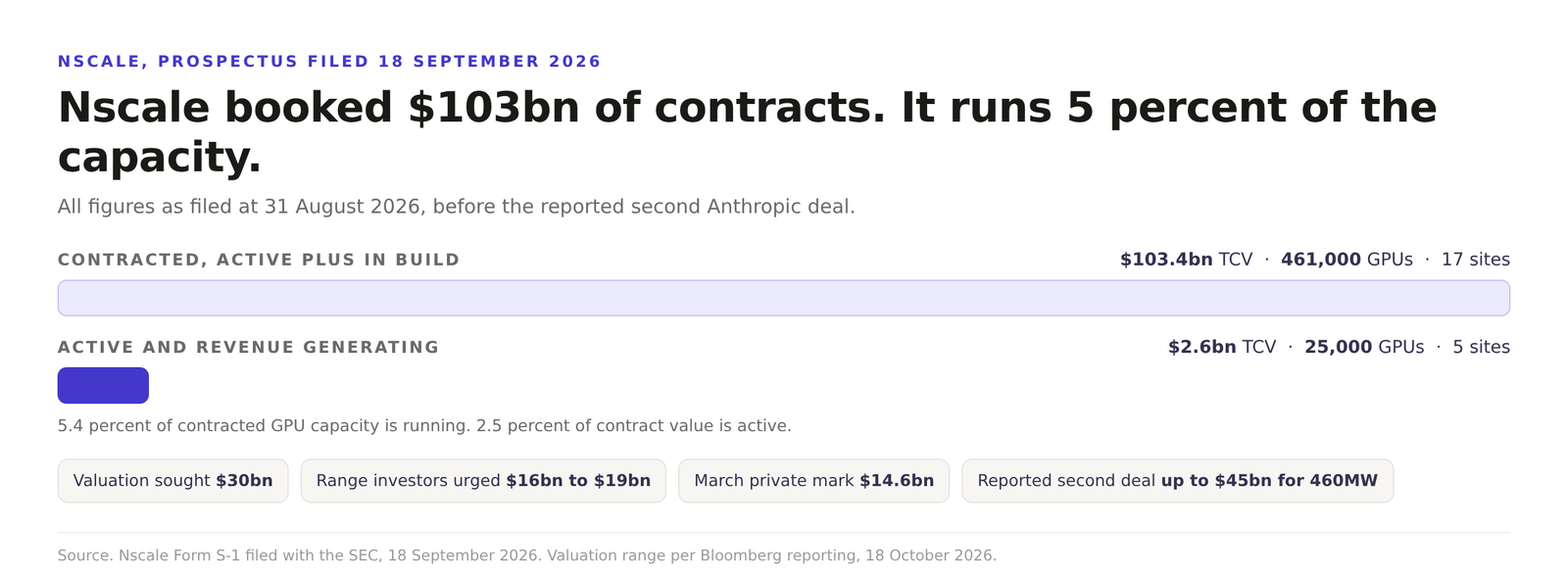
The Nscale IPO is being repriced. Investors are pressing the company toward a $16bn to $19bn valuation against the roughly $30bn it wants, people familiar with the matter told Bloomberg, days after Microsoft walked away from its Essex site. The filing explains the resistance. At 31 August the company carried $103.4bn of active and contracted contract value, of which $2.6bn was active, and 461,000 GPUs active or contracted, of which about 25,000 were running.
A reported second Anthropic deal, 460MW at the same West Virginia campus for up to $45bn, would push the contract book toward $148bn without moving the active figure at all. The market has stopped pricing demand for AI capacity and started pricing the ability to deliver it. Anyone signing a multi-year capacity contract now carries that same distinction on their own balance sheet.
Total contract value has a precise meaning in this filing. It is the aggregate revenue contracted across the full committed term, measured on the day each agreement was signed, excluding optional extensions, renewals and unexercised capacity. It is a promise. It is not revenue, and it is not capacity anyone can schedule a job on today.
Five percent of the book carries the whole investment case
Against that promise, the delivered number is small. Five active sites and twelve more under development, 25,000 GPUs running and $2.6bn of active contract value. That is 5.4 percent of the contracted GPU count and 2.5 percent of the contracted dollars.
The gap isn’t a rounding error. It is the entire question the listing has to answer, and the filing says so itself, with material weaknesses in internal control over financial reporting sitting alongside the construction schedule. For a buyer of capacity the ratio matters less than the slope. Two gigawatts of the Monarch campus is meant to come online in the first half of 2028, which is when the contracted GPUs stop being a slide and start being a rack.
None of this is dishonest. Total contract value is the number neoclouds borrow against, and it is how lenders and equity buyers compare a buildout with its financing cost. The problem is timing. Because the figure is fixed at signing, the book can grow years ahead of the capacity that pays for it, and the company’s own glossary splits active from contracted for exactly that reason.
One customer left Essex and the ask halved
Microsoft’s decision to quit the Loughton campus over a grid connection now expected in the 2030s took an anchor tenant out of the book. The same week, Bloomberg reported that Anthropic is in talks for a second 460MW tranche at the Monarch campus, with Nvidia Vera Rubin chips and a right of first refusal on the third building. Anthropic signed the first tranche at the same campus in August for about the same headline value, on the same 460MW of capacity.
The demand signal and the valuation signal pointed in opposite directions. Investors argued for a $16bn to $19bn valuation, citing the collapse of Australian operator Firmus’s listing and a peer group in retreat, with CoreWeave down 25 percent in a week and Nebius down 32 percent in two. Nscale’s last private mark was $14.6bn in March, after raising more than $3.3bn in pre-IPO financing that September. At $16bn the March buyers make a thin premium. At $30bn they double.
What to ask before you sign for 460 megawatts
Counterparty diligence on a neocloud used to be a power question. It is now a funding question. Start with the split between active and contracted capacity, because that ratio says how much of the counterparty’s revenue depends on buildings it hasn’t finished, and how much of its cost sits in concrete with no customer invoice attached yet.
Then read the definition of the term you’re quoted. Total contract value here excludes optional extensions, renewals and unexercised capacity, so a headline number can sit well above what a customer is obliged to take. Then look at what the construction bill does to your price. Five active sites against seventeen in the portfolio is a great deal of steel to buy before the first invoice on the last one.
Three questions for your next capacity renewal. What share of the term is genuinely take-or-pay? How many sites does the provider run today, not plan? And if its listing prices at half of what it asked, which clause in your contract absorbs that?
Related reading. Why the Essex site failed is the delivery gate, covered in the grid date that outranked the GPUs. The forecast gap between announced and delivered capacity is in the Jefferies capacity revision, and the portability question behind these deals sits in the Decart chip argument.
Get the next one before it is old news
Independent analysis of cloud-native infrastructure, Kubernetes and data center economics. No vendor spin.