

Executive Summary
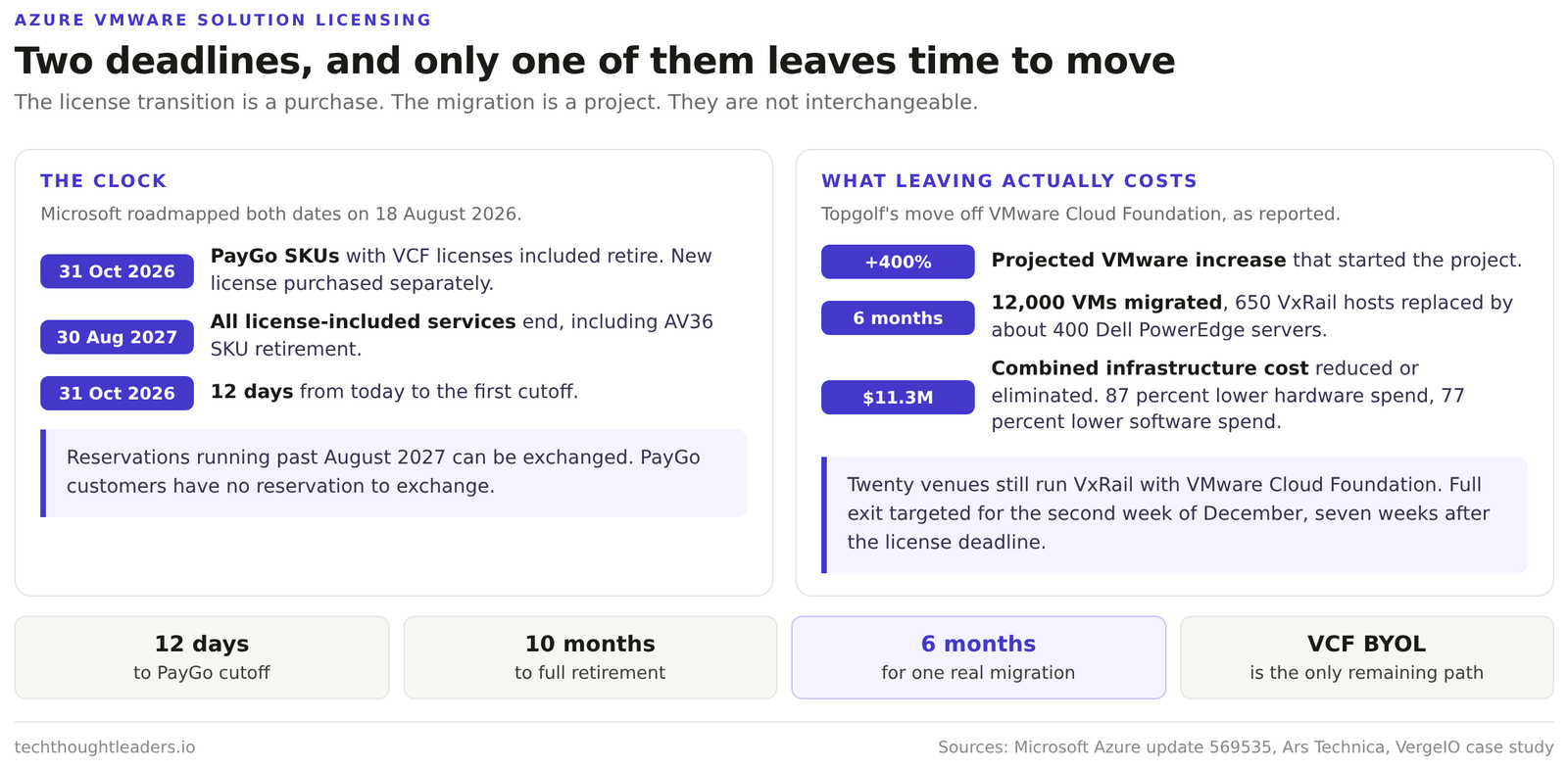
Two dates sit in the same Azure update and they are not the same kind of deadline. PayGo SKUs with VMware Cloud Foundation included retire on 31 October 2026, which is 12 days out. Every license-included Azure VMware Solution service ends on 30 August 2027. The first is a purchase. The second is a project, and a project of this shape took Topgolf six months.
Broadcom set both. Its terms stop hyperscale partners reselling VMware licenses, so every cloudy VMware service now converges on a bring-your-own VCF subscription bought directly from Broadcom. That closes the last route into VMware that did not require a Broadcom negotiation. The verdict is that 31 October is a procurement deadline, not a migration window, and customers who treat the two as interchangeable will reach November holding neither a license nor a plan.
Microsoft put the retirement on its Azure roadmap on 18 August inside a line most customers will skim past. Azure VMware Solution licensing changes on 31 October, when the PayGo SKUs go. Ten months later, every AVS service with licenses included stops.
The dates, and who they land on
The Azure update lists three things. AVS License-included PayGo SKUs retire on 31 October 2026. All license-included services end on 30 August 2027. The AV36 SKU retirement moved to that same date, and reservations with an expiry beyond August 2027 can be exchanged. Customers already running the bring-your-own VCF model are unaffected.
If you are on PayGo with licenses included, you are in the group with the least room. There is no reservation to exchange, and the replacement is a VCF subscription you buy from Broadcom and then register separately on each private cloud.
Broadcom set this date, not Microsoft
Broadcom does not allow hyperscale partners to sell VMware licenses. A cloud provider that wants to run VMware for you therefore has one option, which is to have you bring your own VCF subscription. Google Cloud VMware Engine required portable licenses from October 2025. Oracle aligned in January 2026. The Register reported the AVS change when it landed.
So the AVS announcement is not Microsoft making life harder on purpose. It is the last route closing behind a policy Broadcom set in late 2025. The practical question has already changed shape. It is no longer whether you will deal with Broadcom directly, it is whether your provider appears on the certified cloud services list for portability, because if it does not, the subscription you buy may not travel with you.
There is a second trap in the same change. Core entitlement now matters at the private cloud level. Run over your licensed core count and you are out of compliance, which is a much worse place to be than an unfavorable quote.
A migration is not an option on a 12 day clock
Topgolf is the counter-example worth reading before you plan. Its VMware costs were projected to rise 400 percent after the acquisition. It moved about 12,000 virtual machines to VergeIO’s VergeOS, replaced 650 VxRail hosts with roughly 400 Dell PowerEdge servers, and reports $11.3 million of combined infrastructure cost reduced or eliminated. Ars Technica has the detail, and VergeIO published a case study.
Read the timeline, not the total. That work took about six months and it was not a hypervisor swap. Topgolf did a hardware refresh, moved its gaming stack onto the bay panels and a Kubernetes architecture, and rewired columns. Twenty venues still run VxRail with VMware Cloud Foundation, and the full exit is targeted for the second week of December. Scott Forehand, who runs global infrastructure there, is careful to call the $11.3 million a combined infrastructure figure measured before hardware prices moved, not a license saving.
Six months, at a company with the scale and the appetite for it, with the vendor in the room. VergeOS 26.2 claims transfers running 120 percent faster on the migration path, which helps at the margin. It does not compress a quarter into 12 days.
So split the work. Between now and 31 October the job is a purchase, a portability check and a core count reconciliation. Between November and August 2027 the job is deciding whether you stay on VMware at all, and if you leave, running a program with a hardware refresh inside it.
Three questions to settle this month. How many AVS cores are you actually licensed for, and what happens to a private cloud that runs over. Does the replacement subscription preserve the reserved instance terms you already bought. And if staying is not the answer, which workload moves first and who owns that call.
Related reading. Broadcom sold you two VMware bundles and you probably need one explains the SKU structure underneath the subscription. Ninety percent of VMware users are shopping, and complexity is what stops them covers why these programs stall.
Get the next one before it is old news
Independent analysis of cloud-native infrastructure, Kubernetes and data center economics. No vendor spin.
[…] reading. We covered the end of license-included Azure VMware Solution and how Nutanix rewrote migration after Broadcom pulled the VDDK. Both show what leaving actually […]